
Healthy Campus: University Health Management
The University of Hamburg is focused on the health of all University members. With the University Health Management (UHM) Team, the University aims to promote and maintain students’ and employees’ health, well-being, and ability to study and work in teaching, research, administration, and technology in a sustainable manner.
The Healthy Campus initiative, aims for a holistic and systematic cross-sectional health management that is constantly being developed in cooperation with various stakeholders and departments. Here, health is defined not only as the absence of illness but also as the comprehensive interplay of physical, psychological, and social factors in everyday university life.
The goal of the UHM Team
The UHM Team aims to create health-promoting conditions at the University of Hamburg and to reinforce and expand existing structures and services with a focus on sustainability. The UHM Team sees itself as a service and coordination hub that initiates, links, and supports health-related measures—always with a focus on the needs of the University’s members and the special challenges of the university environment.
With this approach, the University of Hamburg aims to create an environment in which all participants can develop their potential in a healthy and motivated manner.
Find out more about UHM
Health management according to the public health action cycle
The University of Hamburg’s health management is based on the public health action cycle—a cyclical model that comprises analysis, planning, implementation, and evaluation to create a structured and sustainable management of health-promoting measures.

Evaluation and health surveys at the University of Hamburg
An important component of university health management is the systematic collection and evaluation of health-related data. In addition to nationwide and international studies on the health of students and employees, the UHM Team also draws on internal survey instruments and the findings of experts from internal counseling services.
The aim is to gain sound insights into the health situation and needs of University members and, in turn, develop targeted measures, improve framework conditions, and establish health-promoting services.
Health survey and risk assessment for employees
Risk assessments are carried out regularly for University of Hamburg employees. These are required by law and record potential physical, physiological, and psychological stressors in the workplace. The assessment results are used to design health-promoting working conditions, identify risks early on, and initiate appropriate improvements. This involves close cooperation with the various institutions, managers, and employee representatives.
- Conducting risk assessments
- Working together for our common health—fostering workplace health and safety analysis (assessing the risks of psychological stress)
Health survey for students
A comprehensive health survey of University of Hamburg students is conducted regularly. It will collect information on various aspects of physical, mental, and social health, as well as health behavior and study conditions. The survey makes it possible to:
- develop targeted health promotion measures for students
- create comparative values within the University and with other universities
- observe developments over time and identify trends
- provide data-based analyses for strategic health promotion at the University.
The results of the latest health survey for students are now available.
Target groups
Health concerns all of us!
University health management is aimed at all members of the University: students; academic, technical, and administrative staff; managers; and committees. Working together for a healthy university!

Levels of action
University health management takes place at various levels:

Behavior: This comprises the services and measures that support individual health-promoting behavior, such as exercise, relaxation, and counseling services and elective-area seminars.
Conditions: This refers to the health-promoting conditions for studying, teaching, and working, such as ergonomic workplaces, and learning, working structures and an organizational culture that promotes health (health culture).
Networking: This consists of promoting exchange and cooperation between different areas and stakeholders within the University in order to establish and further develop health as a shared issue.
Evaluation: The results of surveys and feedback are directly incorporated into the planning and further development of health services and health-related structures at the University of Hamburg. They make an important contribution to systematically promoting and improving health in studying, working, and campus life.
Biopsychosocial approach
A holistic approach to health!
The UHM Team takes a holistic approach to promoting the health of students and employees. This is based on the biopsychosocial understanding of health as a combination of physical (biological) well-being, psychological, and social factors.

This means that health arises from the interaction of:
- physical conditions (e.g., fitness, nutrition, medical care)
- psychological factors (e.g., stress management, motivation, emotional stability)
- the social environment (e.g., social support, working atmosphere, study culture).
As the UHM Team, we work with stakeholders in our UHM network to develop measures that combine these three levels. This includes exercise programs, counseling and relaxation formats, stress management and mental health programs, and the promotion of a healthy learning and working environment.
Our aim is to improve the long-term health and well-being of all University members and create conditions that enable healthy learning, teaching, and working.
Health as part of the sustainability strategy
University of Hamburg has recognized the importance of health in its sustainability strategy and, by signing the Okanagan Charter (an international guideline for health-promoting universities and colleges), has committed itself to establishing health as a cross-sectoral task and to integrating health promotion and sustainability.

(From left) Anna Zerner, Prof. Natalia Filatkina, Prof. Laura Edinger-Schons, and Birgitta Büsch (from left) at the signing of the Okanagan Charter on 5 March 2025
The University of Hamburg was one of the first universities in Germany to adopt this charter to develop an organizational culture that views health as a shared responsibility. The aim is to involve health-related stakeholders and to embed health in all the University’s structures and processes in the interests of sustainability.

The Okanagan Charter was passed in 2015 at the Seventh International Conference for Health-Promoting Universities and Colleges. It is the result of work by people from 45 countries. The conference took place in Kelowna (British Columbia). The charter’s name was chosen to honor the indigenous Okanagan Nation that calls this region home. In the meantime, the charter has become integral to the quality criteria of the working group on health-promoting universities and colleges.
Our networks
University health management is a cross-cutting task.
The University of Hamburg UHM Team is networked both internally and externally at the regional and national levels.
The UHM Team’s internal network at the University of Hamburg
The UHM network at the University of Hamburg brings together the relevant stakeholders, institutions, and contact persons. Together, they identify needs and challenges, coordinate measures, and further develop health-promoting conditions. Regular exchanges within the network make it possible to better utilize interfaces, create synergies, and jointly take responsibility for a healthy university environment.
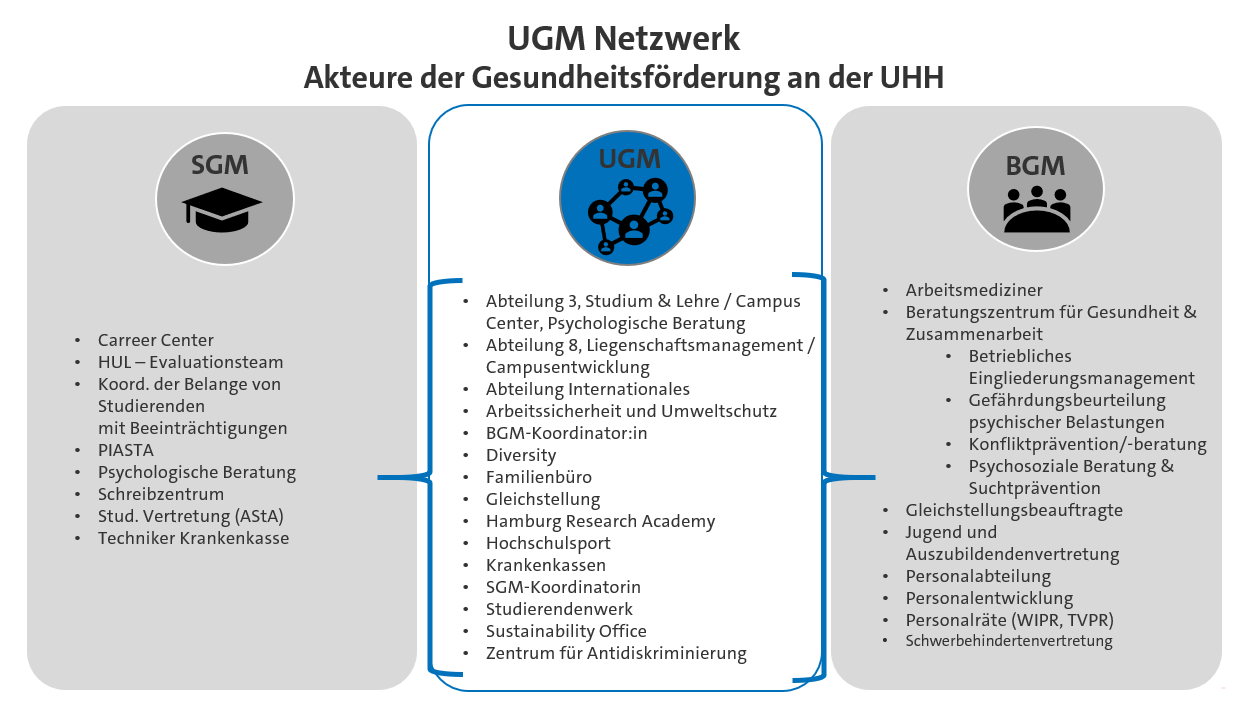
- Occupational health doctors
- Department 3: Studies and Teaching, Campus Center, psychological counseling
- Department 5: Department of International Affairs
- Department 8: Property Management / Campus Development
- Occupational Safety and Environmental Protection Unit
- Center for Health and Workplace Cooperation
- Return-to-Work Program
- Staff health management
- Assessing the risks of psychological stress
- Conflict Prevention and Resolution
- Psychosocial advising and addiction prevention
- Diversity
- Family Office
- Equal Opportunity
- Equal opportunity commissioner
- Hamburg Research Academy
- University Sports
- Department of Human Resources
- HR Development
- Staff councils (WIPR, TVPR)
- Student health management
- Sustainability Office
- Antidiscrimination Center
- Career Center
- Hamburg Center for University Teaching and Learning (HUL)
- Office for Students with Disabilities and Chronic Illnesses.
- PIASTA
- Writing Center (PDF, in German only)
- Disability representatives
- Student representatives (AStA)
University health management external network
- Techniker Krankenkasse (project funding SGM 2021–26)
- Other health insurance providers
- Unfallkasse Nord
- Studierendenwerk Hamburg
- Health care service provider / City of Hamburg health care region
Our regional university health management networks include:
- City of Hamburg health network
- Netzwerk Gesunde Hochschulen Nord