
Lab for Hybrid Learning Spaces
In 2023, the Digital Office at the University of Hamburg started the “Lab for Hybrid Learning Spaces” to develop innovative ideas and prototypes for flexible and hybrid teaching and learning environments — spaces that work just as well in presence as they do digitally. Our work will continue until 2026 and focuses on four main areas:
- Development: We have created a dedicated Media Lab to test and improve technical solutions in a real-world setting.
- Equipment: We are developing prototype shopping baskets for the technical equipment of various teaching and learning spaces.
- Showrooms: We are setting up model rooms, such as lecture theatres, group study areas, and seminar rooms, to showcase new and innovative room concepts.
- Guidelines: We are compiling recommendations for the sustainable use and continued support of these newly designed teaching and learning spaces.
Go directly to the topics
Why do we need “Hybrid Learning Spaces”?
The concept of “Hybrid Learning Spaces” describes learning environments that combine physical and digital elements, extending beyond simply participating in face-to-face events virtually. For the University of Hamburg, developing such spaces is of central strategic importance: they create flexible, effective, and future-oriented learning environments that meet the demands of a digitalized academic experience. The goal is to design teaching and learning spaces that seamlessly connect both worlds, enabling students to learn and participate actively whether they are on-site or online.
As part of its digital strategy, the University of Hamburg pursues clear objectives in the area of teaching and learning:
- Facilitating a quick transition between in-person (face-to-face) and virtual learning formats.
- Providing innovative spaces for testing new digital and analog tools, methods, and technologies.
- Developing inclusive learning environments that are accessible to all users, regardless of whether they are on-site, hybrid, or digital.
This project contributes to laying the foundation for modern, adaptable learning environments that meet the needs of teaching and learning in an increasingly digitized world.
How we proceed
When designing hybrid learning and teaching spaces, we follow an open and flexible approach. As part of the project, we develop concepts and prototypes, test them, gather feedback, and continuously adjust and improve. This step-by-step process leads to innovative, user-centered solutions.
Our principles:
- Interdisciplinary collaboration: We work closely with various units — from faculties to facilities management and construction. This collaboration is essential to creating spaces that meet the needs of users.
- User-centered development: Educators and students are our key drivers. Their needs and requirements directly influence the planning, gathered through surveys, interviews, or focus groups. This ensures the spaces truly fit their needs.
- Agile working: We develop our solutions in small, flexible steps. This allows us to respond quickly to new ideas or changes and to continuously improve our concepts.
- Flexible spaces: We see teaching and learning spaces as adaptable resources. Given the rapid advances in technology and teaching methods, we design them to be easily adjusted and modernized over time. These spaces are built for the future — not as rigid products.
Our development processes follow a step-by-step approach with repeated phases:
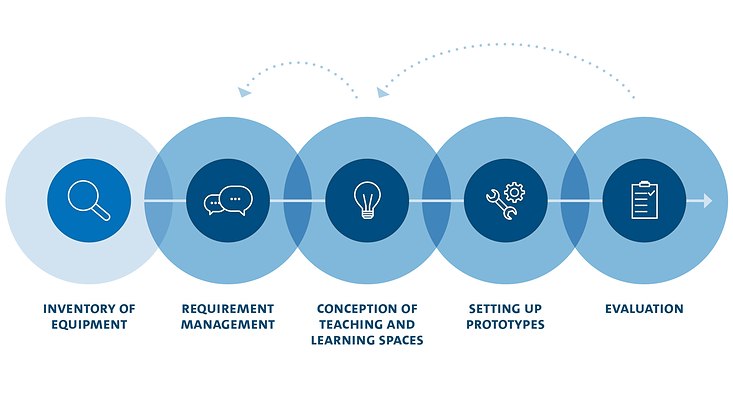
UHH/yschwarz
Development processes
- User-friendliness
- Functionalities
- Service structures
- Qualitative and quantitative survey of needs (teachers, students)
- Development of user scenarios
- Participatory development of exemplary teaching and learning space concepts and equipment
- Involvement of administrative units in charge of media technology, construction and facility management
- Redesign of group workspaces, seminar rooms & lecture hall
- Integration of protype learning spaces into teaching operations
- Reviewing the usability of teaching and learning space concepts and media technology solution with the involvement of users
Contact
Lab for Hybrid Learning Spaces
hybridlearningspaces"AT"uni-hamburg.de
Paula Tsialonina
Project coordinator, Lab for Hybrid Learning Spaces
paula.tsialonina"AT"uni-hamburg.de