
Equity Unit
Equity Unit
Photo: UHH/Denstorf
11 February 2026, by Stabsstelle Chancengerechtigkeit
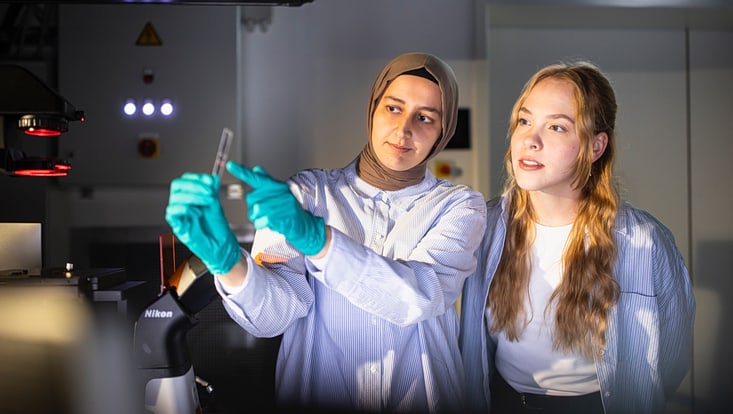
Photo: UHH/Esfandiari
The UN's International Day of Women and Girls in Science, celebrated annually on 11 February, is an important opportunity to recognise and further advance ongoing efforts towards gender equality in academic professions. While women now make up 53% of students nationwide, the proportion of female professors remains low at only 30%, leaving considerable room for improvement. The University of Hamburg has been committed to sustainable development in this area for decades and has made impressive progress.
A significant milestone is the increasing proportion of women among professors. Since the 1990s, this proportion has almost quintupled at UHH: while only 5.5% of professorships were held by women at that time, the figure today is 35.8%. This means that the University of Hamburg significantly exceeds the German average of 30%. Twenty years ago, in 2003, the proportion of female professors exceeded 20% for the first time, reaching 23% to be precise. In 2016, the university recorded just under 30% women in professorial positions. This trend shows that equality is becoming increasingly established in the higher education landscape.
The trend among students is also remarkable. Since the 1970s, the proportion of female students at the University of Hamburg has been growing steadily. In 1999, women outnumbered men among students for the first time, accounting for 50.4% of the student body. In 2016, the university reached a proportion of 55.5% female students. Today, the figure is 57.7%, underscoring the strong presence of women in higher education. In a nationwide comparison, the University of Hamburg, with its share of over 57%, is well above the average of 53%.
These positive developments are proof of the University of Hamburg's successful strategies in the area of women's advancement and equal opportunities. Nevertheless, continuous work on gender equality remains a central task in order to break down barriers and inspire even more women and girls to pursue science and research. This is not solely a question of gender equality; social background, migration experience and disability also play a significant role in access opportunities.
The International Day of Women and Girls in Science reminds us how important diverse perspectives are for innovation and progress and calls on us to continue along this path with commitment in the future.

