
The UHH EUGLOH team – together with its network of UHH students and staff – look back on an eventful year in 2025. We look forward to making more memories in 2026!
Many more highlights from across the entire EUGLOH Alliance can be found in the 2025 Annual Review available on the EUGLOH website.
Bridging Single-Cell Data and Mechanistic Modelling: A Hackathon for the Future of Systems Medicine
20 November 2025, by Dr. Lorenz Adlung

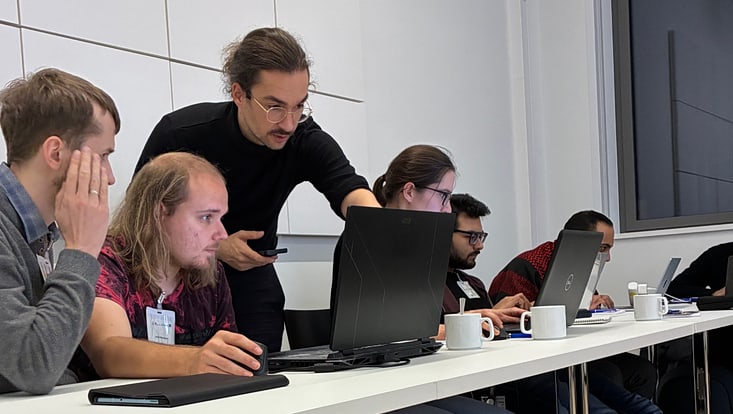
Photo: EUGLOH
From 5 - 6 November 2025, early-career scientists from across Europe gathered at the Hamburg Center for Translational Immunology (HCTI) at the University Medical Center Hamburg-Eppendorf (UKE) for a two-day “Bring-Your-Own-Single-Cell-Data” hackathon. Hosted by Dr. Lorenz Adlung from the HCTI and the Center for Biomedical AI (bAIome), the event focused on integrating single-cell sequencing data with ordinary differential equation (ODE)-based mechanistic modelling to improve our understanding of dynamic immune responses in health and inflammatory disease. The hackathon was financed by a funding program from the German Academic Exchange Service (Deutscher Akademischer Austauschdienst) that provides German higher education institutions with additional financial support for use in EU-funded consortia such as EUGLOH.
The hands-on workshop provided an interdisciplinary environment, bringing together researchers working at the intersection of computational biology, immunology, and mathematical modelling. Participants learned the core concepts behind single-cell data analysis and set up open-source modelling frameworks. They worked in focused project groups, received personalized guidance, and jointly developed model concepts for pending biological questions. The workshop also featured discussions on research careers and funding strategies, complemented by a networking session with local principal investigators from the HCTI and the University of Hamburg (UHH).
By combining data-driven discovery with mechanistic bottom-up approaches, the workshop aimed to encourage a new way of thinking about complex biological systems – one that embraces both high-dimensional data and the need for interpretable, dynamic predictions. The event demonstrated how interdisciplinary exchange can accelerate scientific innovation and establish the basis for new research collaborations across institutions.
As mathematical modelling emerges as a key method in modern biomedical research and personalized medicine, the Hackathon in Hamburg served as an important step in establishing a new community of researchers capable of translating single-cell data into meaningful biological insights.


