Newsroom
Newsroom
27 January 2026, by Claudia Sewig
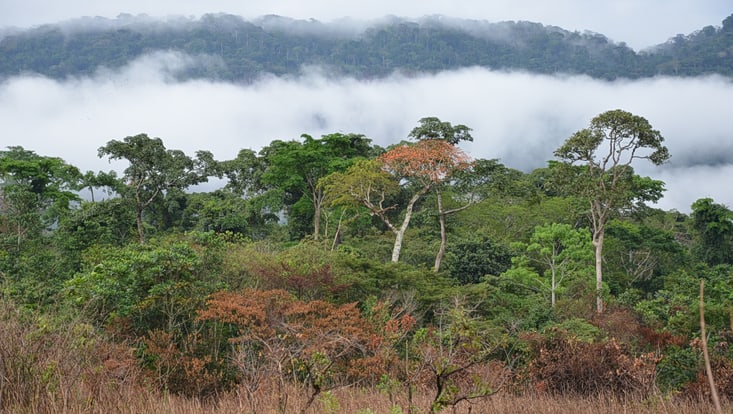
Photo: Barbara Ditsch
The Serra do Pingano Ecosystem (SPFE) in northern Angola consists of several parallel thickly wooded mountain chains.

Photo: Barbara Ditsch
Impatiens pinganoensis (photo), which is unique to the region, is facing extinction. Aloe uigensis, from Uíge, is one of the endemic species.

Photo: UHH/Lautenschläger
Dr. Thea Lautenschläger making a herbary collection.
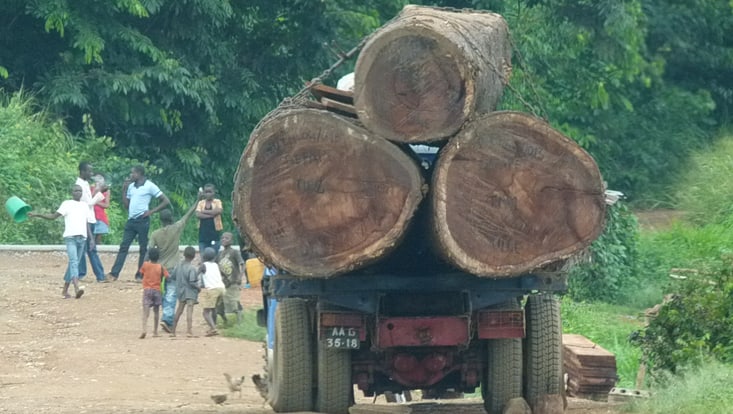
Photo: UHH/Lautenschläger
Deforestation in the region has increased dramatically in the last 2 decades. The reasons include timber exploitation ...

Photo: Raffael Ernst
... and slash and burn, on top of agriculture, poaching, and, increasingly, the search for gold.
Dr. Thea Lautenschläger, scientific director of the the University of Hamburg’s Loki Schmidt Garden, and Dr. Manfred Finckh from the Institute of Plant Science and Microbiology have now published a study in Nature Ecology and Evolution revealing the dramatic loss of a special forest region in South Africa.
Angola boasts a great diversity of ecosystems. Since the country’s independence in 1975, the population has grown from 6.5 to 36 million people, which has become a climate burden and threatens unique habitats such as the extensive South African Great Escarpment. This important landscape has been recognized only recently as an extraordinary center of flora and fauna that live only here, and its northernmost tip, the forest ecosystem of Serra do Pingano (SPFE) in northern Angola, which consists of several parallel, thickly forested mountain chains (Serras), is considered it’s crowning green jewel.
Dr. Thea Lautenschläger has been doing scientific work in the Uíge province in northern Angola since 2012, originally to build a botanical garden jointly with the local Kimpa Vita University. A cooperation agreement was signed to this end with the University of Hamburg in 2024. The Hamburg geoecologist Manfred Finckh and his team often travel to Angola up to 3 times a year to study, above all, the open valley grasslands and their plants while Lautenschläger focused mostly on the field of ethnobotanics, meaning the documentation of traditional knowledge about plant use.
“During our years of work there, it became clear that the region was full of plants and other organisms that had never been described for Angola. At the same time, we observed with the help of satellite data and our own field trips how massive and exponentially increasing destruction is threatening this species diversity, especially timber exploitation, slash and burn, agriculture, poaching, and, increasingly, the search for gold, all initially set into motion by intensive population growth,” said Lautenschläger.
The significance of the region and its conservation value were already made clear to Angolan authorities in 2010, according to both Hamburg researchers and 7 further authors in their newly published study. Since then, however, they say there has been sharp erosion in the last remaining forest area. As the report lays out, the central Serra do Pingano has lost 43 percent and the SPFE 21 percent of its original forest area, which is a loss of 526 square kilometers of forest, with strong degradation in further areas. Animal species such as the Braun's bushshrike (Laniarius brauni), a critically endangered bird species, and the Angolan dwarf galago (Galagoides kumbirensis), a primate species first described in 2017, are suffering the consequences. One of the study’s conclusions is that several amphibian species living in the forests still await formal description and could become extinct before they are scientifically described. A recently discovered population of African forest elephants (Loxodonta cyclotis) facing extinction in the Serra Vamba could suffer a similar fate. For the study, data from a variety of research on the region were consolidated and evaluated.
“Time is running out, and while the world celebrates the 50th anniversary of Angola’s independence, for which the country has justifiably been lauded by the international community as it has mastered the bumpy path from chaos to stability, it would be a compelling symbol of change towards a better future if the country would finally (re)join the journey that started over a decade ago and conserve Angola’s national legacy of biological diversity and an important common planetary good by taking serious measures to protect it’s biological treasures,” the authors state in the study.
The Angolan government, however, has just published an announcement from its environmental ministry that for the time being, it would protect only the Serra do Pingano and not the entire region. There is also no information about the exact nature of its conservation status or the conservation area’s exact boundaries. Lautenschläger explained: “Without comprehensive, complete protection efforts, the region and all of its riches will degenerate rapidly, and without the forest, water will become scarce, to say nothing of a lack of natural resources for the rural population’s daily needs.”