
Newsroom
Newsroom
5 May 2026, by Huke/Red.
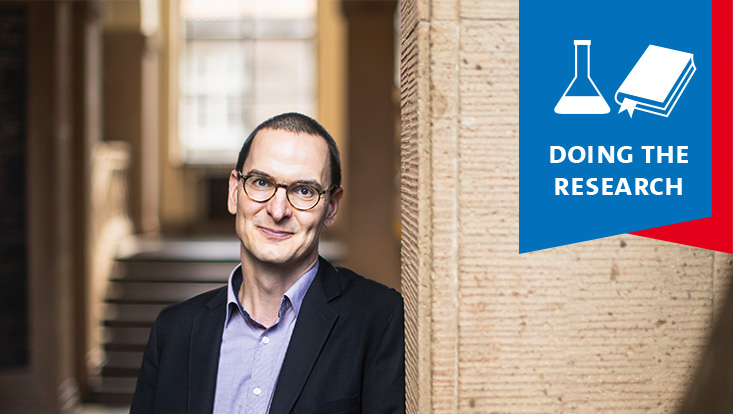
Photo: UHH/Esfandiari
The University of Hamburg is the scientific home to more than 6,200 researchers. Every 2 weeks, we offer a glimpse into their work as part of the “Doing the Research” series in the Hamburger Abendblatt. In this edition, Dr. Nikolai Huke explains why there is a disconnect between legal norms and everyday working life in Germany, and why many workers are confronted with illegal, exploitative working conditions on a daily basis.
In Germany, the workplace is, in theory, strictly regulated. From maximum working hours and mandatory rest periods to the specific conditions under which a contract can be terminated, the law is designed to protect. Yet, while German labor law offers a high level of formal protection, the reality on the ground is often very different. In many industries and employment relationships, these laws are selectively or even systematically ignored. Employees work through their breaks, handle hazardous substances without protective gear, or lift heavy loads that put their long-term health at risk. When occupational safety regulations are brushed aside, the physical and mental consequences for workers can be severe.
Surprisingly, few workers take action against these illegal practices. To understand why—and to uncover the consequences for the world of work as a whole—I am conducting in-depth interviews with affected individuals and staff at counseling centers.
The interviews highlight the immense hurdles workers face when trying to exercise their rights. These barriers to access to justice range from a lack of legal knowledge to the very real threat of retaliatory dismissal. Furthermore, many individuals lack the financial, temporal, or psychological resources required for a protracted legal battle against a company.
Precarious living situations—driven by poverty, uncertain residency status, or health limitations—often compel employees to endure illegal conditions in silence. Foreign workers, in particular, face immense pressure; they must often prove they hold a job that provides a living wage to secure settlement permits, naturalization, or family reunification. For them, leaving an exploitative job or risking termination may simply not be an option.
Companies acting unlawfully have little to fear in terms of penalties. According to the staff at legal advice centers I interviewed, even in the rare event that an employee takes legal action, the case typically ends in a settlement. Employers offer to pay out previously denied claims on a pro-rata basis. Many employees, desperate to avoid lengthy court proceedings, reluctantly agree—ultimately walking away with only a portion of the money they are legally entitled to.
My research underscores a fundamental question: What measures can actually enforce existing labor law in practice? Finding legal and societal answers to this question is essential. It is not just about creating a more equitable workplace; it is about upholding the rule of law in Germany.
(This content has been translated automatically.)
Dr. Nikolai Huke conducts research in the Department of Socioeconomics at the Faculty of Business, Economics and Social Sciences at the University of Hamburg. His project “Labor Law in Precarious Life Situations” is funded by the Hans Böckler Foundation from 2024 to 2026. His research focuses on issues of democracy, inequality, and political mobilization. He is the author of the open-access monograph “Powerlessness in Democracy: The Broken Promise of Political Participation.”

