Newsroom
Newsroom
1 April 2026, by Berger/Red.

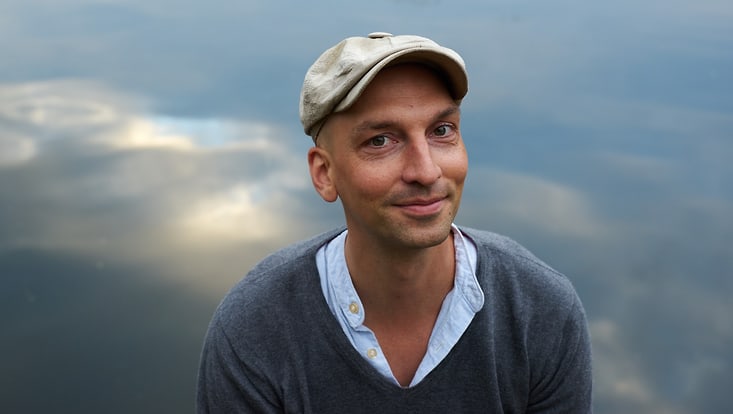
Photo: Milo Berger
Every year, numerous new researchers join the University of Hamburg. In this series, we introduce them and their fields of research. This time: cultural studies scholar Hilke Marit Berger.
Prof. Dr. Hilke Marit Berger moved from HafenCity University Hamburg to the University of Hamburg for the 2026 summer semester and has assumed a professorship in “Digital Cultures and Imaginative Intelligence” at the Faculty of Humanities.
I am interested in how digital technologies, particularly artificial intelligence, shape our visions of possible futures and what is lost when we treat this solely as a technical issue rather than a cultural task of shaping the future. I investigate how digital visions of the future emerge, who shapes them, and which perspectives are systematically missing in the process: local knowledge, cultural experience, diverse voices. In my central research project “Currents of Imagination. Co-Creating Urban Water Futures Through AI, Art and Transdisciplinary Collaboration,” funded by the Volkswagen Foundation’s Change! Fellowship and in close collaboration with the Center for Art and Media Karlsruhe, we examine—using the example of urban water futures—exactly how these perspectives can be integrated with digital tools and what changes when AI is viewed not as a forecasting tool but as a co-creative actor.
When a city has to decide how to prepare for climate change, there are AI models that calculate what is likely to happen: when water levels will rise, where heat will become unbearable, what it will cost. The fact that these models exist is great and can be extremely helpful. But these models do not capture what keeps people in a place. What communities have learned over generations. What other futures might be conceivable if we ask different questions, or ask different people. In my research, we’re testing exactly how this cultural community knowledge can play a central role in digital decision-making processes. So that planning for the future isn’t just efficient, but also does justice to the diversity that actually defines a city.
ILAS is in an exciting intermediate phase of development and embodies exactly what my research and teaching require: interdisciplinary, curious thinking that transcends disciplinary boundaries. Anyone who wants to understand how AI is transforming our culture needs, among other things, Philosophy, Media Studies, governance experience, environmental knowledge, and artistic practice. The breadth of collaborations the degree program already fosters—ranging from literary studies to Informatics to the natural sciences—shows how seriously this interdisciplinary commitment is taken. I am very much looking forward to helping build this degree program, connecting with the university’s existing strengths, and guiding students as they develop critical and creative skills for a digital present.
I would like to establish a research network at the University of Hamburg that systematically integrates digital cultures, climate transformation, and artistic research, thereby strengthening Hamburg’s position as a prominent European hub for this innovative research alliance.
The prerequisites for this are excellent: With the CLICCS cluster of excellence, the Institute for Humanities-Centered Artificial Intelligence (CHAI), Digital Humanities, and others, there are points of connection that I will actively seek out. Looking ahead, I envision a transdisciplinary research space that combines participatory futures studies, speculative AI, and artistic practice. Not as a parallel structure, but as a catalyst that brings together existing expertise and supplements it with new formats: joint doctoral supervision, guest fellowships, transdisciplinary workshops, and publicly visible formats such as exhibitions or participatory labs. In doing so, I see good opportunities to develop larger collaborative grant applications together with colleagues.
In the area of knowledge exchange, I bring a concept I call “shaping responsibility”: the conviction that we do not passively accept technological change, but can and must actively and collaboratively shape it.
I offer teaching formats in which students not only analyze AI but also critically engage with it in a creative way, alongside partners from practice, urban planning, cultural institutions, and civil society. For example, when they collaboratively design a serious game that translates Hamburg’s climate data into playful scenarios. It is important to me that students learn not to accept digital systems as a black box, but to understand their cultural and political implications and help shape them. If you’re interested in working at the intersections of culture, technology, and the environment—and in the process, getting to know methods ranging from speculative storytelling to critical data analysis—you’ve come to the right place. And if you’re not quite sure where your own journey is headed: that’s exactly what this is about. I see the future not as a finished destination, but as a creative task.
My work is embedded in an international network that has grown over many years. As Scientific Lead of the City Science Lab at HafenCity University, a collaboration with the MIT Media Lab, I have experienced international exchange over the past five years as both natural and valuable, and as central to my own thinking and critical inquiry. My research integrates diverse perspectives, which is why my network consists of both researchers and actors from cultural, political, and civil society sectors. Most recently, I led a project with local partners from Jakarta and Alexandria and collaborated on another with the Centre for Urban Science and Policy at TU Delft. In the Currents project, we will cooperate with other Dutch research institutes, the Weizenbaum Institute in Berlin, and researchers from the UK, as well as with policymakers, artists, and civil society initiatives. The transdisciplinary core of the project is the collaboration with colleagues from the Center for Art and Media Karlsruhe, who bring additional exciting international partnerships to the table.
Digital systems help determine which futures we can imagine and which we cannot. This applies to climate change just as much as to the question of how we want to live together in our cities. My research reveals the assumptions and exclusions embedded in these technologies. But it does not stop at criticism. It contributes to our knowledge of transformation, which emerges through the practical shaping of shifts in perspective, through the testing of real fictions, and through the collaborative development of alternatives.
What distinguishes my work is the combination of critical digitality research, research on climate adaptation, and artistic research.
In the Currents project, for example, AI-supported media artworks are created that translate climate data into handwritten letters to policymakers, or immersive experiential spaces that make urban water futures physically tangible.
For me, creative responsibility means: not just describing what is, but jointly enabling what could be—in science, in art, and in society. I am very excited to begin this work at the University of Hamburg.
(This content has been translated automatically.)