
Newsroom
Newsroom
19 February 2026, by Schröder/Red.
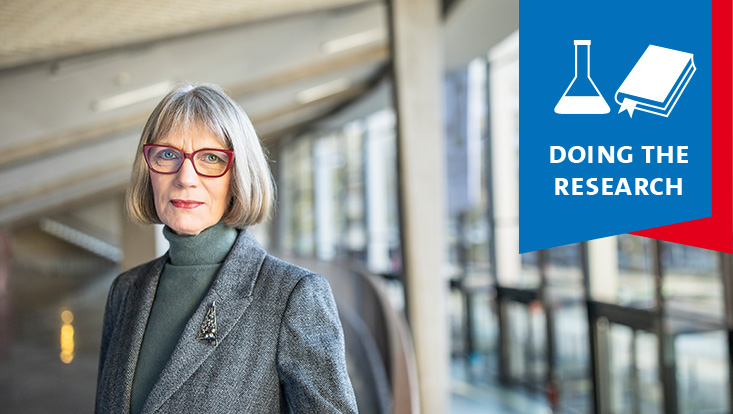
Photo: UHH / Esfandiari
The University of Hamburg is the scientific home to over 6,200 researchers. Every 2 weeks, we offer a glimpse into their work in the Hamburger Abendblatt. In this edition of the column, Prof. Dr. Ingrid Schröder explains how the perception of Low German has changed over the past centuries.
Moin! While this greeting is heard as a matter of course in everyday life in Hamburg today, the Low German language—or as it is colloquially known: “Platt”—more or less disappeared from public life just a few decades ago. I learned the language as a child in my family, but it wasn’t welcome at school. I was therefore surprised that I was able to major in Low German during my German studies in Göttingen. I was given the opportunity to work on the Middle Low German dictionary, and that was the start of my academic career.
Today, as head of the Low German Language and Literature department at the University of Hamburg, I focus on which languages and dialects are spoken in northern Germany, with a particular emphasis on the history of the Low German language. This leads us into a laboratory of social language change: we can see how the status of a language that was used in all areas of society in the late Middle Ages changed fundamentally from the 15th century onwards. First it was replaced in written usage by High German, then in spoken usage, until it was only found in private niche uses.
We primarily rely on surveys to find out the current language situation. Study participants tell us which languages they have learned in the course of their lives and what they associate with them. We use methods of historical linguistics and written material such as books, documents, and private correspondence from various centuries to illustrate the development over time. This allows us to show when and where which form of Low German was used. The language was and is not only spoken in northern Germany, but throughout the entire area of influence of the former Hanseatic League, around the Baltic Sea, and as far as England and the Netherlands.
One approach for our research is the sociolinguistic approach, i.e., the question of who speaks or spoke Low German? Our results show how High German prevailed over Low German across various sectors of society. From the 17th century onwards, Low German faced outright stigmatization, as anyone who was anyone spoke High German. But since the second half of the 20th century, we have seen an increasingly positive outlook, partially also as a reaction to the threat of language loss.
Another approach of our work is to research linguistic variation and its causes. We are interested in how exactly Low German differs between regions, but also within individual areas. Of course, the influence of other languages is also important, especially the close exchange with High German.
My current projects focus in particular on Middle Low German—an early form of Low German that was very widespread in the Middle Ages. For example, I am working with colleagues from Hamburg, Rostock, Frankfurt/Main, and Trier, to compile a database that contains all medieval word formation patterns in both Low German and High German. And in January 2026, we will launch a new long-term project in which we are developing an innovative digital platform that will provide a comprehensive grammar of Middle Low German and systematically incorporate linguistic differences. This allows us to depict language in its many different forms. Such databases are important tools for linguistic research and teaching.
One question that I would personally like to pursue concerns our beautiful Hanseatic city. Having researched Low German in Hamburg rather selectively so far, I would like to expand my work and create a language history of the city.
Prof. Dr. Ingrid Schröder conducted research in the Middle Low German Dictionary project at the University of Hamburg from 1988 to 1999. She was Professor of Low German and German Linguistics from 2002 to 2025 and has been a senior professor since 2025. In 1992, she was the first recipient of the Agathe Lasch Prize awarded by the Senate of the Free and Hanseatic City of Hamburg. Her favorite Low German word is “plietsch” (clever, smart, skillful).

