Newsroom
Newsroom
14 January 2026, by Nagy/Red.
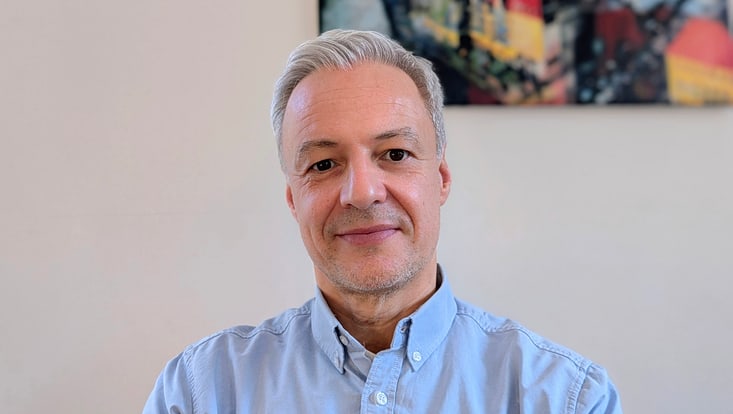
Photo: private
Every year, the University of Hamburg welcomes numerous new researchers. This series introduces them and their areas of research. This time: educational scientist Prof. Dr. Gabriel Nagy.
Prof. Dr. Gabriel Nagy, formerly from Kiel University, came to Hamburg in the Winter Semester of 2025/26, where he is a professor in the Faculty of Education focusing on the design of international comparative studies.
My field of research has 2 focus areas. First, I study how people in institutional contexts such as school, vocational training, and their job develop. I am especially interested in their transitional decisions, for example, choosing a subject or vocational training, and how these decisions affect their further development.
Second, I work in the area of educational measurement. In this area, I look at statistical and psychometric procedures that play a pivotal role, above all, in large-scale educational monitoring studies. I test and further develop these procedures in my work.
I would like to explain my research using 2 examples. In studies on educational monitoring, we would like to find out, for example, what schoolchildren actually know and can do. As a rule, these studies are voluntary and assume that all of the participants are motivated to work on the tests and questionnaires carefully. In fact, however, this is not always the case. This is why I am working with my colleagues to develop methods to recognize and take into consideration these kinds of responses so that we can reliably evaluate competencies.
The second area looks at what happens when educational pathways are a good or less ideal match for someone. What does it mean, for example, if someone chooses a degree program that does not match their interests or strengths? I look at how to measure this fit and the consequences for learning, motivation, and other decisions.
My research is directly relevant to current challenges. On the one hand, it’s about reliably documenting the performance of our educational system. We have to understand the current educational situation to identify urgent matters. I would like my work to contribute to high-quality educational monitoring and a sound basis for educational policy decisions.
On the other hand, I am also concerned with how to shape individual educational pathways. Given the high number of drop-outs in tertiary education, it’s important to support young people early on. I would like my research to help them better identify suitable university and vocational programs, and to assess and exploit them successfully in the long term.
At the University of Hamburg, I would like to fulfill my research and teaching obligations as best as I can. If my work can contribute to strengthening the quality of educational monitoring and inspire greater support for young people as they make career decisions, that would be a great success. I especially want to familiarize students with scientific thinking and inspire their enthusiasm for it. If I succeed, it can prove very useful over time, for the University and beyond.
I am internationally well-connected. I cooperate closely with Oslo University and the University of Central Florida. I am working with colleagues there in several projects, especially in the field of educational measurement.
My professorship is also closely associated with the International Association for the Evaluation of Educational Achievement (IEA). This organization brings together research institutions and researchers from all over the world to better understand and further develop education. This all means that my work is firmly established in international educational research, which I find hugely enriching.