Newsroom
Newsroom
13 October 2025, by Herr/Red.
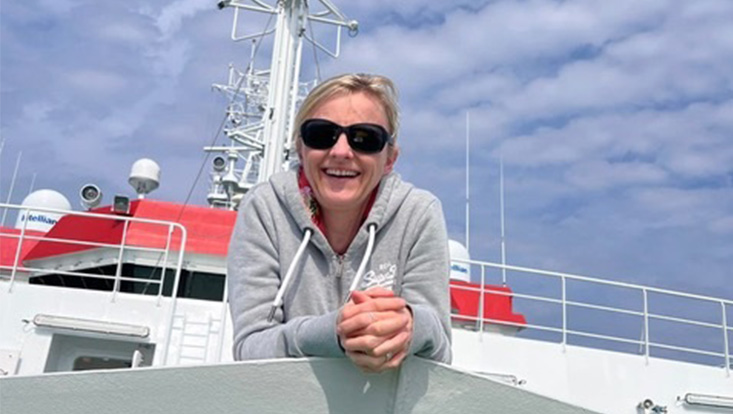
Photo: L. Hickmott
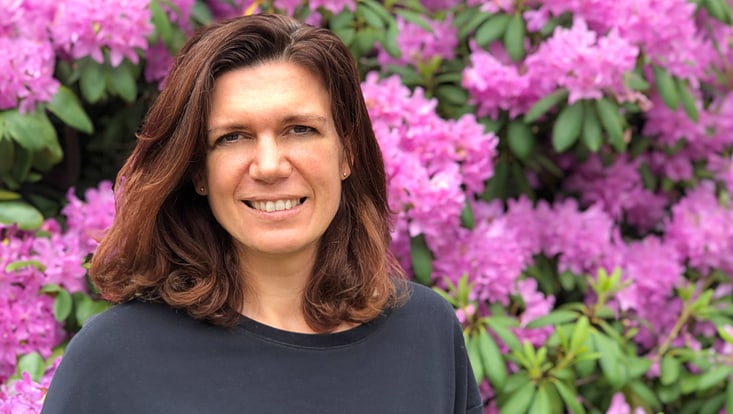
Every year, the University of Hamburg welcomes numerous new researchers. This series introduces them and their areas of research. This time: marine biologist Prof. Dr. Helena Herr.
Prof. Dr. Helena Herr joined the Faculty of Mathematics, Informatics and Natural Sciences in Winter Semester 2025/26, where she is now professor of ecology of marine mammals in a joint academic search procedure with the Helmholtz centre for polar and marine research the Alfred Wegener institute. Helena Herr was previously a research assistant in the Department of Biology and at the Center for Earth System Research and Sustainability at the University of Hamburg.
I have specialised in the assessment of marine mammal populations, their spatial distribution and habitat needs, as well the impact of human activities. My current focus is on large baleen whales of the Southern Ocean and their recovery from whaling. Most baleen whale species were brought to near-extinction by 20th century commercial whaling and are now recovering – some better than others – into a new world of new impacts; this raises many questions and challenges for research and management.
I always tell my 5-year-old daughter that for many whales, we don't even know how many of their species there are, why they occur where they occur, and where their feeding or breeding grounds are. To find out, I count whales and other marine mammals from ships, airplanes, helicopters, and drones, and I map their distribution and estimate their numbers. I tag whales with satellite transmitters to track where they swim, which routes they take, and where they like to hang out. I study what they eat, what threats they face today, and what we can do to protect them. When she's a little older, I'll tell her that whales perform important ecosystem functions, contributing to nutrient cycling and carbon sink capacities, and why this is important.
I was born in Hamburg and love this city! I've already worked at the university for several years and have come to greatly appreciate my institute and the department. Now, in my new role and in cooperation with the AWI, being able to establish a working group for marine mammal ecology fills me with great joy and enthusiasm.
At the Institute of Marine Ecosystem and Fisheries Science (IMF), I will be expanding research and teaching to include (warm-blooded) top-predators. The degree programs at the IMF cover ocean biodiversity, the functioning of marine food webs, and the management of marine resources and ecosystems. My research interests and marine mammals fit perfectly into this. I look forward to introducing students to this group of animals, their importance, and their function in the ecosystem. I will also be happy to be a contact person at the university for all questions about marine mammals. There is great interest in my field in the media and society, and questions regularly arise, e.g. in relation to strandings, sightings, or regarding new behaviours, such as the interaction of orcas with sailing ships off the coasts of Spain and Portugal.
I always say, “Whales make you happy.” I've never met a person indifferent to whales, someone who isn't fascinated by them in one way or another, or who doesn't want to learn more about them. Much more important, however, is that the IMF trains researchers and decision-makers in marine resource management and marine conservation. Marine mammals represent a significant component of the marine ecosystem and are therefore an important part of ecosystem approaches and holistic management concepts.
Whale research, especially in the Antarctic, is inherently highly collaborative. Our study organisms of interest are extremely difficult to reach, collecting data is costly and time-consuming, and generally subject to difficult weather conditions. It is therefore particularly important to share data in order to maximize the information available. A good example is the 'Lost Giants' project, in which we are working with a variety of participating institutions towards a circumpolar population estimate of Antarctic blue whales based on photo-identification data. Important cooperation partners here include the British Antarctic Survey, the Australian Antarctic Division, NOAA, and the University of Pretoria. An important networking body for us is the International Whaling Commission (IWC), which, in addition to its original function as a management body for whaling, is now primarily concerned with new threats and management requirements for whales and defining corresponding research needs.
Furthermore, whale research is, of course, closely linked to research on prey organisms. Therefore, I work closely with krill researchers at the AWI and the plankton group at the University of Gdansk.
Whales fulfil important ecosystem functions, not only as top predators structuring the food web, but also as important contributors to nutrient cycling and carbon sequestration. These ecosystem services were largely lost during 20th century commercial whaling leading to a near-extinction of almost all large baleen whale species. The increasing population recovery we are currently witnessing also represents a revival of these ecosystem services, including a contribution to carbon sink capacities of the ocean, which is more important than ever in times of climate change.