
Newsroom
Newsroom
25 September 2025, by LIB / Newsroom editorial office
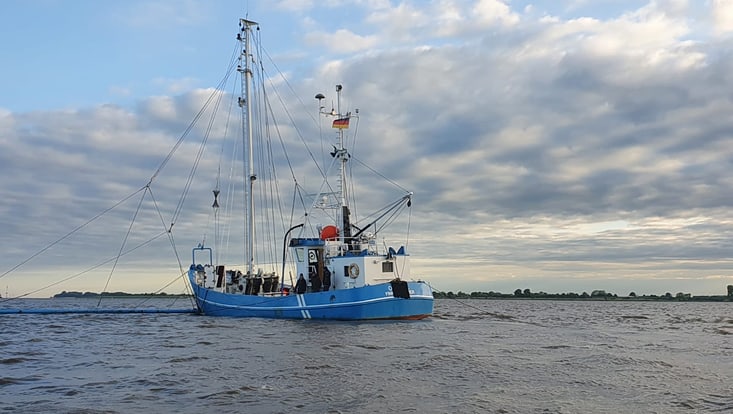
Photo: University of Hamburg / Thiel
In the last 4 decades, fish fauna in the Elbe estuary has changed dramatically according a project jointly conducted by the University of Hamburg and the Leibniz Institute for the Analysis of Biodiversity Change (LIB). Among other things, the project’s researchers examine how environmental factors have an impact on the populations of key fish species. Their findings were published in the journal Estuarine, Coastal and Shelf Science.
Despite the analysis initially showing a recovery phase whereby the fish populations grew from the 1980s to around 2010, they have since declined dramatically, with the total population of all fish species falling by more than 90 percent. In addition to smelt (Osmerus eperlanus), species such as twaite shad (Alosa fallax), flounder (Platichthys flesus), and ruffe (Gymnocephalus cernua) were also severely affected, as were all life stages.
In many species, the occurrence of larvae and juvenile fish declined, partly due to the silting up of important nursery areas. The ruffe (Gymnocephalus cernua), for example, showed impaired growth the in subadult and adult stages. During the same period, marine fish such as herring (Clupeidae) and whiting (Merlangius merlangus) increased in number. This indicates a structural shift in the fish fauna, which is typical of so-called macrotidal estuaries—that is, river mouth areas with a high tidal range.
Standardized fishing data from 5 stations along the Elbe estuary covering a period of more than 40 years were evaluated for species composition, frequency of fish, and relevant environmental factors in all four seasons as the fish community changes seasonally. Researchers used statistical methods to identify temporal trends and correlations between environmental factors and the composition of the fish fauna.
“The long-term changes in fish populations in the Elbe estuary can be closely linked to various environmental factors. While a significant improvement in water quality in the 1990s favored the recovery of many species, conditions have clearly deteriorated in recent years,” explains the study’s lead author, Jesse Theilen from the Leibniz Institute for Biodiversity Change Analysis (LIB).
He designed the current study as part of his dissertation in collaboration with Prof. Dr. Ralf Thiel from the Department of Biology at the University of Hamburg. Dr. Elena Hauten and Dr. Raphael Koll, doctoral researchers in Research Training Group 2530: Biota-Mediated Effects on Carbon Cycling in Estuaries at the University of Hamburg, and Dr. Victoria Sarrazin, former postdoctoral researcher at the University of Hamburg, also participated in the study.
A key factor in the development of the fish fauna is the increase in suspended sediment due to regular dredging of the lower Elbe to allow large container ships to access the Port of Hamburg. This suspended sediment has silted up important growth areas, and the high turbidity of the water makes it difficult for many fish to find food. Less rainfall and the resulting decrease in runoff has exacerbated the problem, as less sediment is washed out of the estuary area, and salinity is increasing, which is disrupting the ecological balance.
“Smelt, in particular, is an indispensable forage fish for coastal birds and other predatory fish, giving it a key role in the food web. Its disappearance would have dramatic consequences for the entire ecosystem,” says Dr. Elena Hauten, coauthor of the study and currently a postdoctoral researcher in the Marine Ecosystem Dynamics and Management research unit at the University of Hamburg.
Using the example of the 1980s compared to the 1990s, the study shows that fish populations can recover within a few years as a result of improved environmental conditions. “So it’s not too late to develop targeted conservation approaches based on our findings and future research projects,” says the biologist.
J. Theilen, V. Sarrazin, E. Hauten, R. Koll, C. Möllmann, A. Fabrizius, R. Thiel: “Environmental factors shaping fish fauna structure in a temperate mesotidal estuary: Periodic insights from the Elbe estuary across four decades”, Estuarine, Coastal and Shelf Science, Volume 318, 15 July 2025