Newsroom
Newsroom
8 January 2026, by Christina Krätzig
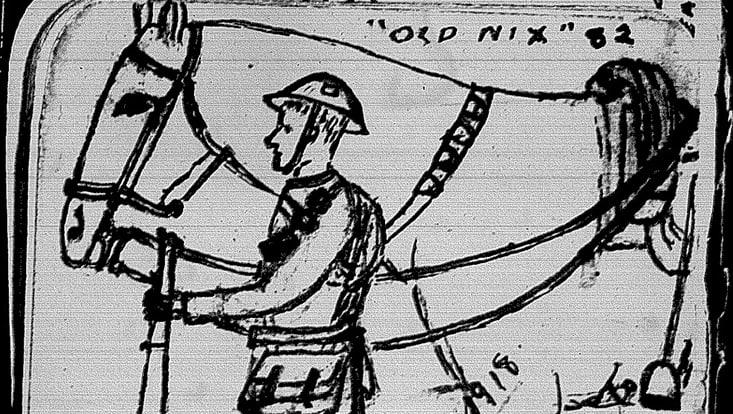
Photo: Warren Breckman
Twenty diaries from World War I form the basis for a research project led by historian Prof. Dr. Warren Breckman from the University of Pennsylvania in Philadelphia, USA. Every year, the Advanced Fellowship program at Universität Hamburg—University of Excellence provides about 15 outstanding researchers and artists with an opportunity to pursue projects they cannot fit into their regular schedules.

My grandfather fought as a Canadian soldier in this war. Unlike many other veterans, he talked a lot about this time—his stories probably turned me into a historian. During his service in Europe, he wrote 20 diaries including poems, drawings, and personal reflections. His writings are stored in the City of Winnipeg Archives, in the capital of the Canadian province Manitoba and present a unique documentation of World War I.
First of all, they are seamless and fully preserved. George Hambley started his diaries in spring 1915, when he became an army volunteer, and finished them in 1919 upon his return to Canada. Besides giving an account of the course of the war, they also describe the personal development of a poorly educated 19-year old farm boy who, despite the atrocities he was witnessing, also used his time overseas to read and broaden his mind.
He was a young man who was deeply religious and stayed true to his faith. In contrast to many other wartime voices, George did not become cynical and managed to preserve his humanity. Even his view of enemy soldiers was compassionate—he considered them brothers. After the end of the war, he lived with a German family for several months and fell in love with the daughter of the house. During this time, he conducted in-depth conversation with the defeated Germans, which he recorded in detail.
When George died in 1983, I initially thought I had to fictionalize his story in order to be able to tell it. Luckily, the methods of historical research have evolved since then. Historians now appreciate the illuminating power of the biographies of ordinary men and women. This helps understand the mentality of people who lived, worked, or fought in a different time. I believe that an in-depth study of personal documents such as George’s diaries can help bridge the gap that separates us from them.
Many aspects did, including the stark contrast between hellish days at the front and quiet moments with the horses. When not involved in war action, George cared for the animals, rode them, communicated with them, and tried to become one with them. He felt that fighting on horseback in a modern war was a strong anachronism. At the same time, the animals were close to his farmer’s boy heart. In his notes, he not only recorded the names of all his fallen comrades, but also those of their horses killed in action. The story of his beloved Nix, who, like himself, had come to Europe from Canada for the war, is depicted in great detail. He describes its astonishingly complex emotional state after the death of its original owner, the horse’s abilities and its death in the Battle of Cambrai in October 1918—the last cavalry battle in the history of Western Europe.
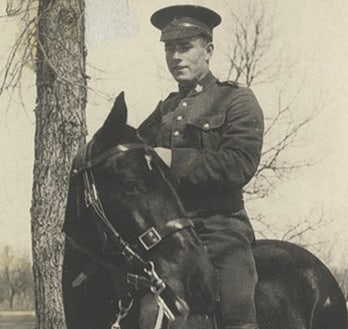
George Hambley on his horse Nix Copyright: Warren Breckman
He first studied art, later theology, and wrote several books on the history of the Canadian prairies during his professional life as a Methodist minister. Ten years after the end of the war, he married and became the father of 3 children.
Today, a memorial plaque in the small town of Iwuy on the outskirts of Cambrai in northern France commemorates him and his horse Nix. Although he was only one of thousands of British Empire soldiers who took part in the battle, his records are of exceptional value for understanding the battle.
I took part in the unveiling of the memorial plaque together with several other family members. It was a very emotional moment that showed how the power of memory not only connects us to the past, but also to each other in the present.
The Advanced Fellowships funding of Universität Hamburg—University of Excellence is financed by federal and state funds.