Newsroom
Newsroom
7 October 2025, by Jakob Hinze

Photo: Charles Steitler
The cuneiform tablets of Mesopotamia are considered the world’s oldest written artifacts. Many of them are hidden in clay envelopes, their contents still a mystery. The world’s first mobile CT scanner for cultural goods is now enabling the Cluster of Excellence Understanding Written Artefacts (UWA) to read the texts for the first time.
Written correspondence in ancient Mesopotamia was unreliable. It was not unusual for the letter writer and the receiver to live hundreds of miles from one another. The letters, written on cuneiform tablets and stuffed into clay envelopes to ensure privacy, were sent through the desert by caravan. They often got lost on the way or could not be delivered if someone died or moved in the meantime. This is why museums and archives the world over house many such letters in their original clay containers. Some of these are 5,000 years old and have not been read by anyone for as long.
The Anatolian Civilizations Museum houses an especially important collection of these sealed letters. They hail from major excavation sites such as Hattusa and Kültepe in what is today eastern Turkey. The texts presumably provide important insight into the economic, legal, and private matters of the inhabitants of these early settlements. For archaeological research, especially Assyriology, they are of vital interest.
Researchers in the UWA cluster of excellence at the University of Hamburg have developed ENCI to read the hidden messages without destroying the envelopes. The acronym stands for Extracting Non-destructively Cuneiform Inscriptions. It refers to the world’s first mobile CT scanner designed especially to research cultural goods.
“Normally, a tomography device with the required radiation intensity weighs several tons,” explains Prof. Dr. Christian Schroer, research group leader at the Institute for Nanostructure and Solid State Physics at the University of Hamburg, which headed the development of the ENCI. “The most important thing for us was that the device could be moved, because few museums want to send their collection elsewhere. ENCI weighs only just over 400 kilograms. The biggest challenge was ensuring that the required radiation intensity could be achieved while keeping the weight down.”
During their previous stay in Ankara, the research team was able to scan 75 letters. While working, the team received a visit from Sibylle Katharina Sorg, the German ambassador to Turkey. Sorg learned about the technology and the subject of the research. Before they return to Germany, the researchers will travel on to Kayseri Province to analyze further cuneiform tablets in the collection of the local archaeological museum.
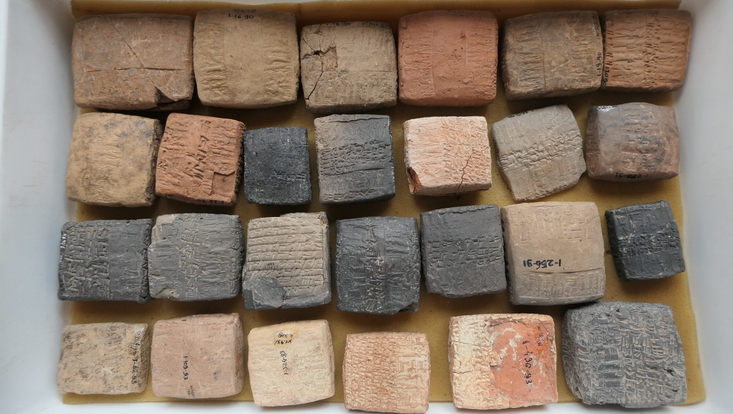
Letters in sealed clay envelopes in the Anadolu Medeniyetleri Müzesi in Ankara, one of Turkey’s most important archaeological museums Copyright: Cluster of Excellence Understanding Written Artefacts