Newsroom
Newsroom
15 July 2025, by Christina Krätzig
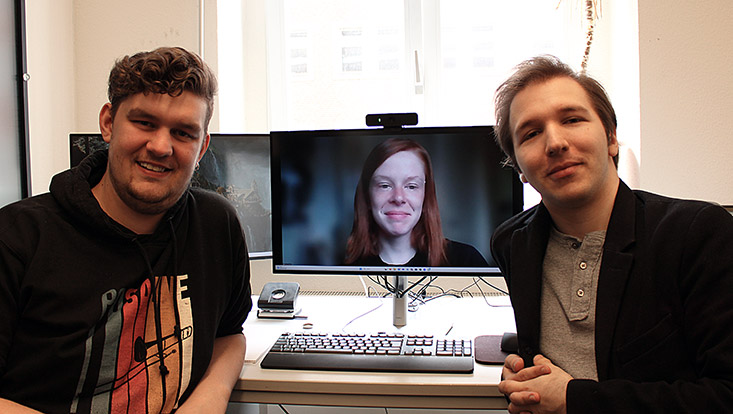
Photo: Private
How do video games and TV series portray the Christian religion? Three students at the University of Hamburg are researching exactly that, and traveling to the world’s leading computer game trade fair in Cologne to investigate. This is one of 9 student research groups funding by Universität Hamburg—University of Excellence in this half of the year.
In Germany, young people and children spend 1.5 hours playing video, computer, or online games per day, and spend another 2 hours watching television. The media they consume often contains Christian elements: medieval monasteries or cathedrals serve as opulent settings, characters include priests and nuns, and obscure, often outdated church rituals are used to raise the tension.
“Our experience as consumers today suggests that institutionalized religion tends to be portrayed negatively,” explains theology student Sebastian Ryterski, who has been interested in the subject since his school days. “Young people have very little trust in institutionalized power structures like political parties and the church, and negative stereotypes like the corrupt priest have long since become cliché.”
To test his theory, he, together with Janos Kiedrowski and Lisa-Marie Blume, are examining the games Blasphemous and Baldur’s Gate, as well as the TV series Good Omens. Their findings will be converted into a publicly accessible database, which should be expanded over the coming years.
Ryterski's personal experience shows that a negative portrayal of the church in media is not necessarily precursor to a fundamental rejection of the church as an institution. He explains that as a child he rarely attended church services and was not confirmed, meaning that in contrast to his peers at school, he was not socialized into Christianity. It was computer games that first piqued his interest. “At some point, I just wanted to understand the events or terminology associated with the church, like “Chalcedonian Christianity” which led to me becoming interested in theology as a subject.”
He is not however sure that other players will be equally motivated to look into the religious aspects of games or films. This is because on closer inspection, religious elements serve predominantly only as a backdrop, spiritual rituals remain superficial, and games or TV series rarely explore religious values or Christian life more deeply. “We suspect it is more important for most players whether a game is fun, or a TV series is entertaining,” says Ryterski.
At gamescom in Cologne, the largest video game trade fair in the world, the students want to ask participants about this, and are planning interviews with developers. “If we stick with this topic for the longer-term, we will be able to find out something about the zeitgeist over the years.” hopes Ryterski. This is because the themes of video games or the worlds in which they take place are also influenced by trends: the middle ages, fantasy, science fiction, World War II, all these come and go. Ryterski believes religion is currently becoming more important, meaning it might be portrayed more positively in the future, but only the future will tell if that really happens.
The series was developed using funds from the Excellence Strategy of the Federal and State Governments.