Newsroom
Newsroom
20 February 2026, by Newsroom editorial office

Photo: University of Hamburg / Esfandiari
University President Prof. Dr. Hauke Heekeren (third from right) welcomes Prof. Dr. Markus Kotzur, Prof. Dr. Ursula Schröder, Paolo Gentiloni, Liv Assmann, Luigi Mattiolo, and Dr. Roberto Luppi (from left to right) to the Hamburg-Vigoni Forum
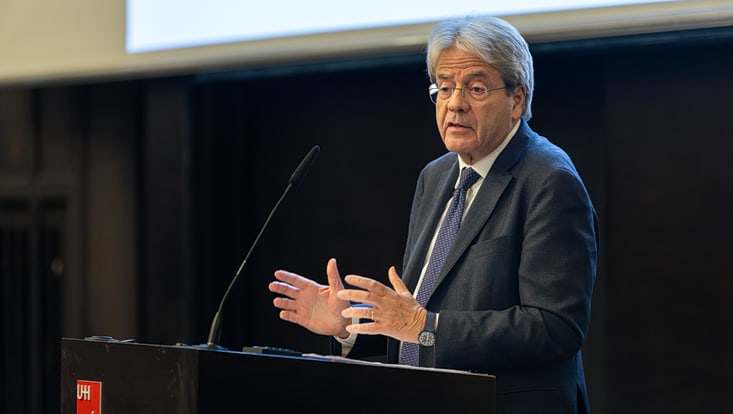
Photo: University of Hamburg / Esfandiari
“Europe must seize the moment”— Paolo Gentiloni, the former Italian prime minister, spoke about the need for European strategic autonomy.
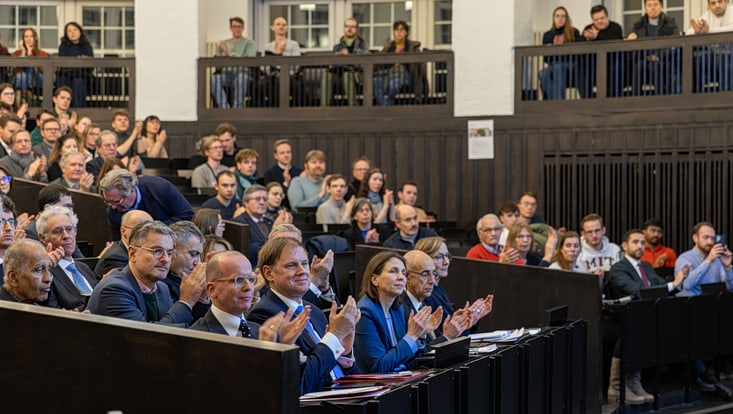
Photo: University of Hamburg / Esfandiari
There was considerable interest in the Speech on the Future of Europe event, and Gentiloni’s remarks were met with enthusiastic applause.
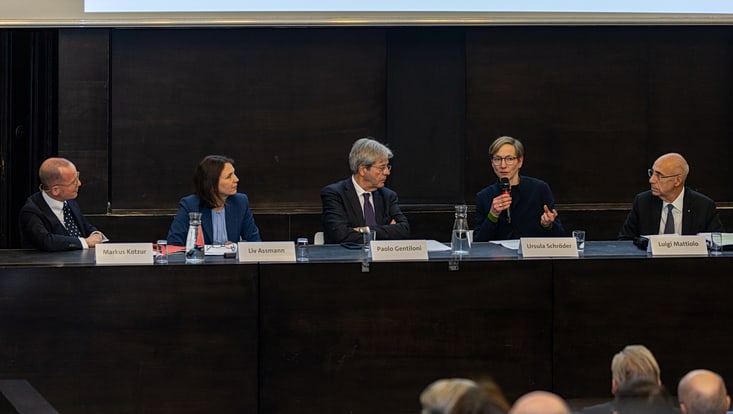
Photo: University of Hamburg / Esfandiari
During the subsequent discussion, Prof. Dr. Markus Kotzur, Liv Assmann, Paolo Gentiloni, Prof. Dr. Ursula Schröder, and Luigi Mattiolo (from left to right) talked about aspects of the speech and shared their own perspectives.
Global crises, doubts, and criticism from inside and outside: Paolo Gentiloni, the former Italian prime minister and EU commissioner, discussed how historic the current situation in Europe is and outlined what a secure, democratic future looks like in his speech on 16 February 2026. It was an evening full of confidence and European conviction.
The high degree of interest showed the Hamburg Speech on the Future of Europe event to be particularly relevant in these times, with a capacity audience of over 350 in the Agathe Lasch lecture hall at the University of Hamburg attending Paolo Gentiloni’s speech and the subsequent discussion with experts from academia and politics (a recording of the event can be viewed below).
In his opening remarks, Prof. Dr. Hauke Heekeren, president of the University of Hamburg, stated that—in the current political climate—universities had a particular responsibility to make knowledge available and to provide space for reflection and exchange. Heekeren introduced Gentiloni as “a leader who has shaped Europe at the highest levels.” The former EU commissioner used his speech to present a clear and hopeful vision of a strategically autonomous European Union. “There is no point looking back,” explained Italy’s former foreign secretary and prime minister; then, echoing Canadian Premier Mark Carney, he said “Nostalgia is not a strategy.” There has never been a perfect world, and changes should inspire us to find new solutions.
In view of geopolitical developments, particularly in relations with Russia and the United States, Europe’s strategic autonomy is an “urgent necessity.” This should not be understood as a rejection of alliances but as a “refusal to coerce a future we do not want or believe in.” In his speech, Gentiloni stated that this requires preparedness and the ability to act in key areas, such as security and defense, economic policy, and investment “in democracy, in institutions, and in our citizens.”
He also acknowledged the fact that these transformations are not easy to achieve as well as three key starting points: greater burden sharing, deeper integration, and faster decision-making. Gentiloni also emphasized how much Europe has already achieved in recent years—for example, in its support for Ukraine. “We are much stronger than we appear . . . we should become aware of our strengths, and we should show more than we are accustomed to, our strength.”
Luigi Mattiolo (president of Villa Vigoni), Prof. Dr. Ursula Schröder (director of the Institute for Peace Research and Security Policy at the University of Hamburg), and Liv Assmann (state secretary and representative of the Free and Hanseatic City of Hamburg to the Federal Government, to the European Union, and for foreign affairs) agreed with this assessment in the discussion with Gentiloni and moderator Prof. Dr. Markus Kotzur (president of the Europa-Kolleg Hamburg and scientific director of the Hamburg-Vigoni Forum).
They discussed in depth what strategic autonomy should look like in security and defense policy, economic policy, and institutional reform of the EU. The German-Italian partnership played a special role in this context. Aware, active, resilient, strong—these were the wishes expressed for Europe’s future and its strategic autonomy during the discussion, reflecting the optimism of the evening and underscoring a joint call for European strength and decisive action.
The Hamburg Speech on the Future of Europe is part of the Hamburg-Vigoni Forum—a joint initiative by the University of Hamburg, Europa-Kolleg Hamburg, the Institute for Peace Research and Security Policy (IFSH) at the University of Hamburg, and Villa Vigoni, the German-Italian Center for European Dialogue. The Hamburg-Vigoni Forum on is one of the University’s international strategy conferences, financed with funds from the Excellence Strategy of the Federal and State Governments.