Newsroom
Newsroom
5 December 2025, by Claudia Sewig

Photo: University of Hamburg / ZWS
The bronze figures from the Wissmann monument have been loaned to several museums. Next year, part of the monument will be on display in Cologne.

Photo: University of Hamburg / Esfandiari
Oskar Kokoschka's large-format painting Thermopylae oder der Kampf um die Errettung des Abendlandes returned to Lecture Hall D in the Philosophenturm on the Von-Melle-Park campus in October 2025. It was previously on loan to Zurich and Vienna.
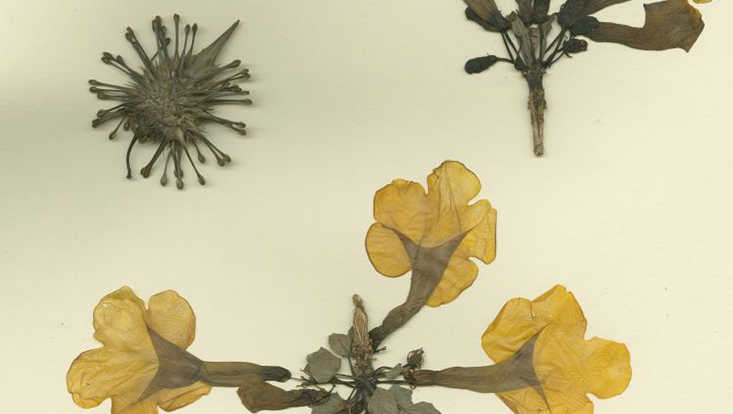
Photo: Herbarium Hamburgense
A dried specimen of the species Uncarina ihlenfeldtiana from the sesame family that was collected in Africa is also available in dried form in the herbarium at the University of Hamburg and can be borrowed by researchers.
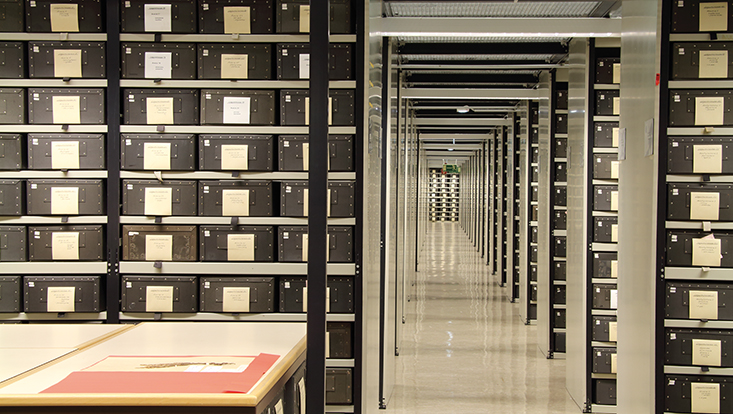
Photo: Matthias Schultz
A total of more than 27,000 boxes containing plants mounted on paper are stored in the herbarium’s stacks.
There are more than three million objects in 33 scientific collections at the University of Hamburg. Museums, institutions, and individual researchers regularly borrow some of these for exhibitions or their research. For example, the large-format Kokoschka painting—which has just returned to its original location in the University’s Philturm—has toured Europe in recent years.
The Herbarium Hamburgense at the University of Hamburg is not quite as large and well known as the painting, but is unbeatable in terms of numbers. With more than 1.8 million dried plant specimens and separate collections for large and alcohol specimens, it is an internationally significant plant collection. It documents and archives a large part of global plant diversity and is an indispensable resource for evolutionary and biodiversity research. Botanists from all over the world therefore regularly borrow specimens from Klein Flottbek for their research.
Another collection at the University of Hamburg is the art collection, which is managed and curated by the staff of the Center for Collections and Museums. On request, they make selected works of art from the University’s collection available for exhibitions in Germany and abroad. Thanks to this service, paintings, sculptures, and other cultural assets that were previously little known are displayed in museums in Germany and abroad. “This gives many visitors to these exhibitions the opportunity to engage with the University’s works of art,” says René Rackow from the Center for Collections and Museums.
Before the painting Thermopylae oder der Kampf um die Errettung des Abendlandes returned to Lecture Hall D in the Philosophenturm on the Von-Melle-Park campus in October 2025, this triptych by the famous artist Oskar Kokoschka had also been on a small European tour in the past few years. In 2018, it was exhibited at the Kunsthaus Zurich and a year later at the Leopold Museum in Vienna. In 2021, there was even a request from the Musée d’Art Moderne in Paris to borrow the painting for its exhibition Oskar Kokoschka. Un Fauve à Vienne. According to Rackow, “This shows how important the works owned by the University are and how highly they are regarded by international museums.”
At the same time, the historically significant Image Collection on the History of Astrology and Astronomy designed by art historian and cultural theorist Aby Warburg can be viewed in its entirety for the first time in Hamburg this year in the Planetarium’s large Kesselsaal. The collection shows how people used to view the stars and the universe—and how this has changed over the centuries.
One particularly sought-after work from the University of Hamburg’s art collection is the Wissmann monument, which serves as a symbol of German colonial history. This bronze statue weighing almost 500 kilograms was created by sculptor Adolf Kürle and shows Hermann von Wissmann in his role as colonial governor of German East Africa. It was completed in Germany in 1909 on behalf of the German Colonial Society and shipped to Dar es Salaam in the then colony of German East Africa, now Tanzania, where it was installed. After Germany lost its colonies to the Allies at the end of the First World War, the monument was returned to Germany by the British Empire in 1921.
In 1922, it was installed next to the Main Building of the University of Hamburg, which was founded in 1919 and previously housed the Hamburg Colonial Institute. There was considerable political controversy surrounding the statue at the time of its dedication, as Wissmann had been involved in the violent suppression of resistance movements. The first public protests against the monument began in 1961; in 1967 it was toppled from its pedestal by students and was not reerected after a second toppling in 1968.
Today, the bronze figures are managed and professionally stored by the university. In the wake of a growing social awareness of the historical consequences of colonialism, German museums have increasingly focused on the topic in recent years. For this reason, the University of Hamburg loaned various parts of the Wissmann monument to several museums between 2017 and 2025, including the Deutsches Historisches Museum Berlin, the Bundeskunsthalle Bonn and, most recently, the World Cultural Heritage Site at the Völklingen Ironworks. Next year, part of the monument will once again be on display at the Museum Ludwig in Cologne in the exhibition Along the Color Line: Perspectives of a Transatlantic Modernity from 3 October 2026 to 7 March 2027.
“Museums are dependent on loans,” says Dr. Antje Nagel, head of the Center for Collections and Museums Unit. “Keeping objects to loan to museums is therefore part of our strategy. This is, so to speak, a form of cultural promotion on our part and also brings the University into the public eye.” Knowledge about the nature and circumstances, the historical contexts, or even contexts of injustice in which the objects entered the University’s collections is taken very seriously, according to Nagel: “In recent years, museums and collections have increasingly focused on the history of ownership and origin of objects.” The University is also bringing this topic to the public, for example, in the collaborative project on human remains in school collections.
The scientific collections at the University of Hamburg, the Leibniz Institute for the Analysis of Biodiversity Change (LIB) and the State and University Library Carl von Ossietzky (SUB) can be explored and viewed online at FUNDus!, the research portal provided by the University of Hamburg.