
Newsroom
Newsroom
10 August 2026, by Brüggen/Red.
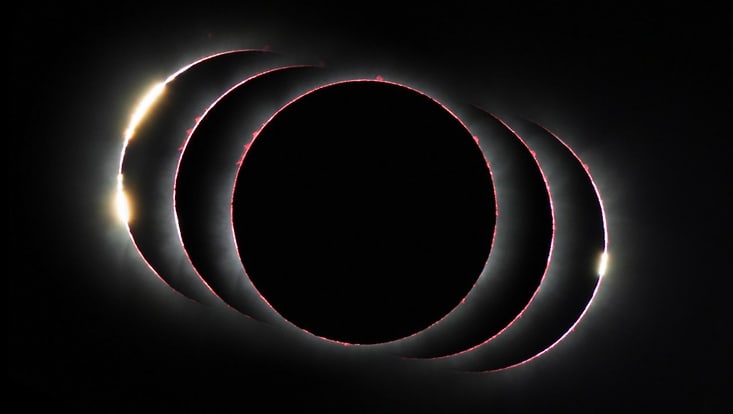
Photo: P. Horálek/ESO https://www.eso.org/public/germany/images/eso1822g/
On the afternoon of 12 August 2026, the Moon will pass in front of the Sun – and for a few minutes, some parts of Europe will become as dark as twilight. It will be the first total solar eclipse to reach mainland Europe in almost three decades, an event that will prompt millions of people to look up at the sky together. Prof. Marcus Brüggen, a researcher in the Cluster of Excellence “Quantum Universe” at the University of Hamburg, explains the phenomenon.
Professor Brüggen, what exactly happens during a solar eclipse?
The Moon orbits the Earth, and once a month it passes between the Earth and the Sun – this is the new moon. Most of the time, it passes slightly above or below the Sun, because its orbit is tilted by about five degrees relative to the Earth’s orbit around the Sun. Only when the Earth, Sun and the new moon are precisely aligned does the Moon cast its shadow on the Earth.
Anyone standing in the Moon’s umbra experiences a total solar eclipse: for a few minutes, the Sun’s dazzling photosphere disappears completely behind the Moon, the sky darkens, stars and planets become visible, and around the black disk of the Moon, the otherwise invisible corona – the Sun’s outer atmosphere, which reaches temperatures of millions of degrees – appears as a shimmering halo of rays. This spectacle is possible only because of a cosmic coincidence: the Sun is about 400 times larger than the Moon, but also about 400 times farther away. As a result, the two appear almost exactly the same size in the sky.
Can the solar eclipse be observed from Germany?
Germany will not be within the Moon’s umbra this August. Depending on the location, the Moon will cover around 85 percent of the Sun’s disk in some parts of the country, for example in northern Germany, and just under 90 percent in southern Germany. This is impressive, but surprisingly difficult to notice in the sky: even with 90 percent of the Sun covered, it will remain bright, because even a narrow crescent of sunlight provides enough illumination. Nevertheless, anyone planning to observe the eclipse should obtain certified eclipse glasses – looking directly at the Sun is dangerous.
Those who want to experience the full drama of totality – the darkened sky, the corona and the drop in temperature – will have to travel to a narrow strip of the Earth that stretches across Greenland, western Iceland, northern Spain and the Balearic Islands. In cities such as Bilbao, Burgos and Zaragoza, totality will last just over two minutes.
What makes this solar eclipse special?
The Moon’s umbra will reach mainland Europe for the first time since 1999 – and it will pass over Spain for the first time since 1905.
In addition, the Sun will already be low in the sky during the eclipse in the late afternoon – only a few degrees above the horizon in Spain. This will give the event a particularly striking quality of light, but will also make observation challenging: only locations with a truly unobstructed view to the west will be suitable.
Thirdly, the eclipse will occur almost at the peak of the Perseid meteor shower, creating a double celestial spectacle within a few days.
Do solar eclipses have any significance for astronomy?
Absolutely. Because the solar corona is visible to the naked eye only during totality, eclipses were the only way to study it for centuries. In 1868, researchers discovered a previously unknown spectral line in the spectrum of the corona. It came from a new element, which was named “helium” after Helios, the Greek god of the Sun, long before the element was detected on Earth.
During the eclipse of 29 May 1919, stars near the eclipsed edge of the Sun were photographed, demonstrating that their light is slightly deflected by the Sun’s gravity. This provided the first major experimental proof of Albert Einstein’s recently formulated General Theory of Relativity, catapulting him to worldwide fame.
Didn’t the Hamburg Observatory at Universität Hamburg also play a special role in the study of solar eclipses?
That is correct. As early as 1860, astronomer George Rümker travelled to Spain’s eastern coast near Castellón to observe an eclipse – precisely in the region through which the Moon’s umbra will pass again in 2026. And under the leadership of its then director Richard Schorr, a team from the Hamburg Observatory travelled to Souk-Ahras in what is now Algeria for the solar eclipse of 30 August 1905 to photograph the corona. At the time, the researchers were particularly interested in investigating the then-unsolved “coronium mystery” – the supposed discovery of a new chemical element that was later identified as highly ionized iron.
And what about today? Does the solar eclipse have any significance for you as a scientist?
Even today, eclipses still provide astronomers with valuable data, for example on the fine structure of the corona or for calibrating instruments, although modern coronagraphs and space telescopes can now observe the solar corona at any time.
My own research, however, focuses on the radio astronomy of very distant galaxy clusters and on simulations of turbulent, magnetized plasmas – such as the hot, tenuous gas between galaxies in galaxy clusters. Observations with radio telescopes such as LOFAR and MeerKAT, combined with sophisticated simulations on high-performance computers, help us understand how magnetic fields and turbulence shape these cosmic plasmas. Ultimately, the solar corona is also a magnetized, turbulent plasma – just a thousand times closer and millions of times smaller than the structures I usually study.

