Newsroom
Newsroom
7 January 2026, by Claudia Sewig
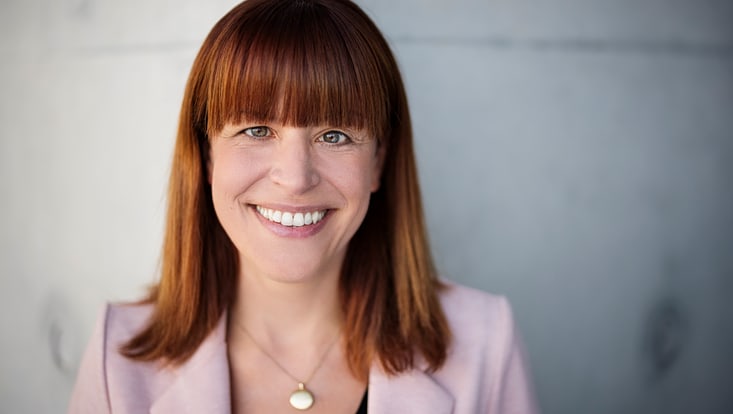
Photo: Tobias Koch
Dr. Julia Reuschenbach, one of the University of Hamburg’s first senior lecturers, joined the Faculty of Business, Economics and Social Sciences on 1 December 2025. She feels her role comes with various privileges and also sees the need for academics to go public.
“Most people do not have a clue what the term senior lecturer means at first—it just sounds fancy,” says Reuschenbach and laughs. Joining the University of Hamburg when the winter semester was already up and running, she started teaching right away. Reuschenbach quickly bought 2 potted plants for her rather bare office during a lunch break in mid-December.
“When explaining my position I usually compare it to what used to be called an academic counsel. In other words, a position below a professorship, but with the privilege of a permanent contract and a very high teaching load.” What is special about being a senior lecturer, is that instead of being assigned to a specific professorship or a specific job, like counsel positions in the past, I am working within a central structure for the department. “This is still completely new and rather unusual to most academics—including myself,” says the political scientist.
The Faculty of Business, Economics and Social Sciences hired 2 senior lecturers by 1 April 2025: All faculties at the University of Hamburg may follow suit. Teaching is a key responsibility, hence the job title “lecturer.” The job also includes independent research and organizational duties. Pursuing one’s own a professorship remains always an option— it is what Julia Reuschenbach is doing as well.
After studying political science, sociology, and history in Bonn and Berlin, Reuschenbach worked as a research associate in various research areas, most recently as a postdoctoral researcher at the Otto Suhr Institute of Political Science at the Center for Political Sociology of Germany at Freie Universität Berlin. My main focus is on political parties and election research, political communication, and thus on democracy as such. I also focus strongly on political approaches to history and political education and have longstanding experience in extracurricular educational work outside academia. I have been a bit of a globe-trotter, examining dictatorial processes, memory of migrant societies, and the political instrumentalization of history—most recently doing managerial work and, before that, educational work with school classes, among others,” says Reuschenbach.
All of this is shaping her current teaching approach at the University of Hamburg, but in a novel way: “I am not just a senior lecturer for political science, but rather for social sciences with a primary focus on teacher training. Most of my students are teacher training students, says the researcher. Her 5 exercises for general studies training in primary school cover topics such as justice, inequality, climate, borders and migration. While challenging in academic respect, all content is suitable for very young children according to Reuschenbach.
“I used to teach didactics in Bonn and I believe that anyone aiming to teach history or politics at school must first of all be a good political scientist or a good historian. You have to master a subject in order to work on it with young people. On the other hand, I also consider it our task to make sure teacher training students are aware of how all of this relates to teaching in schools before they begin their teaching practice period. From the very start, continuous self-reflection and a critical look at polarization, media consumption, and the attitudes related to political affiliations are key to being a teacher,” says Reuschenbach.
One of the privileges she sees in her new role is that teaching, the exchange with students, and course preparations offer food for thought on her research. “The greatest privilege, however, is that I can do research without having to worry about financing my position. The opportunity to focus on the topic rather than on funding applications is sheer bliss. Although the 25% percent of research including other tasks stipulated in my employment contract seem minor compared with 75% of teaching, they are indeed a treasure trove of ideas.”
Her largest current research project focuses on the strategic power of popular parties. Reuschenbach: “I find it very interesting—and as a citizen also very worrying—what is happening in today’s party competition. How parties make life difficult for each other, and how it is getting increasingly difficult to keep society together. I am thus conducting interviews with CDU party stakeholders.”
She is elated about the project because she feels there is a great need for qualitative research in party research. This may also relate to the rigors of qualitative research. According to Reuschenbach, you have to gain people’s trust before they are willing to talk to you about internal party matters. “Nonetheless, I think that the current situation strengthens this research area, for instance through the pensions debate and voting behavior of parliamentary groups.”
Her topics have increased her media visibility as an expert. Reuschenbach is convinced that “We need to gain much more media attention for academia’s relevant role in society.” “During corona, there was much discussion about what researchers do all day at universities, for example, and how this affects all of us. But that died down again.” She would clearly argue that academia needs to reach out to society: “We must not consider it beneath us to communicate our own work. This has a lot to do with recent developments in the face of an increasing hostility towards science, the doubting of evidence, and the jazzing up of survey data. We really have a responsibility to the public.”
Many colleagues in her field tell her that they are much sought after by the media: “There is a huge need for classification, for orientation. And I think it would be a mistake if we didn’t face up to it.” Just a few years ago, she basically expected this from all her colleagues. She has come to realize, however, that academia needs to diversify in this respect. Reuschenbach: “I wish we could all agree to make this a joint effort.”