Newsroom
Newsroom
29 July 2026, by Newsroom editorial office
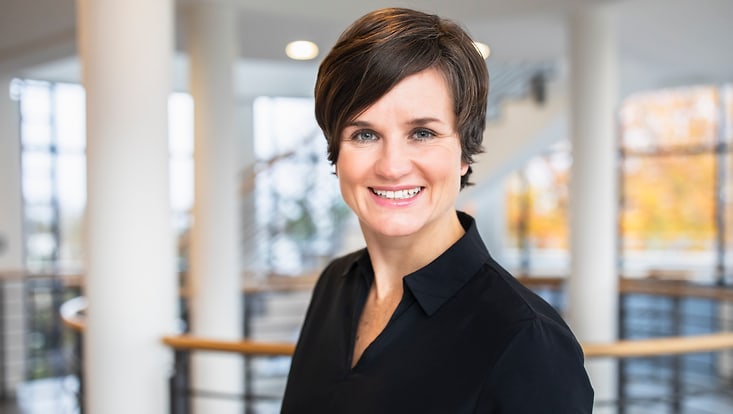
Photo: UHH/Esfandiari
In light of fake news, drastic changes in media consumption, and the age of artificial intelligence, science communication has taken on even greater importance. At the same time, however, it must be thought of in new ways in order to be effective. Katrin Greve, head of the Department of Communication and Marketing, explains how the University of Hamburg is achieving this.
This interview is part of the University of Hamburg’s 2025 Annual Report. The full annual report, featuring a wealth of information and fascinating insights, is available to read online or download.
We are living in a time of multiple crises, social tensions, and rapid technological change. Communication, particularly communication in higher education and research, plays a crucial role in this regard: it can build trust, strengthen public institutions, and firmly anchor research and ist institutions in societal discourse. To achieve this, we must equip our researchers with the necessary skills, provide guidance, and help them build resilience so that we can all respond appropriately to disinformation or skepticism toward science.
It has finally been recognized as systemically important and part of the overall strategy at an increasing number of higher education institutions. All major research-funding organizations have included mandatory standards for research communication and knowledge exchange in their calls for applications. Guidelines were also developed to foster a culture of recognition in the #FactoryWisskomm initiative, led by the Federal Ministry of Research, Technology, and Space (BMFTR). We have adapted this for our own use and incorporated it into our guiding principle.
What matters to us is that we help our researchers, starting from the early stages of their careers, to view communication and knowledge exchange as an integral part of their academic identity. Both are integral to the academic DNA of a University of Excellence and should not only be supported but also recognized in academic competition.
AI is a powerful tool for improving efficiency. In our central University communication, we already use generative tools for monitoring and for drafting texts, project plans, and PR materials. The opportunity lies in scalability and speed. In addition, AI helps us make our websites more user-friendly, which increases our visibility on search engines and—we assume—with AI bots.
In the end, however, we shouldn’t underestimate the fact that it is people who make the decisions. AI can only make suggestions; humans determine whether it achieves the desired effect. Sensitivity and responsibility are particularly important when it comes to the application of AI in the scientific and higher education sectors, because we demand thorough fact-checking and must thus provide it ourselves.
Absolutely. We definitely see ourselves as ambassadors—just like some other departments at the University—and certainly as enablers. As part of large-scale projects, such as the website redesign or the launch of the social intranet, we encourage our colleagues to use AI tools. We provide sample prompts for this purpose. The social intranet will also feature an AI-powered translation function. As is likely the case in many areas, our goal is to free up our resources from routine operational tasks so that we have more time to focus on content quality, consulting services, and personal dialogue.
More than ever! AI can generate a lot of things for us, but it cannot define strategic goals or replace personal interactions. We demonstrated this at the annual conference of the Bundesverband Hochschulkommunikation, which we hosted this year: while the welcome address in the Audimax by the president’s avatar was technically flawless and very realistic, no AI could replace the authenticity and impact of seeing the real Hauke Heekeren live on stage afterward.
It should also be noted that the more content generated by AI floods our world—especially via social media—the more important it becomes for the University to maintain a professional presence across all channels. This required expertise in key communication roles, as the system is becoming increasingly complex and fragile.
We want to keep improving our use of AI transformation and shape it in a way that gives us the flexibility to explore new formats and channels, particularly to reach a younger audience. In addition, we are expanding our interactive and participatory formats, which we have already successfully implemented through our Lab for Tomorrow at the University Museum.
And my personal goal is to further embed our president’s guiding principle—the culture of communication—strategically across all areas of the University, so that research communication also becomes a core element that is actively practiced and valued in every aspect of our University.