Newsroom
Newsroom
1 October 2026, by Kirsten/Red.
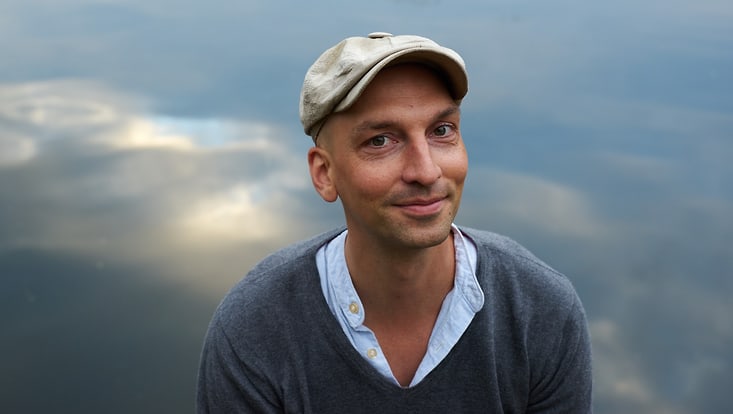
Photo: Flo Maak
Every year, numerous new researchers join the University of Hamburg. In this series, we introduce them and their fields of research. This time: film and media scholar Prof. Dr. Guido Kirsten.
Prof. Dr. Guido Kirsten came to Hamburg from the Konrad Wolf Film University Babelsberg in the winter semester of 2026/27 and assumed a Heisenberg Professorship in Media Studies at the Faculty of Humanities.
I study the transformations of découpage (scenic composition) in digital media productions. Using methods from production studies, I examine the changes in découpage and the resulting aesthetic and production-logical consequences brought about by the increasing digitization of production processes. Découpage, according to one of my main theses, is of dual significance for moving-image productions: Not only are important formal (narrative, affective, and ideological) decisions made here—such as how close we get to the characters—but découpage is also one of the most important tools for organizing and structuring production processes.
Before a film, an episode of a series, or a scene for a commercial or music video is shot, a decision must be made regarding the various angles from which the camera will capture the scene. This happens when the director and the cinematographer pore over the script together to consider how they want to tell this story through a sequence of moving images. I’m now interested in the changes this process is currently undergoing and the potential consequences of these changes.
I’m looking forward to working at the Institute for Media and Communication, where I’ll have dedicated and friendly colleagues. I’m also looking forward to getting to know my colleagues in the faculty and exchanging experiences and ideas with them. Hamburg is an interesting and diverse city that I don’t know very well yet—there’s a lot for me to discover there. The University of Hamburg has a strong research focus and has once again been designated a University of Excellence. At the same time, I’m curious to see how the current financial crisis will be managed and what impact the austerity measures will have. Of course, I hope that after a few structural adjustments, we’ll weather the storm successfully. Overall, I’m optimistic about the near future and am looking forward to working in Hamburg.
I would like to incorporate my research on issues of découpage into my teaching and knowledge transfer. In particular, my contacts with film and media professionals—whom I plan to invite to my courses—can be very helpful in this regard. In general, film screenings at movie theaters or other venues are always good opportunities for discussions that extend beyond the discipline.
In my courses, I address current research questions and phenomena: methods and topics in Production Studies, audiovisual discourses on class issues and other social concerns, 360-degree video, etc. In my classes, students can actively participate and develop their own questions and approaches.
To ensure my research remains practice-oriented, I will step outside the seminar room and offer field trips to festivals and other events.
I’ve been fortunate to have studied and worked at universities in other European countries: in France, Switzerland, Sweden, and Austria. In addition, I have contacts with institutions and research networks in many other countries and with colleagues in places like the U.S. and Canada, with whom I hope to continue collaborating in the future. For example, I plan to host a major conference on the topic of “découpage” in Hamburg. International media production will also play a role in my research.
A more precise understanding of how audiovisual media work is probably more important today than ever before. We are witnessing political campaigns on social media that, in some cases, deliberately employ targeted disinformation and AI-generated moving images. However, understanding how films, series, and other audiovisual products are produced—and what happens behind the scenes—can contribute not only to greater media literacy but also to a deeper aesthetic understanding. Ultimately, it’s always about recognizing that aesthetic forms are contingent constructs that could look entirely different. The specific meaning lies in the difference between the concrete form and its manifold virtual and latent alternatives.
(This content has been translated automatically.)