
Newsroom
Newsroom
6 August 2026, by Kütt/Red.
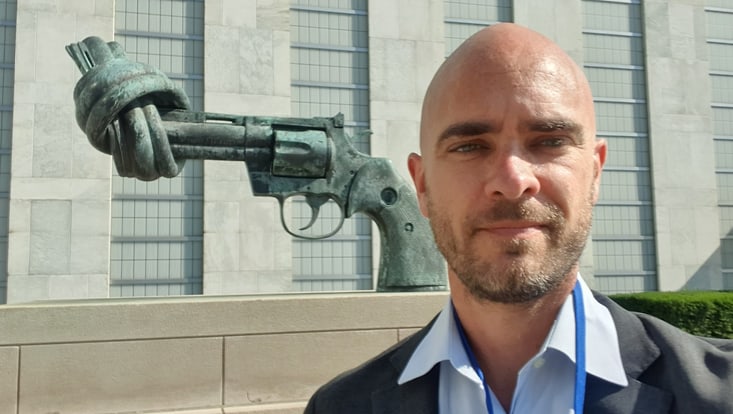
Photo: privat
Every year, numerous new researchers join the University of Hamburg. In this series, we introduce them and their fields of research. This time: Physicist Prof. Dr. Moritz Kütt.
Prof. Dr. Moritz Kütt has joined the Faculty of Mathematics, Informatics and Natural Sciences from the Institute for Peace Research and Security Policy at the University of Hamburg and has assumed a professorship in Natural Science-Based Peace and Conflict Research.
I would like to establish the Hamburg Nuclear Disarmament Laboratory (HaNDL) within the Department of Physics and at the university—both as a physics laboratory and as an intellectual hub for exchange. We conduct research on the verification of nuclear disarmament, the remediation of long-term consequences of nuclear weapons programs, and the effects of nuclear weapons. In doing so, we primarily use physical methods from particle physics: muon detection, neutron detection, gamma spectroscopy, and dose rate measurements, often in interdisciplinary research contexts.
We develop measuring devices for radioactive radiation emitted by nuclear weapons. Either to show that a container holds a weapon (disarmament), or to identify where traces of (test) explosions still remain. Our goal is to help nations find political solutions for nuclear disarmament. After all, the only physically secure protection against nuclear weapons is if there aren’t any.
Hamburg offers incredible diversity and cosmopolitanism. I’m looking forward to exciting encounters and the occasional punk rock concert in the city’s vibrant event scene. Maybe St. Pauli will even lure me back to the soccer stadium again. In terms of research: Hamburg has a long tradition of peace research—both at the university and beyond—which offers great potential for research and teaching.
I’d like to offer interdisciplinary courses in peace studies. I’m starting with a lecture series titled “Confronting the Sciences of Destruction,” which examines weapons of mass destruction, their disarmament, and the role of science in this process. Good peace research is interdisciplinary—and I’ll be emphasizing the natural sciences perspective.
In my courses, we will always address specific questions about peace and nuclear disarmament. Unfortunately, these often have a direct connection to current events. This gives students the opportunity to look beyond the boundaries of their own disciplines and explore how to successfully collaborate with students from other fields.
For many years, I have been closely associated with the “Program on Science and Global Security” at Princeton University in the U.S., currently as a visiting scholar. I also collaborate with researchers at the School of International Service, American University, U.S., the Division of Public Policy, Hong Kong, the University of Science and Technology, Hong Kong, and the Evident Lab at the University of Wisconsin-Madison in the U.S. on issues related to nuclear disarmament.
I’d like to quote a former German chancellor here: “Peace isn’t everything, but without peace, everything is nothing.” Nuclear disarmament is simply essential for sustainable peace.
(This content has been translated automatically.)

