Newsroom
Newsroom
18 August 2026, by Jürgens/Red.
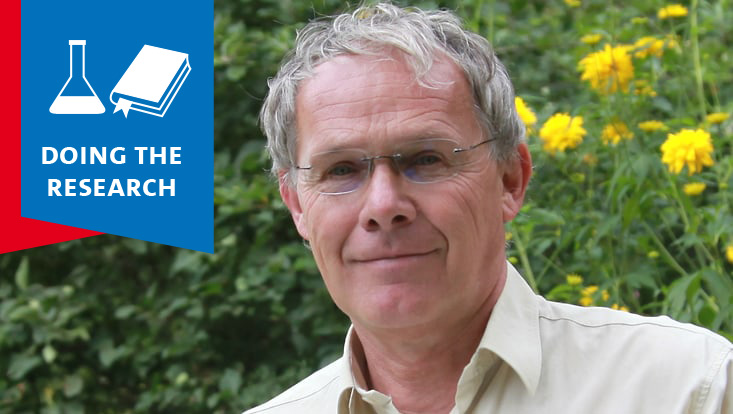
Photo: privat
The University of Hamburg is the scientific home to more than 6,200 researchers. Every 2 weeks, we offer a glimpse into their work as part of the “Doing the research” series in the Hamburger Abendblatt. In this edition, Prof. Dr. Norbert Jürgens explains the dangers that importing green electricity from Africa poses to one of the Earth's most valuable ecosystems.
In the 1930s, droughts and dust storms ravaged vast swaths of farmland in the Midwestern United States. The so-called “Dust Bowl” destroyed countless livelihoods and helped trigger the Great Depression. Richtersveld in South Africa is currently undergoing a similar climatic shift: an area on the edge of the Namib Desert that, at 10,000 square kilometers, is about half the size of Hesse.
At first glance, the area appears dry and barren. But after more than 40 years of conducting research there as a biologist, I know that this region along the lower reaches of the Orange River is a global hotspot for flowering plants. The evolution of water-storing succulent plants has created an astonishing diversity of species there. An impressive 1,000 endemic plant species grow there—plants that exist only there and nowhere else on Earth. By comparison, Germany has fewer than 50 endemic species, including the hemlock water fennel, which Hamburg residents know from discussions about port development.
In this semi-desert—the most species-rich on Earth—desertification is spreading on a scale never before observed, almost unnoticed. Ever since I first visited the area as a graduate student in 1980, I have repeatedly mapped all the plants on permanently marked monitoring plots. I have analyzed satellite images and historical photographs that I tracked down in archives and from private individuals. I have precisely recreated some of these images at their original locations. And all of these methods reveal the same alarming trend: both the number of species present and the biomass of the protective plant cover are declining.
At first, I thought that while the vegetation might fluctuate, it would eventually return to its original state after a while. But I now know that the gradual decline of the plant community began decades ago. It continues even today, after the end of the most recent ten-year drought.
The loss of species follows a pattern that is consistently similar. First, land that was once densely vegetated loses its ecologically most important species: long-lived, water-storing dwarf shrubs that cover the ground. Subsequently, short-lived, salt-tolerant species replace these plants, which are crucial to the ecosystem. This secondary vegetation cannot protect the soil from wind erosion: the fertile topsoil is simply blown away—on a scale so vast that it can even be seen from space in the form of gigantic dust plumes. What remains are vegetation-free areas that turn green again only briefly after rainfall. The change in soil properties becomes a tipping point for the decline in biodiversity.
Why is this the case? Clearly, climate change—with higher temperatures, faster wind speeds, and longer periods of heat and drought—plays a role. But it is also frustrating that the behavior of local people contributes significantly to the desert’s advance. Mining companies extract diamonds and then leave behind bare open-pit mines. Often, the goats, sheep, and cattle of herders overgraze the vegetation cover.
Furthermore, in recent years, more and more energy projects have been planned to generate green electricity, even in national parks and biodiversity hotspots. However, wind power, photovoltaic, and hydrogen facilities require extensive infrastructure: roads, pipelines, cables, buildings, solar parks, and foundations. It would be disastrous if we were to import green electricity from Africa whose production contributes to the destruction of one of the most valuable ecosystems on the entire planet.
The decision on land use, of course, lies in the hands of the countries in southern Africa. If they choose to allow industrial development in protected areas, policymakers and businesses in the importing countries should, in my opinion, help raise the standard of nature conservation there to a high level. It is in both parties’ interest to preserve this unique region for future generations.
(This content has been translated automatically.)
Prof. Dr. Norbert Jürgens is professor emeritus of plant biodiversity at the University of Hamburg. An evolutionary biologist and ecologist, he served as director of the Herbarium Hamburgense at the university and coordinated major projects aimed at addressing environmental problems and the biodiversity crisis in the countries of southern Africa.