Newsroom
Newsroom
23 April 2026, by Leininger/Red.

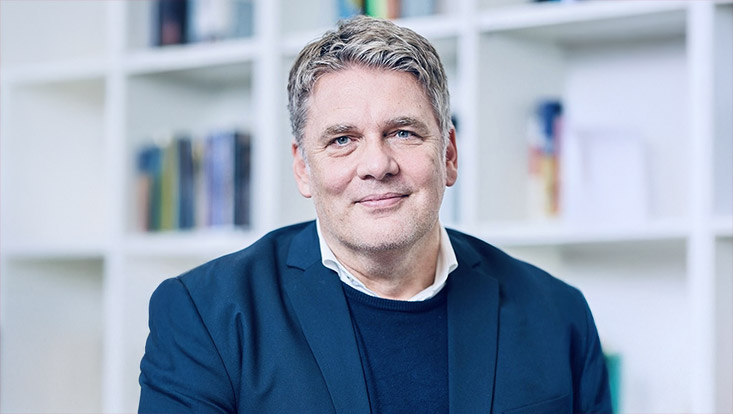
Photo: Alfried Krupp Wissenschaftskolleg Greifswald
Every year, numerous new researchers join the University of Hamburg. In this series, we introduce them and their fields of research. This time: political scientist Arndt Leininger.
Arndt Leininger moved to Hamburg from the University of Chemnitz for the summer semester of 2026 and has taken up a professorship in Political Science, specializing in methods, at the Faculty of Business, Economics and Social Sciences.
My research focuses on the intersections of electoral and attitude research as well as comparative Political Science. I am particularly concerned with the challenges of representative democracy, social divisions, and the influence of electoral rules and information environments on voting decisions. I am especially interested in the emergence of polarization, the reasons for voting for right-wing populist parties, and the question of how direct democracy procedures can complement representative democracy. Methodologically, I take an empirical-analytical approach using a broad repertoire of quantitative methods, particularly experimental designs and population surveys.
I try to understand why people vote the way they do—and why some don’t vote at all. I investigate why more and more people are voting for right-wing populist parties, whether referendums strengthen or weaken democracy, and how deeply divided society is politically. To do this, I analyze surveys and election data and try to distinguish real causes from mere coincidences. My empirical-quantitative approach to these questions means that I examine as many voters and elections as possible to identify patterns in the mass of data.
As a media hub and cosmopolitan city, Hamburg is an ideal place to make my research findings accessible to a broad public. The University of Hamburg offers me an excellent environment for my research through the Faculty of Business, Economics and Social Sciences, the WiSo Research Lab, and opportunities for collaboration, such as with the CLICCS cluster of excellence. I am particularly looking forward to working with colleagues from various disciplines and contributing to the university’s interdisciplinary research. In my free time, I would like to explore the city’s sociocultural offerings. At the top of my priority list are visits to the Millerntor and the Elbphilharmonie.
In my teaching, I want to inspire students with quantitative methods and show them how Political Science questions can be answered through rigorous analysis. Basic statistical knowledge is not only relevant for an academic career but is also in demand in many other professional fields. A basic understanding of data and probabilities is now part of the essential toolkit for informed citizens. Furthermore, I would like to contribute my experience with the nonprofit organization CorrelAid to the work of the Research Office for Social Integration (ROSI) to provide students with practical research experience.
Because methods are not a dry, mandatory curriculum, but rather the tools used to answer interesting questions in the field of Political Science and socially relevant questions. In my courses, I therefore always link methodological knowledge to current, socially relevant topics—from elections and polarization to populism. I place great emphasis on practical courses, regular feedback, and a learning environment where questions are explicitly encouraged. Methodological competence is not only valuable for an academic career but is also increasingly in demand in many professional fields.
I collaborate with researchers in various countries, both within and outside Europe. For example, I am currently working on joint studies with colleagues from the Netherlands and Switzerland. In addition, together with a colleague from Tel Aviv University, I am leading a third-party funded project on the affective polarization of political elites in Israel and Germany.
Representative democracies are currently under enormous pressure: right-wing populism and political polarization threaten social cohesion. In my research, I seek to empirically capture and analyze these developments to find answers to the following questions: What factors drive them? And what countermeasures could be effective?
(This content has been translated automatically.)