Newsroom
Newsroom
2 March 2026, by Burkhardt/Red.

Photo: Private
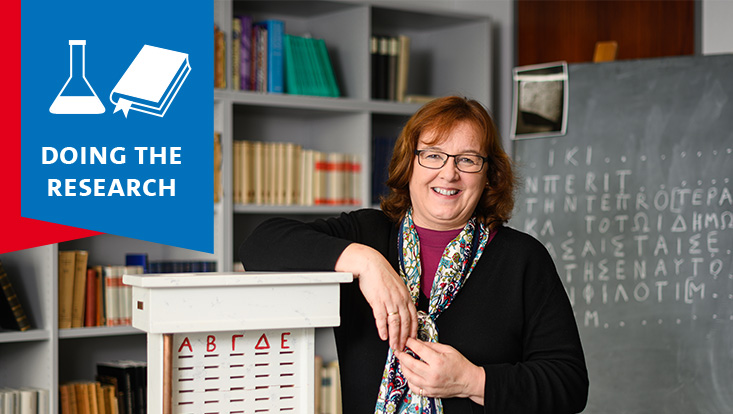
Every year, the University of Hamburg welcomes numerous new researchers. This series introduces them and their areas of research. This time: Religious Studies researcher, Prof. Dr. Stefanie Burkhardt.
Prof. Dr. Stefanie Burkhardt came to the University of Hamburg from the University of Münster in Summer Semester 2026 to commence her appointment in the Faculty of Humanities as Junior Professor with a focus on Protestant Theology: Intercultural Theology and Religious Studies.
As a religious studies researcher, my work looks at religion as an aspect of culture, and at religions in their plurality and historical interconnectedness. In particular, I am interested in the many intersections and interconnections between religion and literature, in particular in terms of individual modes of knowledge of production. Specifically, my current research projects focuses on the figures of the undead and narratives of contact with the deceased, through the lens of historical interconnectedness and comparative analysis across cultures along a key route of the transatlantic slave trade across West Africa, Central and North America and Western Europe. For me, the religions of the African diaspora and to a certain broader extent, esoteric religions are central, but figures like zombies or poltergeists have spread to broader pop culture.
People everywhere have always been preoccupied with the questions of what happens after death, whether and if there is anything after death, and whether it is possible to have contact with people after death, even though it is never possible to know for sure. That is why there is no strictly scientific body of knowledge on the subject, but many stories (e.g., ghost stories), that work through experiences, suppositions, received messages, etc. If we look more closely at these narratives, we can learn a great deal about hopes, fears, and very fundamental conflicts within societies, as well as within individual groups and people which are usually hidden beneath the surface.
I am looking forward to the proximity Hamburg provides with the larger, wider, world, both because of the harbor, but also because of the presence of people from many different cultures, both historically and now. And generally, I think the closer to the sea, the better! I’m looking forward to working at the University because there are so many colleagues working on exciting projects. I am hoping for a lot of interesting conversations and certainly any collaborations that may result.
Together with my colleagues in Intercultural Theology and Religious Studies, I would like to expand, strengthen, and actively shape the religion and literature research area, and promote international networking. In addition, I also have many ideas for further addressing Hamburg’s colonial legacy, and for communicating knowledge from the field of religious studies to the wider public. I am keen to see which ideas will ultimately be put into practice.
To look beyond our own horizons and thus gain the knowledge needed to navigate around tricky situations. Things that are unknown or strange to us can provoke fear and rejection, but also result in practices being portrayed as exotic or clichéd. Of course, both are often exploited for political ends. It is important to me that students learn critical thinking and the ability to articulate their thoughts.
I am also planning exciting excursions and projects that I hope students will enjoy just as much as me.
to think and write together, so we can incorporate more than one perspective, I see that as a central factor in conducting good research. It expands the horizon, pushes us ever on, and also, is fun!. I am in discussions with colleagues from various disciplines at many locations across the world, such as in the USA, India, South Korea, Italy, and Great Britain. Making these collaborations into permanent institutions is very high on my to-do list.
We live in pluralistic societies with people who see some aspects of the world in fundamentally different ways, but who also have many things in common. We cannot change that, but we can learn to deal sensibly with the challenges this presents, while also learning to appreciate the enrichment that diversity brings. Religious Studies can help with exactly this, by building the ability to tolerate ambiguity and deal with difference nad diversity. The literature that I draw upon in my religious studies research provides further insights into how people construct the world and reality, as into thinking in terms of opportunities that go beyond a supposedly unchangeable reality.