Newsroom
Newsroom
17 July 2025, by Anna Priebe
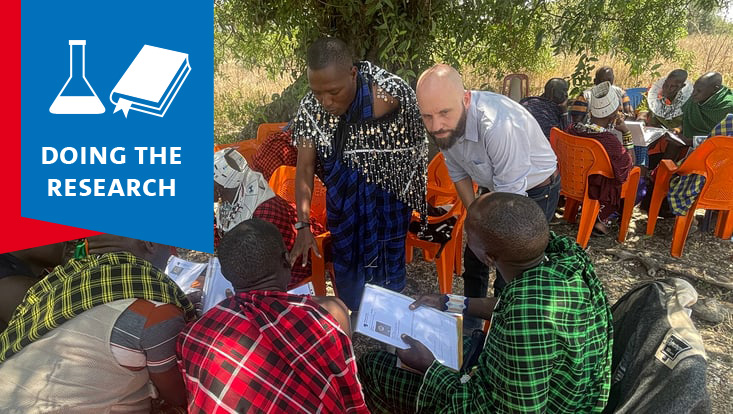
Photo: UHH/Bens
Many legal issues, for example the question of property, are regulated differently in different societies. Prof. Dr. Jonas Bens, Heisenberg Professor of Anthropology at the Department of Studies in Culture and Arts at the University of Hamburg, is investigating the conflicts that arise from such normative pluralism.
When you study law, you quickly realize that societies sometimes regulate things very differently at different times and in different places. So people will always have differing views of what is right or wrong, just or unjust. Legal anthropologists investigate this diversity of legal forms.
Over the past 500 years, a global process has unfolded in which colonialism has spread a very specific European-influenced legal regime throughout the world, what we call today ‘modern law’. These normative ideas, such as capitalist property rights, still clash with alternative legal concepts, for example indigenous legal systems. The resulting conflicts are the focus of my work.
In a current project, I am investigating property conflicts in relation to ethnographic museum collections. These often came to European museums under violent conditions during formal colonialism. The question now is whether these objects still belong to the museums today or whether—and if so, how—they should be returned.
This sounds like a straightforward enough legal question, but it is more complicated. In northern Tanzania, Germany, as a colonial power, forcibly looted many of the items in its collections. However, indigenous Maasai communities often do not see them as ‘objects’ that can or may be owned. Rather, our research shows that these belongings—such as weapons, bracelets, textiles, or tobacco containers—are understood as parts of the human body.
Such fundamentally different understandings are not that unusual. In indigenous communities in Amazonia, for example, such collection items are seen as kin members or ancestors, therefore as non-human actors with their own agency. From this perspective, property law is not the suitable framework for such a discussion. And talking about property can itself be understood as a form of colonial violence when museums start discussing restitution with these indigenous communities of origin.
Some legal systems, for example modern state law, are written into law books—even if we know that things are not always implemented in practice as they are on paper. Other normative systems mostly rely on other formats, such as oral forms. This also requires different research methods. We engage in ethnographic observations and in intensive conversations in direct contact with people to explore conflicts between these systems. At the same time, it is crucial to examine the long-term history of these conflicts and gather knowledge about their political, social, cultural, and economic context.
Legal anthropology is not just about helping people to resolve certain individual conflicts. More even than that, we want to understand and critically analyze the inner workings of conflicts more generally. By taking stock of the fact that several competing normative frameworks always play a role, we can develop an understanding of the complexity of these issues and can take this into account when seeking solutions.
By learning about others, we also learn something about ourselves
No, we want to explore the differences between people, cultures, and societies, but also what we all have in common. To do this, we look beyond the societies in which we ourselves grew up. By learning about others, we also learn something about ourselves—and something about what it means to be human.
In Germany, we constantly have conflicts about which normative frameworks should be applied. Think, for example, of the often heated debates about gender and sexuality. Conflicts like these involve fundamental normative questions: Are there only men and women or are there also other genders? As anthropologists, we know that societies have always answered these questions in very different ways.
This is also evident in topics such as migration. Are people free to decide where they want to live or are they forcibly made to stay or move from somewhere? In modern law, with strict regimes of citizenship and borders, there are specific rules, not least based on colonial logics, but these rules are by no means universal. As a legal anthropologist, I would always argue: When we ask ourselves how we can resolve our conflicts in a humane way, we have to look at humans in all their diversity and ask whether these rules only benefit the rich and powerful few, or do they also protect those who are marginalized?
In a previous research project, I did ethnographic research on the International Criminal Court. This is where war crimes or crimes against humanity can be tried and punished in those cases when national courts fail to do so. This global legal regime regularly comes into conflict with national or local normative orders. I am interested in the tensions that this creates and the role of emotions in these conflicts.
International criminal law is always a politically contested issue and is perceived as a form of colonialism, especially in Africa. Many actors there feel that the Europeans want to continue resolving conflicts according to their own rules. At the same time, marginalized people all over the world who feel ignored by their state governments often turn to these global legal systems, such as the European and Inter-American Courts of Human Rights or the United Nations Human Rights Council. This in turn leads to many governments rejecting international legal systems. That is one of the most exciting questions: Will international law as we know it today, including human rights and international humanitarian law, still exist in the future or is it eroding? This is precisely the moment when the conflict between normative orders becomes visible.
A critical legal perspective. Modern law, especially in its liberal variant, often claims universality, as in: this is how it has to be done and no other way. All other legal forms are then rejected as 'premodern'. In contrast, legal anthropology also critically decentres modern systems. We can bring this important perspective to current discussions, because legal anthropologists are used to seeing modern law as part of a larger field of normative orders rather than as a universal yardstick. This becomes particularly acute when authoritarian movements turn against liberal legal systems, as we are currently experiencing. Then it is all the more important to analyze exactly what is going on here and take a very broad perspective to ask what kind of society do we want to live in and what rules do we want to set ourselves?
Prof. Dr. Jonas Bens is trained both as a lawyer as well as an anthropologist. He received his doctorate in 2015 and Habilitation in 2021. After holding positions at the University of Bonn, the University of Wisconsin-Madison and the FU Berlin, he joined the Department of Cultural Studies as Heisenberg Professor in Anthropology in October 2024.
There are approximately 6,200 academics conducting research at 8 faculties at the University of Hamburg. Many students also often apply their newly acquired knowledge to research practice while still completing their studies. The Doing the Research series outlines the broad and diverse range of the research landscape, and provides a more detailed introduction of individual projects. Feel free to send any questions and suggestions to the Newsroom editorial office(newsroom"AT"uni-hamburg.de).