Newsroom
Newsroom
8 April 2025, by von Sass/Red.

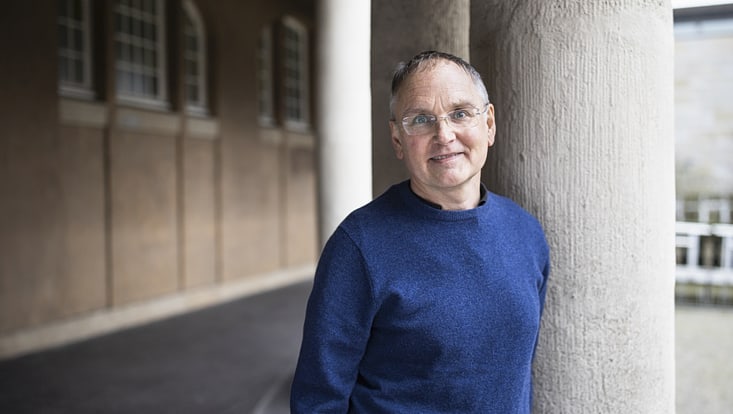
Photo: @HannahZufall
Every year, the University of Hamburg welcomes numerous new researchers. This series introduces them and their areas of research. This time: theologian and religion philosopher Prof. Dr. Hatrmut von Sass.
Prof. Dr. Hartmut von Sass joined the Faculty of Humanities as professor of systematic theology with a focus on dogma and the philosophy of religion in Summer Semester 2025. Previously, he had been at the Humboldt-Universität zu Berlin.
Normally, theology is concerned with the argumentative analysis of faith. In addition to the “what” there is also the “how,” meaning the question as to how people practice their faith.
This is what interests me, especially in three areas: the dynamic relationship between religion and emotions; faith as a distinct notion of the future; and generally, a practical theoretical model of faith with new approaches to individual practices such as prayer or communal celebration and their complex interrelationships.
The practice of faith I outlined above includes the question about to what extent faith leads to certain actions. Imagine a true believer, for whom questions of the environment and creation, and other human beings, of course, are irrelevant, and who is utterly convinced of their own views. Doesn’t this kind of conviction lead to a specific, and in this case, very different kind of conduct? While it may seem easy to answer this in the affirmative, it is difficult to determine in fact which direction this conviction might take.
We are here for our students, not the other way around. And if you believe that, you must act accordingly (see above). Imparting knowledge is not the main thing—we could let ChatGPT do that for us; it’s the discussion. It is important to me not just that we talk to each other but also to learn how to conduct a conversation; to argue; to practice intellectual empathy with other people’s views; to lead by example; to be critical, starting with yourself. That is the focus of my classes, where we really get into things.
Also, Hamburg has a philosophy-of-religion focus that we want to strengthen and make more visible. And that means getting out and involved, especially outside of the University. Kampnagel, Literaturhaus, Thalia. That would be great, and diverse!
Theology is the most wonderful field in the humanities! Theology is multifaceted and by nature a very interdisciplinary field. Whoever really wants to indulge in exchange, intellectual rigor, maybe in a good argument and intellectual challenge will, I hope, feel at home in my classes. I try to live my enthusiasm for my field and its sometimes almost strange but usually multifaceted questions; and vice versa: “my classes” are not just my classes. I am also a student, of course, and want to learn something new!
It seems obvious to highlight the variety in Hamburg between Blankenese and Wilhelmsburg, between Schanzenviertel and Harvestehude. And that’s all true! But there are 2 more reasons that are even better: With regard to the University: I attended my first university seminar here; I was about 14 and my big sister took me to a research seminar at the Philturm and everyone, including me, had to take part in the debate; now I can reconnect, so to speak, to that in my own classes. Of course, I hope to be able to say something more meaningful than 30 years ago. And with regard to Hamburg itself and my delight at being able to work here now: I met my wife here. What could be better?
Naval-gazing is a big problem in German-language theology; there is a lack of interest, for example, on English-language discourse. But I have been abroad so often and so long—most recently for one-and-a-half years in New York, that I am really interested in shifting the discourse: to name one concrete example (maybe I am giving away too much here!) ): two close, respected colleagues of mine in Paris and Oxford are also interested in a joint summer school program with students from our otherwise very different institutions. I could easily see that!
Actually, my first impulse is to resist the premise that we have to identify the “use” to society. On the other hand, it cannot be that theology and the philosophy of religion remain speechless in the face of the questions of our age.
One of the tasks and feelings of faith that has preoccupied me recently is hope, in all of its ambiguity. This is currently one topic in public discourse. It is, of course, best when whatever really preoccupies you is, so to speak, “automatically” relevant. In other words: to ponder hope when it has become so precarious. We often think best under pressure. Theologists are quite familiar with that.