Newsroom
Newsroom
21 October 2025, by Anna Walter

Photo: ESO/B. Tafreshi
A few days ago, the European Southern Observatory launched operation of a new type of instrument, the 4-meter Multi-Object Spectroscopic Telescope (4MOST), which will carry out unique sky surveys over the next five years. The University of Hamburg is involved in this milestone of the international 4MOST consortium with its Cluster of Excellence Quantum Universe.
On 18 October 2025, 4MOST captured the light of the night sky for the first time. This moment is decisive in the life of every telescope, because it marks the beginning of its scientific work. 4MOST not only creates images of the sky, but also records detailed information about the color components, so-called spectral colors, for over 2,400 celestial objects. The breakdown of light into its individual color components, known as spectroscopy, provides astronomers with information about the properties of celestial bodies, such as their temperature, chemical composition, and movement.
4MOST is located at the Paranal Observatory in Chile and is the largest instrument for spectroscopic sky surveys in the southern hemisphere. The combination of a large field of view, the number of simultaneously observed objects and the large number of simultaneously detected spectral colors is unique in the world. The powerful instrument is able to break down light from 2400 celestial objects into 18,000 color components simultaneously. By analyzing the detailed spectral colors of thousands of objects every 10 to 20 minutes, 4MOST creates a comprehensive catalog of physical parameters of approximately 30 million objects spread across the entire southern sky.
4MOST helps with research into dark matter
In this way, 4MOST contributes to a better understanding of the formation and development processes of stars and planets, the Milky Way and other galaxies, and to gaining new insights into black holes and exotic objects, as well as into the universe as a whole. “With the help of 4MOST, we also obtain information about the distribution of dark matter in the universe,” explains Jochen Liske, Professor of Observational Astronomy at the Hamburg Observatory and senior scientist at the University of Hamburg’s Cluster of Excellence Quantum Universe. “We are interested in this because the statistical distribution of dark matter in the universe allows us to draw conclusions about the physical properties of dark matter particles.”
Liske and his team have contributed to the development of the instrument over the last 10 years. The University of Hamburg contributed a total of 2 million euros to the construction of 4MOST, most of which was used to develop one of the instrument’s three spectrographs. “After the long development period, we are overjoyed that the observations are finally starting,” says Liske happily.
The Cluster of Excellence Quantum Universe at the University of Hamburg is researching the creation and development of the universe from its origins to the present day. It has long been known from astronomical observations that the gravitational force of visible matter in the universe, for example in the form of stars and gas, is not sufficient to explain their movement in galaxies. Researchers therefore assume that every galaxy is permeated and surrounded by dark matter. Quantum Universe is significantly involved in the development and implementation of experiments to detect dark matter and thus solve one of the greatest mysteries of the universe.
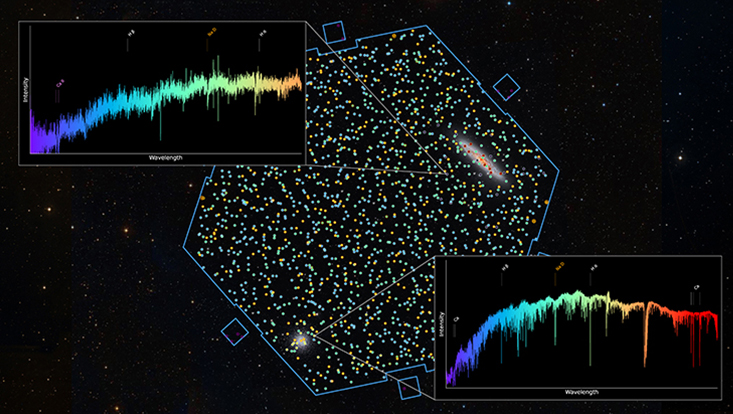
During its first measurement, 4MOST observed a large section of the sky containing two prominent objects: the Sculptor Galaxy and the globular cluster NGC288. This image shows 4MOST’s hexagonal field of view and the many objects marked with different colored dots for different types of objects. 4MOST has recorded a spectrum for each of these individual objects so that their properties, such as chemical composition or temperature, can be investigated. The figure shows an example of the spectra of two objects.
Copyright: AIP/R. de Jong, Centre de Recherche Astrophysique de Lyon/J.-K. Krogager, Background: Harshwardhan Pathak/Telescope Live
4MOST was designed and built by an international consortium of 30 universities and research institutes in Europe and Australia under the leadership of the Leibniz Institute for Astrophysics Potsdam (AIP) and is scientifically operated by the AIP. The most important institutes involved in the construction and operation of the plant include: Leibniz Institute for Astrophysics Potsdam (AIP), Macquarie University/Australian Astronomical Optics (AAO), Centre de Recherche Astrophysique de Lyon (CRAL), European Southern Observatory (ESO), Max Planck Institute for Astronomy (MPIA), Max Planck Institute for Extraterrestrial Physics (MPE), Nederlandse Onderzoekschool Voor Astronomie (NOVA), University of Cambridge/Institute of Astronomy (IoA), University of Hamburg (UHH)/Hamburg Observatory, University of Heidelberg, Center for Astronomy (ZAH).
The development and operation of 4MOST was made possible by funding from the German Federal Ministry of Research, Technology and Space, the large-scale equipment program of the German Research Foundation (DFG), and the University of Hamburg.