Newsroom
Newsroom
12 August 2026, by Claudia Sewig
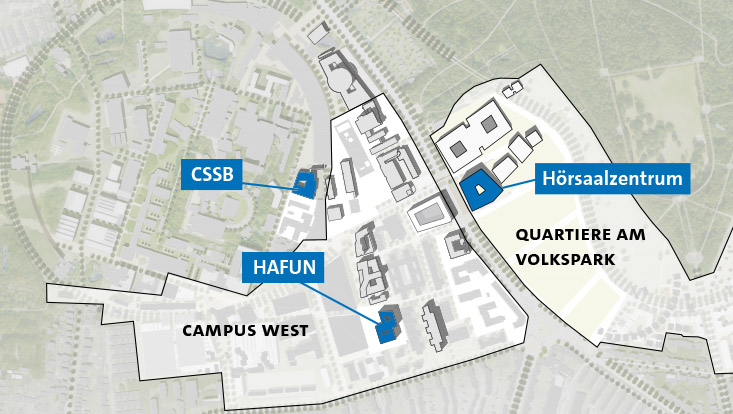
Photo: UHH/Engels
Science City Hamburg Bahrenfeld is currently Hamburg’s fastest-changing science hub. In this series, those working there will introduce, in no particular order, existing or planned research facilities at the University of Hamburg — and what makes them special. Today: the Hamburg Fundamental Interactions Laboratory (HAFUN), the Center for Structural Systems Biology (CSSB), and the Lecture Hall Center.
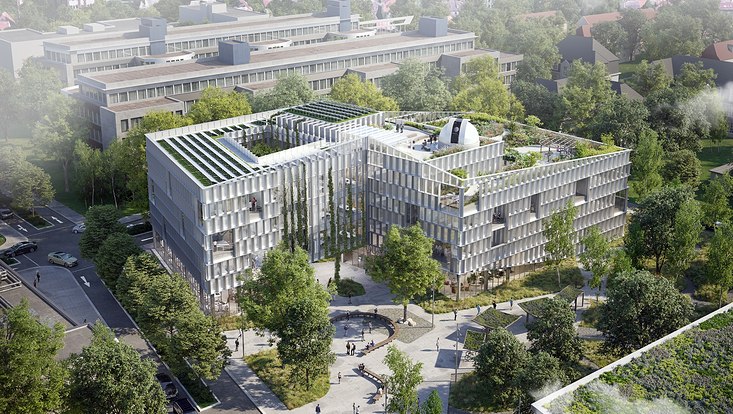
Fundamental Interactions—when a building promises this right in its name, you can expect great things. Even if some of the particles that researchers at the “Hamburg Fundamental Interactions Laboratory” will study in the future are minuscule. Around 200 scientists from the “Quantum Universe” Cluster of Excellence, as well as from the Department of Physics and the MIN Faculty at the University of Hamburg, will investigate fundamental questions in particle physics and cosmology using state-of-the-art infrastructure in the new building known as HAFUN, for which the groundbreaking ceremony took place in January 2026.
One of them is Prof. Dr. Dieter Horns. The professor of astroparticle physics is director of the Institute of Experimental Physics (IEXP). With his research group, he focuses, on the one hand, on the high energies generated in our universe within objects near black holes. And, on the other hand, on the search for dark matter—a hypothetical, invisible form of matter that does not interact with light but makes its presence known through its gravitational pull. “The two topics complement each other wonderfully, because we can search for the particles we suspect are dark matter both by observing the high-energy universe and by attempting to generate them ourselves in experiments,” says Horns.

To observe the sky above Hamburg, his team—which is currently still working in Building 68 at Science City Hamburg Bahrenfeld (SCHB)—has already set up detectors on some of the roofs there. “Everything will be much better with HAFUN because we’ll have a telescope on the roof under a dome that we can open and close as needed. Then we won’t have to crawl around on random rooftops at night anymore,” says Horns with a laugh. During the day, school classes, for example, could visit the observatory on the green roof of the new building.
That’s not the only reason Horns is looking forward to the special, 250-million-expensive new building, which is being financed by the federal government and the Free and Hanseatic City of Hamburg. Above all, it’s the possibilities offered by the seven full stories with a total gross floor area of approximately 19,000 square meters. “It’s very important to me that we don’t just conduct theoretical research, but also build experiments. In the HAFUN building, this will be possible in a very special way. On the ground floor, there will be a large hall—36 by 11 meters in floor area, with a height of nine meters—that we can use for our experimental setups,” says Prof. Horns.
Architecturally, a bright, striking façade will define the building. A transparent ground floor is intended as an interface with the public, while a central spiral staircase connects all levels up to the roof. Abundant natural light and open floor plans are designed to foster exchange, interdisciplinary collaboration, and a communicative work environment. Prof. Horns is also looking forward to this: “HAFUN is being built in the immediate vicinity of existing physics buildings at the University of Hamburg, the German Electron Synchrotron (DESY), and other research institutions. For example, this brings us closer to our colleagues at the Center for Hybrid Nanostructures (CHyN), with whom we collaborate on detector development.”
The entire research community—both locally and worldwide—will also benefit from the fact that the new research building, with its highly specialized laboratory spaces, large-scale equipment, and experimental infrastructure, will itself become a massive measuring instrument thanks to the installation of various sensors. The integrated Gravity Laboratories enable precision experiments in gravitational wave research and cosmic ray physics. In one of the laboratories, for example, a nine-meter-high pendulum will be installed on an air-suspended experimental table, opening up new and improved dimensions for researchers’ physical investigations.
Construction progress on HAFUN can be monitored via a construction site camera.
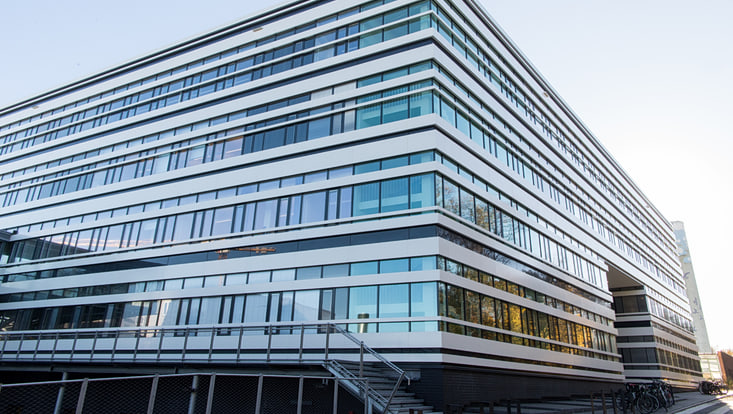
The Center for Structural Systems Biology serves as the scientific home for numerous researchers from the University of Hamburg in Science City Hamburg Bahrenfeld, even though the linear building with its large glass surfaces is not originally a UHH building. About 200 people from 39 countries currently work at the interdisciplinary center—known as the CSSB—which is a joint initiative of four universities and six research institutes in northern Germany. Whether you’re affiliated with the University of Hamburg (UHH) or the University of Lübeck, DESY or EMBL, and whether you work here as a research group leader, a early-career researcher, a technical assistant, or in a research support role—the mission is the same for everyone: to collaboratively investigate the molecular mechanisms of infections. “If we understand the structure, dynamics, and function of pathogens, we can identify targets for therapeutic interventions,” explains Prof. Dr. Kay Grünewald. “Ultimately, building on our exciting basic research, innovative medical applications can be developed, which in turn contribute to the long-term strengthening of public health.”
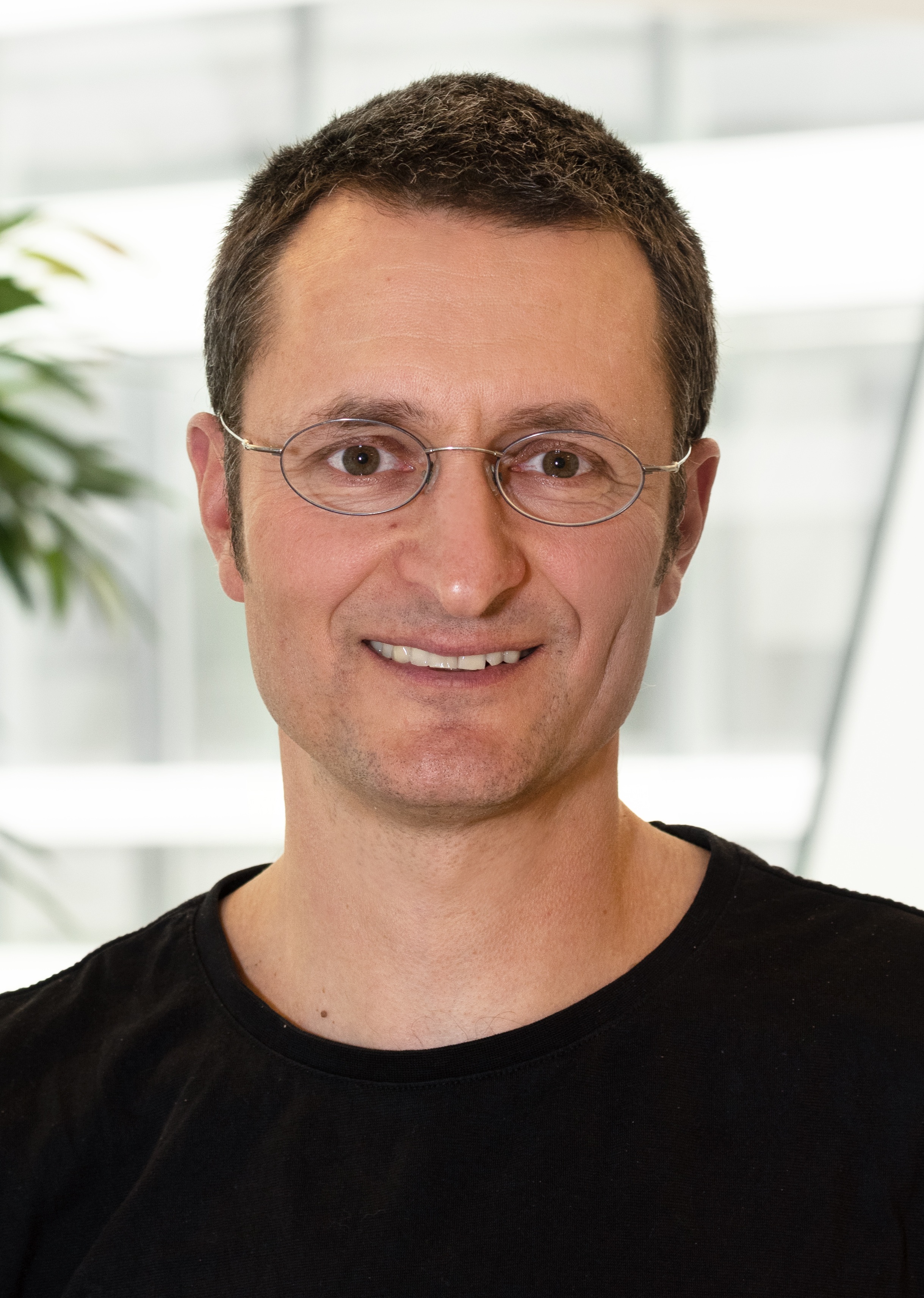
The research group leader at the Institute of Biochemistry and Molecular Biology at the University of Hamburg—who also heads the “Structural Cell Biology of Viruses” department at the Leibniz Institute for Virology—was jointly appointed to the CSSB by both institutions in 2014. He moved from Oxford to Hamburg for this position and was thus able to help plan the research center, which opened in 2017. “The concept for our building was to bring new, complementary technologies to the Science City Hamburg Bahrenfeld research campus, such as cryo-electron tomography,” says Grünewald. In this advanced form of electron microscopy, cells are frozen in a flash, creating glass-like ice. This preserves the spatial structure of all cellular components down to the atomic level. This, in turn, enables researchers to study macromolecular complexes in their natural functional environment.
While Kay Grünewald’s research group works primarily with viruses and frequently heads to the basement of the CSSB to analyze, among other things, herpesviruses, adenoviruses, bunyaviruses, and poxviruses in their interactions with host cells; other research groups, such as that of Prof. Dr. Tim Gilberger—who holds a joint appointment at the UHH and the Bernhard Nocht Institute for Tropical Medicine—have focused their research on parasites.
Bacteria, in turn, are studied by, among others, the research groups of Prof. Dr. Caroline Barisch—who holds a joint appointment from the UHH and the Borstel Research Center—and Prof. Dr. Michael Kolbe, who holds a joint appointment from the UHH and the Helmholtz Institute for Infection Research.
“It’s certainly almost unique to be able to bring together so much diverse institutional and individual expertise within a single building,” sums up Kay Grünewald, highlighting the CSSB’s successful concept: “The open and collaborative research culture that we’ve all developed together here—and that we live by every day—is truly something very special.”
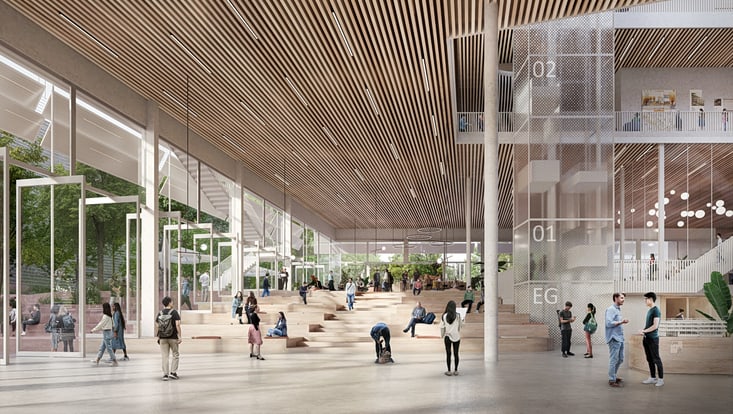
The trotting track grounds still stretch along Luruper Chaussee, directly across from the entrance to the existing research campus at Science City Hamburg Bahrenfeld. In the near future, the “Quartiere am Volkspark” will be built here, designed to integrate research, teaching, learning, and academic life with a new residential neighborhood. The architectural competition for the first building to be constructed here was recently decided: the University of Hamburg’s new Lecture Hall Center has thus been given its design.
Together with the Learning Center—which is also in the planning stages and will be built on the campus side of Luruper Chaussee—the lecture hall center will become the heart of the future learning and teaching infrastructure for approximately 5,500 students at Science City Hamburg Bahrenfeld. The calmly structured building, with its spacious, inviting foyer, will house modern classrooms, collaborative and flexible workspaces and gathering areas, as well as a cafeteria and a café. It will extend the campus axis beyond Luruper Chaussee while also making the University of Hamburg visible along this prominent street.

Jan de Wolff, Team Leader for Site Development at Science City Hamburg Bahrenfeld and Deputy Head of the Campus Development Division at the university, is also involved in planning the lecture hall center, among other things. “As architects, my team and I work together with the users to create optimal conditions for studying, teaching, and innovation. In 2019, we developed ‘learning worlds’ concepts with students, faculty, staff, and partners as the foundation for the teaching and learning infrastructure. The plans for the lecture hall center and the Learning Center were then built upon this foundation.”
What exactly can students expect to find in the lecture hall complex? A large lecture hall with 700 seats that can be used as an event space outside of lecture hours, together with the foyer. Multifunctional, flexibly configurable lecture halls and seminar rooms that will offer a high degree of flexibility thanks to their ability to be interconnected and their directly adjacent storage areas. A café with a lounge area, a cafeteria with more than 400 seats, a bike garage for 300 bicycles and parking spaces for cargo bikes, as well as a green roof with solar panels that supports the building’s sustainable design.
Jan de Wolff is pleased that work on two such important buildings for the University of Hamburg—the Lecture Hall Center and the Learning Center—is now getting underway so soon: “In this way, we are further developing the existing research campus in tandem with the neighborhood’s development toward an integrated and sustainable science district that offers an attractive environment for researchers, students, and staff and promotes innovation and knowledge transfer.”
(This content has been translated automatically.)
The Science City Hamburg-Bahrenfeld will eventually span 125 hectares in Hamburg’s western suburbs, right next to Altona’s Volkspark, a public park. Various renowned institutions, including DESY, the European X-Ray Free-Electron Laser GmbH, the Max Planck Institute for the Structure and Dynamics of Matter, and the European Molecular Biology Laboratory already form a research campus. Two out 4 University of Hamburg clusters of excellence are located here: CUI: Advanced Imaging of Matter and Quantum Universe.
And the area continues to grow. By 2040, lively residential areas, sports and leisure facilities, and shopping opportunities will supplement research, training, and businesses. A cover on the A7 expressway and the relocation of Hamburg’s racing track will allow for the construction of 3,800 new apartments and 2 schools.
The Science City Hamburg Bahrenfeld GmbH is in charge of developing the premises. Its Infocenter offers information for visitors and guided tours around the area. Every Thursday at 6 pm, there are tours for interested members of the public. You do not have to sign up in advance. The free tours start at the Science City Infocenter, Albert-Einstein-Ring 8–10. For more information, visit the website.