Newsroom
Newsroom
3 August 2026, by Anna Priebe
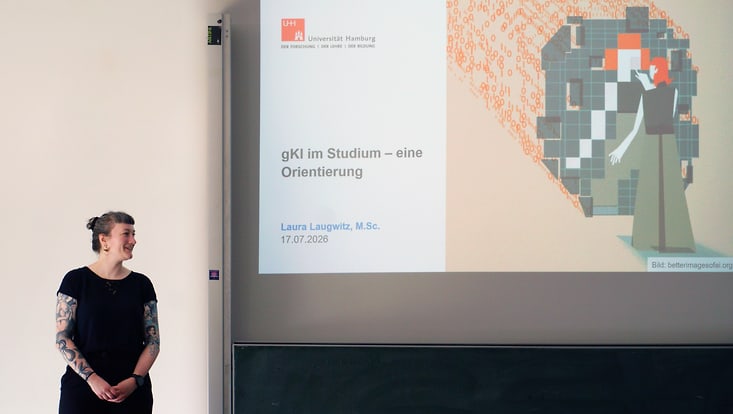
Photo: Florian Gnau
How can artificial intelligence be used in academic studies and teaching? What is permitted, and what makes sense? The 90-minute session “gKI in Academic Studies” provides a space for discussion on these questions and can be easily integrated into everyday academic life. For this initiative, Laura Laugwitz from the Faculty of Business, Economics and Social Sciences has been awarded the July Hochschulperle award.
Lecturers really have no choice but to address the topic of artificial intelligence in their courses—and especially in their exams. Realistically speaking, however, the time we can devote to teaching within the academic environment is very limited. With the gKI im Studium module, instructors incur no additional workload yet still learn the basics of AI—knowledge that is relevant not only to their own academic work but also to students’ everyday lives. In this way, they actually save time and gain a better sense of direction for their own professional development moving forward.
Since lecturers assess at the end of the semester whether—and how well—students have completed a course, a certain hierarchy exists in the learning environment. By inviting an external expert like me, who deliberately conveys AI knowledge to both instructors and students, this hierarchy can be temporarily relaxed. Everyone is a learner, which allows for a more honest exchange about understanding and using AI.
Faculty members then also share how they use AI themselves and gain a better understanding of why students do so in certain contexts. This creates a more constructive atmosphere in which solution-oriented discussions take place about how AI should or may be used within the context of a course or exam. It also gives lecturers the opportunity to make targeted adjustments to their own teaching and to equip students with the skills they need to avoid relying on AI solutions.
We’re currently starting with a playful introduction that makes the technical basics of large language models (LLMs) like ChatGPT tangible. Then we briefly discuss the guidelines—that is, what is permitted in the field of generative artificial intelligence (gAI) at the University of Hamburg and what that means for your studies. After discussing specific use cases—such as literature reviews, text editing, or brainstorming—we’ll provide a brief overview of specific academic AI tools for particular tasks. We’ll then conclude with a discussion on the societal impacts of AI, including massive resource consumption, the situation of click workers, and de-skilling—that is, the failure to acquire new skills or the loss of existing ones.
As another focus area, I’d like to expand on the topic of AI and data protection. However, I’m still struggling to figure out how to present this without making it too dry. Because we often perceive AI chatbots as very human, we reveal significantly more about ourselves to them than we would in other situations. This benefits the company providing the service, which can sell the data, but potentially harms the users. Actually, this isn’t anything new: Privacy and data protection have been discussed for decades by organizations like the Chaos Computer Club or at events like CryptoParties. But the university context and academic work aren’t, of course, the focus there. We need to develop our own expertise in this area.
To stay constructive, I’d also like to focus more on alternative AI applications: models other than LLMs, different providers, locally running applications, and systems with different optimization goals. For example, there’s the Critical Thinking Bot, a project by a doctoral student in the USA that is designed not for quick answers but for critical thinking.
Gaining a technical understanding of LLMs is the first aha moment and demystifies this technology. This allows students to assess more critically just how much “intelligence” these systems actually possess, which in turn gives them greater confidence in their own abilities. When instructors make it clear during the course that, for example, they’d rather read the potentially rough-around-the-edges ideas of real people in term papers than the generic texts produced by an LLM, it takes the pressure off students to deliver perfect results. It reminds everyone that mistakes and imperfection are important parts of learning. And that we don’t expect second-semester students to produce texts that sound as if they came straight out of an academic publication.
In particular, students are also surprised by the societal prerequisites for and consequences of AI. These are all important prerequisites for responsible use at the university—and beyond.
(This content has been translated automatically.)
The interactive 90-minute session gKI im Studium is offered by the Office for Digitalization in Teaching at the Faculty of Business, Economics and Social Sciences and is held in person. It is directly integrated into existing courses and is aimed at both faculty and students. More than 200 people have already participated since its launch in the summer semester of 2025.
Each month, the Stifterverband honors an innovative project at a university with the Hochschulperle award. In 2026, the award’s overarching theme is Future Skills 2030 – Skills for Tomorrow’s World. The Stifterverband is seeking projects that already effectively incorporate and embed future skills, thereby making an active contribution to shaping a world in transition.