Newsroom
Newsroom
7 November 2025, by Mackert/Red.

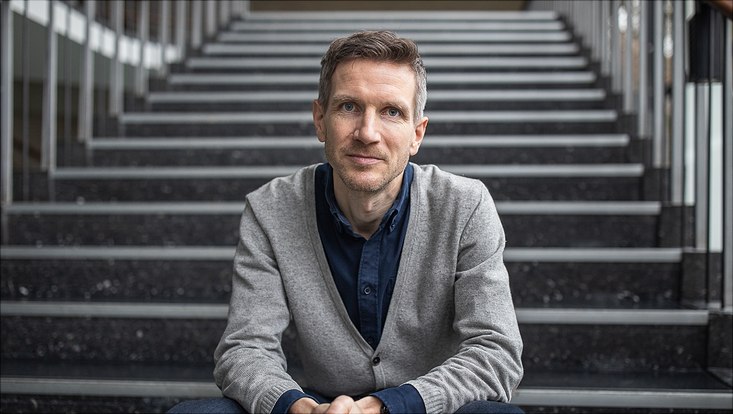
Photo: University of Hamburg / Yzer
Every year, the University of Hamburg welcomes numerous new researchers. This series introduces them and their areas of research. This time: historian Prof. Dr. Nina Mackert
Prof. Dr. Nina Mackert left the University of Leipzig and joined the University of Hamburg in Winter Semester 2025/26 to assume the professorship for North American history and public history in the Faculty of Humanities.
I research the history of knowledge and the body in the nineteenth- and twentieth-century United States in their trans-Atlantic and global contexts. I am interested in the production of knowledge for modern societies. That means I ask how knowledge emerges, how it becomes “true,” how it circulates, and its significance for societal order, power relations, and inequality. I am especially interested in the history of health, nutrition, and the environment and the way we tell this story.
I often talk to my children, who are 5 and 8, about how differently people used to think about health and food and how they understood and treated their own and others’ bodies. My mother, siblings, and parent-in-laws followed my post-graduate work for many years: a history of the calorie in the United States. I looked at how calorie counts were introduced and what the consequences were. Counting calories led firmly to the conviction that physical form and weight could be individually controlled through nutritional knowledge and that was a major condition for the development of today’s weight norms, which of course goes hand in hand with extensive social exclusion.
Hamburg is my home! I studied here—history, gender/queer studies, and political science—and I lived here for almost 20 years before I went to Leipzig for a postdoc position. It is really nice to be back, especially in the Philturm. I feel like I’ve gone back to my student days (with one major difference being that at the time, you could still smoke in the lobby). I am really looking forward to the many opportunities for collaborating with colleagues in the Department of History in all their subject variety and to new opportunities for interdisciplinary research and teaching at faculty and University levels in the fields of environment and health.
Punctually for my start in Hamburg, I am also starting my German Research Foundation network Planetary Health: Planetary Thinking in the Social Sciences and Humanities. This focuses on the challenges posed by the “planetary turn” for the humanities and social sciences, and on new approaches to a topic area that has been seen by the public as almost exclusively the domain of the natural sciences. With Planetary Health, I want to work in other collaborative projects, current or prospective, at the University of Hamburg. I am also planning a project on food security with colleagues from Hamburg, Leipzig, Amsterdam, and Munich. Nutrition, health, and the environment are topics that are suitable for the most various of knowledge exchange activities, from Wir wollen’s wissen! and public history projects to teaching, of course.
For me, studying history means primarily to cultivate curiosity and to enable students to explore their own topics independently and to reflect upon the variety of historical perspectives using a scholarly and critical approach. This is why I place such special value on working with sources. In my teaching, I combine training in modern methodologies and orientation as well as topics that are research-based and relevant for current discourse. In the upcoming semester, for example, I am offering a talk on the history the United States in the nineteenth century and an advanced seminar on the history of racial capitalism as well as a practical course on the public history of health and nutrition.
I have built up various contacts to historians in the United States over many years and which are especially important to nurture now. I especially want to conduct joint teaching projects on the history of “lifestyle diseases” and environmental health in the upcoming years with colleagues at Temple University in Philadelphia, the American University in Washington, D.C., and the UC Davis. Together with Caroline Meier zu Biesen, who does research on global and planetary health at the transdisciplinary Athena Institute of the Vrije Universiteit Amsterdam, I applied for the above-mentioned German Research Foundation grant; in the coming years, I will work with scientists and scholars from various universities in Europe, the US, and South Africa and initiate new projects.
A quick glance at the newspapers is enough to reveal how important it is to study North American history and to turn a critical eye on their own public narratives. They are having existential discussions about democracy. And for current debates on the climate catastrophe, the question about the link between knowledge (of health and the environment) and societal order is vital. This adds the urgently needed perspectives of history and the humanities to the natural science perspective and opens new debates about colonialism and global inequality, modernity, extractivism, and about whose voices are heard. Overall, historical perspectives can call into question things we currently take for granted and ostensibly unchangeable physical and social conditions. This makes it possible to shape the present and the future democratically.