
Newsroom
Newsroom
18 July 2024, by Anna Priebe
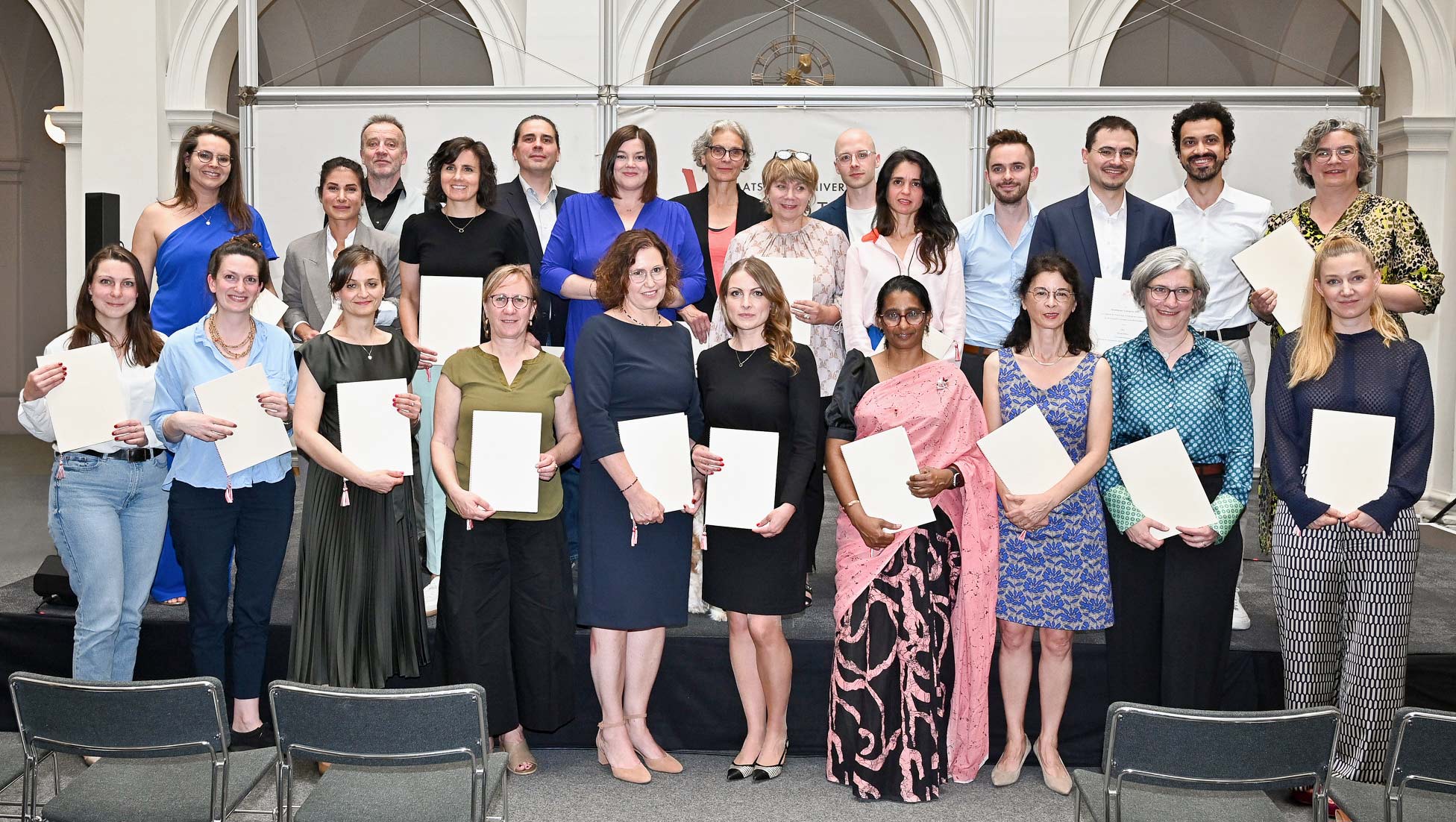
Photo: BWFGB/Kirstin Hammerstein
This year’s awards took place on 16 July 2024 in the Hamburg Town Hall. A total of 13 teachers from the University of Hamburg were recognized for their outstanding seminars, modules, or exercises.
The Ministry of Science, Research, Equalities and Districts awards this prize, each worth €10,000, for engagement in teaching and innovative teaching and communication methods. What makes this seminar special because students nominate the candidates. Students also choose the winners together with an internal university jury. This is designed to foster open discussion between teachers and students regarding the nature of good teaching.
Prof. Dr. Natalia Filatkina, vice president for studies and teaching at the University of Hamburg: “I am delighted that we once again were able to honor outstanding teachers at our University with the Hamburg Teaching Prize! The prize-winning classes are exemplary of the great commitment, technical expertise, and didactic quality our teachers bring their important task. Excellent teaching is the foundation of the excellent research for which we stand at the University of Hamburg. And our teachers display exactly what we envisage when we speak of excellent teaching: innovative, at times, interdisciplinary teaching formats that inspire a thirst for knowledge in our students, and prepare them not only for their future careers, but also to tackle social challenges. I would like to sincerely thank the prize winners and congratulate them for their fantastic achievements!”
Award-winning courses: Bachelor module, Foundations of Operations Research
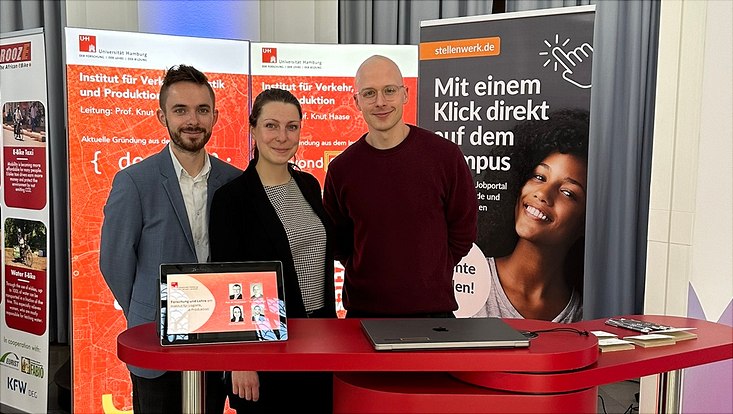
The module is the result of many years of work, under the leadership of Prof. Knut Haase. Our primary goal was always to build a module that would also have spoken to us when we were students. Content-wise, it is about finding mathematical solutions to complex logistical problems. As part of the course for example, we deal with transport issues, as well as calculating the shortest possible routes within networks, or optimizing schedules in comprehensive projects.
One of the first challenges we could remember from our time as students, was studying intensely before exams. Or faculty introduced a web-based exam training platform in 2016, on which students receive tasks in two-weekly blocks, which, if they were solved correctly would provide bonus points for the exam. The unique selling point: The blocks operate on a cycle, with one block ending as the next begins. For students to get all the bonus points, they have to constantly revise their material throughout the semester. The platform is now a fixed component of our module.
The exercises have also been restructured, to make them more interactive and flexible. Now, the there are videos laying out the working for the individual tasks which can be accessed on the digital learning platform, OpenOlat. Students can then comment under the videos, and enter into conversation with the tutors and with other students.
We also have in-person discussions, in which students solve additional tasks, and present them to other students. Students can also earn bonus points here, if they have the confidence to present their results—regardless of whether or not they are correct. Then the results are discussed. This way, mistakes are not punished, but serve instead to valuable exchanges of information. Basically, students should have fun with the subject, and participate continuously throughout the semester, even if it seems that the workload is higher than for other subject.
Dr. Tobias Vlćek: For me, good teaching is communicating knowledge as equals. A lot of content, that seems obvious to us after years of teaching it, can be complicated on first glance for students. To communicate this content well, it would be explained simply, and demonstrated using examples. That is why dialogue must be open, with no questions deemed wrong or silly.
Simon Rienks: Students, particularly bachelor’s students, often ask “What do I need that for?” It’s a question that a teacher should always try to answer, to highlight the relevance of the material, but also to spark their interest. If you can’t answer that question, even if the topic has long been part of the curriculum, it should be removed from the program. I also believe that students want and need to be challenged. The harder the content seems to be, the more energy needs to be put into its communication.
Fiona Sauerbier: Firstly, it needs to spark interest and enthusiasm for the content, which is often challenging, particularly for fundamental subjects that rarely seem that interesting. It is also important to communicate complex information in such a way that it is easy to understand, without obscuring the depth and complexity. For me, there is nothing more boring than “just” learning something off by heart, only to forget it the moment the exam is over. An other important point for me is that every participant feels at home, so we create a space in which everyone can ask any questions, and is happy to come to lectures and tutorials.
Award-winning courses: Holocaust and National Socialism in General Studies in Primary Education.

Our seminar deals with the Holocaust and National Socialism in primary education and the relevance of the subject for primary school children to learn about history and politics. Students of the course explore how to develop a successful age-appropriate approach to the subject. The seminar picks up on relevant topics from the world of primary school students, such as war and peace, and offers suggestions for teaching basic concepts. It is about making students aware of current topics and discussions, and to encourage them to bring them into their teaching.
We present a broad range of exemplary approaches and methods to historical and political learning in general studies, some tested in practice, and reflect critically on them. We place particular emphasis on collaboration with experts from practice and research, to allow for a multi-perspective and comprehensive perspective on the complex topics and encourage dialogue and discourse. We have also involved other people from the field of monument pedagogy, allowed for insights into teaching practice, and invited teachers to come in and discuss.
Additional important aspects for us include the local reference and learning using biographies. Among other things, we have also looked at places of remembrance, such as the Stolpersteine and the Children of the Bullenhuser Damm Memorial, and integrated biographies in the context of children’s literature and interviews with contemporary witnesses. In addition, digital media was actively incorporated into seminar work, with students creating podcasts and explanatory videos. Approaches using autobiographical reflection were also integrated to maximize the benefits for professional development of future teachers from of the diverse impressions from the seminar. Reflection on these diverse experiences allows students to become aware of and critically reflect on their own ideas, approaches, and conduct.
Close cooperation between students and teachers is an important part of the seminar design and makes it possible to take up (research) questions, points of discussion, and students’ subject needs for use in structuring the seminar.
For us, good teaching is characterized by a range of aspects. It is important for us to create a learning environment that is multi-perspective, communicative, cooperative, and interactive. An interdisciplinary orientation is equally important for us, as is a project and practice oriented approach that makes knowledge transfer possible. The interlinkage of theory, empiricism, and practice, as well as the involvement of current academic discourse are essential to ensuring grounded learning.
Creating transparency in relation to the expectations and goals of the seminar is important to provide students with a clear direction. A positive reflection and feedback culture also supports an ongoing learning process and the design of participative learning and teaching enables active involvement, creates space for student’s own ideas and discussions, and supports close collaboration between students and teachers.
One of the main considerations is how to pass on our enthusiasm for the subject and encourage students to engage with it in a sustainable way. A holistic approach allows students to develop professionally and didactically, as well as personally.
Award-winning courses: Interpreting for People with Special Needs, and Interpreting in Theater Settings
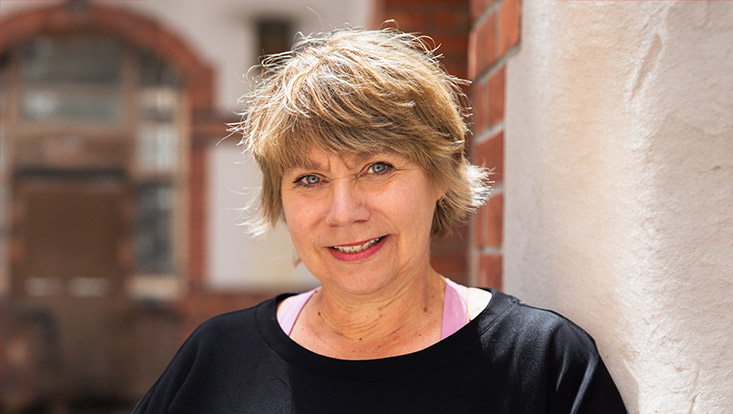
My courses in the sign language interpreting degree program deal with interpreting in different situations and for various target groups.
I offered the Interpreting in Theater Settings seminar in Winter Semester 2023/24, and translated script for the fairy tale Rumpelstiltskin into German Sign Language with a very motivated group of students. The Ohnsorg Theater gave us the invaluable opportunity to provide simultaneous interpretation of the dialogue we had established and rehearsed for the audience over 4 performances.
On the one hand, the seminar teaches skills like terminology, team work, intention of the roles, and audience-appropriate translation for a younger audience. On the other hand, the students are all still in training and are expected to perform on stage in front of an audience at the end of the seminar. That requires courage and stage presence in their roles. This required rehearsals outside of the seminars, which opened up a lot of space for open questions, that gave them the opportunity to be better prepared for the performances.
Overall, it is very important to me to involve and motivate all students equally and to give them strength and self-confidence. This also applies to the Interpreting for People with Special Needs course, which focuses on strategies for a range of difference target groups. This means interpreting for people such as seniors, people with cognitive disabilities, or people who did not grow up with German Sign Language.
For me, good teaching means catering to individual seminar participants and their specific needs and meeting the students at their level. Communicating the techniques and strategies is very oriented to professional practice, and teaching is varied. It is also important to me to build up the courage to make mistakes. This includes being willing to learn from mistakes, and seeing them as an opportunity for professional development.
Award-winning courses: Emergency Treatment of Chest Pain and Emergency Treatment of Acute Respiratory Distress practical course in the cross-sectional area of Emergency Medicine

Psychosocial skills, the “non-technical skill” (NTS) play a decisive role in medical care. We have developed a comprehensive, multimodal approach to teach these skills successfully, which has been examined in multiple projects. It was our goal to measurably improve our students NTS. We used the simulation-based teaching units on respiratory and cardiological emergencies that students complete in their third learning cycle.
In preparation, students received material on the standardized assessment of NTS and then had to carry out a peer-to-peer debriefing, that means, they assessed their fellow students after simulating an emergency. Students with this level of reflection show significantly better NTS than the control group. The principle, described as flipped learning, was successfully expanded using a video-based learning journal the students created in their individual learning phases.
Our approach also include group work to analyze the emergency situation together, and special entrustable professional activities (EPAs). In a 360° environment, students can go through the content of the classes at their own pace.
Good teaching is characterized by multiple central aspects of learning psychology and pedagogy. The most important principles include:
By combining these principles we create a learning environment that not only promotes the understanding and application of knowledge, but also strengthens students’ self-efficacy and motivation.
Award-winning courses: Computer Applications in Physics Parallelization and High-Performance Computing
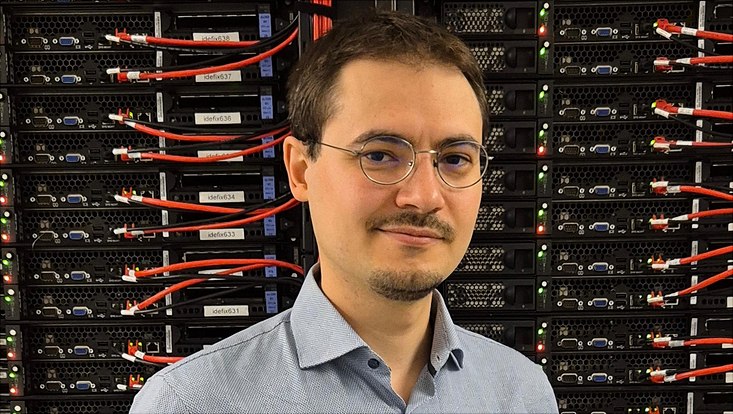
As a research associate in the PHYSnet computing center in the Department of Physics, my tasks include supporting research groups in the development of parallelized software. The lecture was developed in 2019 as a joint initiative between myself and Dr. Niklas Käming from the Cluster of Excellence CUI.
We wanted to provide practical high-performance computing (HPC) skills to students studying physics and related subjects. When parallelizing computer calculations, as many computers and their individual processor cores as possible work simultaneously to solve the same calculation. The development of parallelized software for academic calculations has long been part of everyday life both for researchers, and many people outside of research. This programming knowledge is often advantageous for students, particularly for bachelor’s and master’s theses.
Starting in 2012, I expanded the lecture together with Mohammed El-Nabulsi, who has 10 years of professional experience in commercial software development, to include concepts of efficient and collaborative programming. We attach particular value to demonstrating the advantages of program code structured according to established standards and to introducing the sensible use of large language models like ChatGPT as a programming aid. So, we developed a course making the synergies of the topics covered clear, that creates added value for students during their studies.
When students can feel the added practical value of their work, and can see the “why” and the “what for” behind what they are learning, they are exceptionally motivated and ready to work. The key to good teaching is therefore, in my opinion, continuously building on this understanding and showing students their learning progress over course of the semester.
That is why we ask for anonymous feedback from our students every week, which we use as a basis for continuous adaptation of course structure. These adaptations and the feedback is communicated transparently to the students, to make it clear they have an influence on the design of the lecture. To show ongoing learning progress, we assess the work performed on project tasks we regularly set for patients. The students’ overall assessment for the course is made up of these individual assessments.
Students rate this form of ongoing assessment as more fair than a single final exam at the end, even though it is comparatively more work, and they are actively working for the whole semester.
Award-winning courses: Internationalizing Teacher Education through Partnership in the Third Space
Future teachers must be prepared to teach in a culturally diverse and inter/transnational world. However, their professional training takes place predominantly in nationally-structured and subject-specific areas. Against this background, it was particularly important to me to include authentic and diverse learning environments into this seminar, that would give rise to problem-related discussion and reflection in international, interdisciplinary, and cross-phase interaction.
The seminar is run as part of a comprehensive collaboration between the University of Hamburg and the University of North Carolina, Greensboro (USA) and is supported as a teaching project by the Innovative Teaching and Learning Formats funding line. The central idea was to create productive links between university teaching and school practice as well as to promote international exchange in teacher training.
Through preparatory and follow-up COIL (collaborative online international learning) teaching/learning formats and mutual 10-day internship exchange visits, the focus could be set not only on international, intercultural and interdisciplinary exchange, but also on familiarizing students with the differences and similarities in (sports) teacher training, educational settings and school cultures between the two countries, reflecting on them and raising awareness of the professionally dealing with diversity among (sports) teacher training students.
Based on their own experience, students should reflect on their approaches, feelings, knowledge, and conduct to critically and constructively develop their knowledge.
Teaching for me, means taking on responsibility for learning success, and for the shared enjoyment in teaching and learning. It is important for me to create the most motivating and supportive learning environment, with an exciting innovative and knowledge-based development.
A significant part of my teaching is ensuring students learn in an open, mistake-friendly learning atmosphere, that encourages constructive discussions, the acceptance of various perspectives, knowledge-based judgment, and independence, as well as a research-based attitude are required and encouraged.
Award-winning courses: Seminar II Work and Organizational Psychology, A: Interventions in Workplace Health Promotion

For me, the relevance of the seminar content was first and foremost. Our society depends highly on functional health and social services, to ensure appropriate care and supervision. Unfortunately, the lack of specialist and management staff is becoming more acute. The goal of the seminar was therefore, to develop solutions to remedy this lack of staff. One of the main focuses was on behavioral and prevention measures for promoting workplace health. Students were tasked with independently developing and reflecting on (digital) health interventions for staff.
I wanted to provide students with content and skills they could use for their later professional practice. The academic challenge is very important for me, because this contributes to ensuring the quality of psychological counseling services in practice. My main goal is for students to contribute to improving and professionalizing psychological activities in practice and thus making them more effective.
In line with constructive alignment methodology, I also wanted to give students the freedom to acquire different skills in a targeted manner by allowing them to decide for themselves what is particularly relevant to them in their future professional practice and in which areas they expect to make the greatest learning gains.
I trust the students to regulate their learning themselves, and to be able and want to achieve good results. At the same time, I am convinced that familiarity with the skills and trust in relationships characterized by respect and appreciation, that fosters the intrinsic motivation of students, as well as their ability to act with confidence and self-efficacy.
As part of good teaching, I consider it to be particularly important to convey the relevance and use of seminar content to the students. In addition, I provide a lot of room for manoeuvre and decision-making in the choice of topics and involve the students in the planning of procedures, among other things. It is also important to provide variety in terms of tasks and methods, to expand students’ learning horizons and perspectives. I begin the seminar by clearly communicating the objectives, ascertaining students expectations, and conclude with an evaluation. In this, I made sure that the seminar content matched the students’ needs. Comprehensive feedback is a central component, both from me and between the students themselves.
Similar to the principles of agile leadership that promote health, I believe that the role of the teacher is to provide guidance, advice, support, encourage reflection and give feedback. That means that, in my view, good teaching requires the flexible application of teaching methods. In addition to research-oriented learning, elements from activity-based learning can be combined will with agile teaching principles. Reflection on the learning process is an obligatory part of teaching.
Award-winning courses: Refugee Law seminar

In my introductory course for the Refugee Law Clinic Hamburg, I taught future student legal advisors the basics of humanitarian migration law.
In designing the course, it was particularly important to me to create a safe space where everyone felt valued and open to interact with one another in an environment open to learning from mistakes. As a teacher, I want to act as an expert in the subject matter being taught, but always keeping an open space in which everyone can contribute their knowledge, experiences, and thoughts. As the participants came from different disciplines and also from very different backgrounds, this resulted in a valuable, multi-layered exchange from which I also gained a lot of inspiration.
In jurisprudence, it is particularly important to me to convey law as an abstract, neutral, thing, but as a result of a social and political negotiation. I would also like to illustrate the very specific implications of individual cases. Most students are somewhat perplexed by current migration law, as changes to the law and the application of the law are less and less oriented to protecting individual rights and the legal interests of those affected, and instead focus more on partitioning and establishing . That is why the seminar also involves reflecting critically on the current narratives in terms of migration and displacement, and approaching the subject matter from a human rights perspective using specific individual cases.
Good teaching for me involves self-reflection, not in the rigid sense, but as holistic effort by the teacher and the students, which produces an increase in knowledge and new perspectives. It should also respond to student needs within the ongoing process, and whenever possible, link seminar topics to current events.
Award-winning courses: Mathematics pre-semester course, Exercises for the Mathematics for Economic Analysis I and II lectures, Monetary Theory and Policy introductory seminar
One of the biggest problems for us as teachers is that we can’t always foresee the difficulties students may or are having, because we are so familiar with the subject matter ourselves. Particularly for preliminary courses and exercises in mathematics, I take a lot of care to meet students at their current level of knowledge.
In the preliminary course, I generally start with the basics, and explain the fundamentals of addition, subtraction, multiplication, and division. That makes sure the course is accessible to all and reduces the danger of losing students from the start. Of course, it quickly becomes more challenging, but everyone is starting from the same starting point. I also try to interactively involve the students, for example by integrating multiple-choice tasks they can answer using their mobile phones.
In monetary theory it is particularly important to me to explain the basics of our credit system. As this is a social science, we also need to compare competing views. That is why I place great value on controversial discussions. Since the pandemic, students had to watch my lectures on my YouTube channel, that keeps our time in the lecture hall free for questions and discussions. Not all students use this opportunity, but those that do are very dedicated. I see how much students enjoy arguing their ideas with me openly and without time pressure.
I think there are a lot of ways to do good teaching. The most important thing is that you are authentic and find your own style. I also believe that the following 3 points are essential for good teaching: