• Zur Metanavigation
  • Zur Hauptnavigation
  • Zur Suche
  • Zum Inhalt
  • Zur Subnavigation
  • Zum Seitenfuß
  • University of Hamburg
  • For journalists
  • Staff Service Portal0
  • STiNE
https://www.kus.uni-hamburg.de/aktuelles.json?recentnews=true
  • Institutions and target groups
    • Einrichtungen
      • Faculties

        • Faculty of Law
        • Faculty of Business, Economics and Social Sciences
        • Faculty of Medicine
        • Faculty of Education
        • Faculty of Humanities
        • Faculty of Mathematics, Informatics and Natural Sciences
        • Faculty of Psychology and Human Movement Science
        • University of Hamburg Business School
      • Services

        • Study Information Net STiNE
        • Surfmail
        • Exchange
        • Staff Service Portal
        • Learning Platforms
        • Katalogplus – Catalogue of Hamburg Libraries
        • SharePoint
      • Student facilities and services

        • Campus Center
        • Career Center
        • PIASTA
        • AStA (student council)
        • University Sports
        • University Music
        • Family Office
        • University Language Center
        • General Languages
        • Office of Affairs for Students with Disabilities or Chronic Diseases
        • Departmental libraries
        • Healthy Campus
      • Further facilities and services

        • The Cluster of Excellence CLICCS
        • The Cluster of Excellence CUI
        • The Cluster of Excellence Quantum Universe
        • The Cluster of Excellence Understanding Written Artefacts
        • Hamburg Research Academy
        • Pier Plus
        • Hamburg Center for University Teaching and Learning (HUL)
        • Hub for Crossdisciplinary Learning (HCL)
        • CEN
        • Museums and collections
        • University Archives (in German)
        • Regional Computing Center (RRZ)
        • University Administration
        • Knowledge Exchange Agency
        • The Unikontor Shop (in German)
    • Target groups

      • Prospective students
      • Students
      • International prospective students
      • Young researchers
      • Researchers
      • Instructors
      • Staff
      • Prospective continuing education students
      • Alumni
      • Journalists
      • Refugees (in German only)
    Close
  • Language
    • English
    • Deutsch
  • /en/newsroom/sitemap.json
University of Hamburg - to research, to teach, to educate and form, to homepage
Newsroom
Newsroom
  • Newsroom
  • Press releases
  • Social media
  • Videos
  • Events
  1. UHH
  2. Newsroom
  3. Campus
  4. Universität Hamburg’s youngest student

University at 16? Yes, it’s doable!Alissa D.—Universität Hamburg’s youngest student

4 December 2017, by Janine Fricke

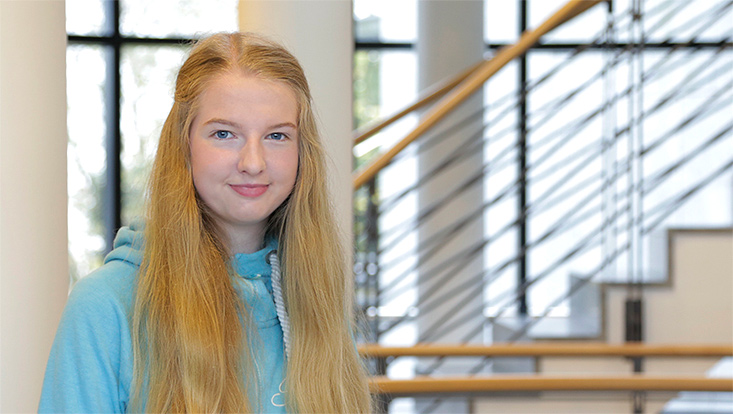
Alissa D.

Photo: UHH/Wendt

At 16, Alissa D. is currently Universität Hamburg’s youngest student.

With one year less of Gymnasium, German high school students are now younger on average when starting university. According to the Federal Statistics Office, more and more first-year students are minors when they begin their studies. Alissa D., however, is probably one of the youngest. At 16, she is studying foodstuffs chemistry and is currently Universität Hamburg’s youngest student.

“Amazing! How did you manage that?” This is the question most people ask Alissa as soon as they hear that she is already studying at a university. “It just happened that way,” says the young student shrugging her shoulders.

It was already unusual when she started school just 3 months after her 5th birthday. And it was more so that she was bumped up to 2nd grade just 2 weeks later. At 10, she skipped 7th grade and, just shy of 15, she found herself completing written Abitur exams.

Her kindergarten teachers had already suspected their 3-year-old charge might be gifted. “My mother didn’t know exactly what that meant. As far as she was concerned, I was completely normal,” says Alissa. At the standard school entrance examination when she was 4, a psychologist confirmed that she was highly gifted and strongly recommended putting Alissa in school early.

I was too young; I could only study

Her decision to begin university study was influenced by the fact that there were few alternatives. At 15 Alissa was too young to go abroad after completing her Abitur or to begin professional training. She did not want to take a one-year break, either, so she decided to study foodstuffs chemistry. “Chemistry always interested me at school. And I definitely wanted to do something practical,” she said.

The greatest challenge at the start of her studies in Winter Semester 2016/2017 was the level of university work in organic chemistry. “At the beginning I really had to cram!” A new experience for the young student. Gnerally, however, Alissa still does not have to study too hard to get good grades.

Lecture halls, labs, and stables

On a typical day, Alissa leaves the house around 7 am, attends her first lecture around 8 am, conducts lab experiments from noon to 6 pm, and then takes care of her two horses before heading home around 10 pm. She admits that it can all be a bit strenuous. Nonetheless, she doesn’t miss the carefree life of the average 16-year-old. “I don’t know if they have it any better. When I see how much my peers have to study for school, I realize that I have more time than they do, especially in the semester breaks.”

Her cats and horses also help relieve stress. “When I ride, I have a physical outlet and can be my age so that I don’t always have to be the smart or studious one.”

At the university, her age plays (almost) no role anymore

At school, her classmates always thought it was exciting to have a much younger girl in their class. The only envy she encountered was from a few parents when Alissa got better grades with less effort than their own gifted children.

At this point, most people don’t notice the age difference. For example, the participants of this year’s preparatory math course did not know that their tutor was only 16. Her age is only an issue in legal matters. “At 15, for example, I am not allowed to use a lighter, but it’s okay for me to use the Bunsen burner!” she says laughing.

First a bachelor’s, then a master’s, and then?

If Alissa graduates in the regular period of study, she will have a bachelor’s at 18 and a master’s at 20. She doesn't know what she wants to do after that. One thing is clear, however: she doesn’t want to finish faster. She’d prefer to take a relaxed approach. “And if I fail now and then, I still have a few years ahead of me.”

Latest articles

Student playing an exergame on the laptop in a lecture hall

Photo: UHH/Lorf-Stahl

24.11.2025|Campus
From Cube Ninja to City Hopper: Have Fun, Stay Fit While Studying
Whether with someone else or alone, you can have fun, and for free, with the 8 movement games in the ExerRise project designed by researchers at the Institute of Human Movement Science and their project partners. The goal is to foster student health and wellbeing on a scientifically sound basis. The...
Portrait of Prof. Dr. Nina Mackert

Photo: University of Hamburg / Yzer

07.11.2025|Campus
Welcome aboard: Prof. Dr. Nina strengthens the Humanities.
Every year, the University of Hamburg welcomes numerous new researchers. This series introduces them and their areas of research. This time: historian Prof. Dr. Nina Mackert

Last update: 28 December 2017

  • Feedback
  • Legal notice
  • Privacy statement
  • Accessibility
  • Site map

University of Hamburg

Innovating and Cooperating for a Sustainable Future in a Digital Age

  • Instagram
  • Facebook
  • Bluesky
  • YouTube
  • LinkedIn
    • Studies
    • Prospective students
    • Continuing education
    • Research
    • Teaching at UHH
    • Doctoral studies
    • Job opportunities
    • Knowledge exchange
    • University
    • Excellence
    • Faculties
    • Alumni
    • Contact
    • Campus Navigator
    • Emergencies, safety and security
    • Antidiscrimination
audit familiengerechte hochschule
Audit
HRK-Audit
System accreditation

© 2025 University of Hamburg. All rights reserved

OBVZu9