
21 April 2026
DFG FundingNew Emmy Noether independent junior research group investigates properties of quantum materials
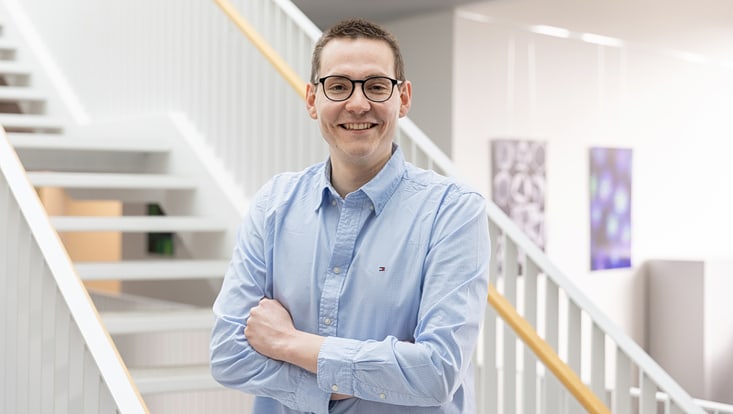
Photo: UHH/Krüger
A central focus is on understanding structure-property relationships—that is, how the underlying molecular structure of these materials relates to their physical properties. This provides a crucial foundation for the targeted improvement of existing materials as well as the development of new materials with optimized properties.
In molecular quantum materials, however, investigating these relationships is particularly difficult, as their properties are attributable to complex quantum mechanical interactions of electrons. There is broad consensus that these effects result from the collective behavior of electrons in the materials. Yet in many cases, understanding is still insufficient.
Theoretical methods are particularly well-suited here for directly investigating the underlying microscopic processes. However, the approaches currently available are not capable of describing the relevant quantum mechanical effects with the necessary accuracy.
The work of the new Emmy Noether Group at the University of Hamburg addresses precisely this issue: “Our project aims to develop novel theoretical methods that enable a reliable and detailed investigation of structure-property relationships in molecular quantum materials,” says Dr. Johannes Tölle, head of the Junior Research Group at the Institute of Inorganic and Applied Chemistry. Together with his team, he will develop these novel approaches and transfer them to efficient computer programs.
Since molecular quantum materials offer a broad spectrum of potential applications—from modern storage systems such as random access memory to lossless power grids—an accurate description would be of great significance for various economic and societal sectors.
1.3 million euros through the Emmy Noether Programme
The funding is provided under the Emmy Noether Programme of the German Research Foundation (DFG), which enables outstanding early-career researchers to establish and independently lead a research group. Approximately 1.3 million euros are available for the six-year project.
(This content has been translated automatically.)