
• Zur Metanavigation
  • Zur Hauptnavigation
  • Zur Suche
  • Zum Inhalt
  • Zur Subnavigation
  • Zum Seitenfuß
  • University of Hamburg
  • For journalists
  • Staff Service Portal0
  • STiNE
https://www.kus.uni-hamburg.de/aktuelles.json?recentnews=true
  • Institutions and target groups
    • Einrichtungen
      • Faculties

        • Faculty of Law
        • Faculty of Business, Economics and Social Sciences
        • Faculty of Medicine
        • Faculty of Education
        • Faculty of Humanities
        • Faculty of Mathematics, Informatics and Natural Sciences
        • Faculty of Psychology and Human Movement Science
        • University of Hamburg Business School
      • Services

        • Study Information Net STiNE
        • Surfmail
        • Exchange
        • Staff Service Portal
        • Learning Platforms
        • Katalogplus – Catalogue of Hamburg Libraries
        • SharePoint
      • Student facilities and services

        • Campus Center
        • Career Center
        • PIASTA
        • AStA (student council)
        • University Sports
        • University Music
        • Family Office
        • University Language Center
        • General Languages
        • Office of Affairs for Students with Disabilities or Chronic Diseases
        • Departmental libraries
        • Healthy Campus
      • Further facilities and services

        • The Cluster of Excellence CLICCS
        • The Cluster of Excellence CUI
        • The Cluster of Excellence Quantum Universe
        • The Cluster of Excellence Understanding Written Artefacts
        • Hamburg Research Academy
        • Pier Plus
        • Hamburg Center for University Teaching and Learning (HUL)
        • Hub for Crossdisciplinary Learning (HCL)
        • CEN
        • Museums and collections
        • University Archives (in German)
        • Regional Computing Center (RRZ)
        • University Administration
        • Knowledge Exchange Agency
        • The Unikontor Shop (in German)
    • Target groups

      • Prospective students
      • Students
      • International prospective students
      • Young researchers
      • Researchers
      • Instructors
      • Staff
      • Prospective continuing education students
      • Alumni
      • Journalists
      • Refugees (in German only)
    Close
  • Language
    • English
    • Deutsch
  • /en/newsroom/sitemap.json
University of Hamburg - to research, to teach, to educate and form, to homepage
Newsroom
Newsroom
  • Newsroom
  • Press releases
  • Social media
  • Videos
  • Events
  1. UHH
  2. Newsroom
  3. Press releases
  4. Pressemitteilungen 2026
  5. Arktisbrände

26 March 2026

Study using climate simulationsHuman-caused climate change fuels mega-fires in the Arctic
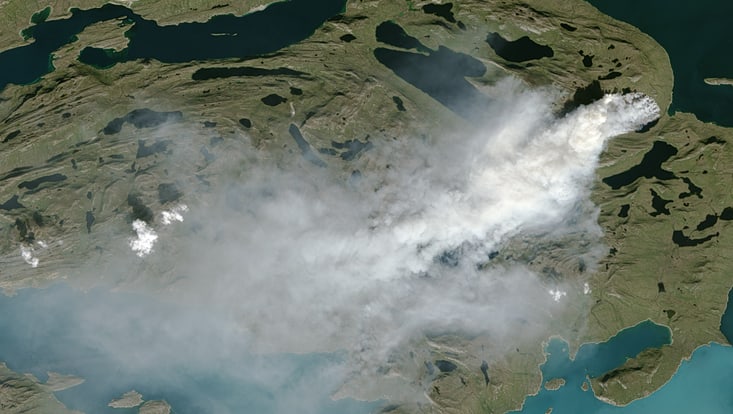
North in flames: Satellite image of a large-scale fire in western Greenland.

Photo: NASA Earth Observatory

North in flames: Satellite image of a large-scale fire in western Greenland.
The Arctic has been experiencing record wildfires for years. Lukas Fiedler, a researcher at the Earth and Society Research Hub (ESRAH) at the University of Hamburg, has now been able to demonstrate: the extreme fire years 2019 to 2021 can be attributed to human-caused climate change. His study was published in the scientific journal Environmental Research Letters.

The Arctic is not only snow and ice. Peat layers and the vegetation of the tundra and taiga provide abundant highly flammable fuel. Since the early 2000s, the extent and frequency of major fires in the Arctic have increased markedly. The years 2019, 2020 and 2021 represent a preliminary peak: in just three years, more area burned north of the 60th parallel than in the entire decade from 1990 to 2000.

Lukas Fiedler systematically investigated, as part of his doctoral research, how strongly human-caused climate change is fueling these fires. The doctoral researcher at the Earth and Society Research Hub (ESRAH) at the University of Hamburg conducted the research together with colleagues from the Max Planck Institute for Meteorology.

The result: human-caused emissions are a necessary condition for the occurrence of these extreme events. This is particularly evident in so-called fire weather—climatic conditions that determine how easily fires can ignite and spread. For 2020 and 2021, the human influence is close to one hundred percent. “An event like 2021 becomes 235 times more likely due to human-caused climate change,” Fiedler says. “The clarity of these numbers surprised even me.”

Human influence is also detectable in the size of the burned area, albeit less sharply—because additional local factors such as potential ignition sources or vegetation also play a role.

Using climate simulations, the team compared how likely the extreme fires are in a world with human influence and how likely they are in a world without it. The researchers then broke down the drivers of fire danger into their individual components. This allowed them to show that it is not a lack of rainfall, but rising temperatures and increasingly dry air that are the decisive drivers of Arctic extreme fires.

For a long time, the Arctic was considered a carbon sink, binding more CO₂ than it releases. However, recent record fires in Siberia and Canada have already released more than one billion tonnes of carbon—comparable to the annual emissions of a major industrialized country. If the Arctic tips from CO₂ store to CO₂ source, it could make climate mitigation efforts worldwide more difficult. “Instinctively, you know extremes are getting worse,” Fiedler says. “With our analysis, we can now demonstrate what humans are actually causing.”

Publication: Attribution of observed pan-Arctic extreme fire events to anthropogenic forcings

  • Press releases

  • Press release archives
  • Mailing list for the press
  • Publications
  • Information for the media
  • Contact
  • Expert Service

Queries:

Lukas Fiedler
Universität Hamburg
Earth and Society Research Hub (ESRAH)
Email: lukas.fiedler"AT"uni-hamburg.de

Last update: 26 March 2026

  • Feedback
  • Legal notice
  • Privacy statement
  • Accessibility
  • Site map

University of Hamburg

Innovating and Cooperating for a Sustainable Future in a Digital Age

  • Instagram
  • Facebook
  • Bluesky
  • YouTube
  • LinkedIn
    • Studies
    • Prospective students
    • Continuing education
    • Research
    • Teaching at UHH
    • Doctoral studies
    • Job opportunities
    • Knowledge exchange
    • University
    • Excellence
    • Faculties
    • Alumni
    • Contact
    • Campus Navigator
    • Emergencies, safety and security
    • Antidiscrimination
audit familiengerechte hochschule
Audit
HRK-Audit
System accreditation

© 2026 University of Hamburg. All rights reserved

OBVZu9