
25 March 2026
New Study in “Nature Communications”Well-fed penguins live longer but age faster—much like modern humans
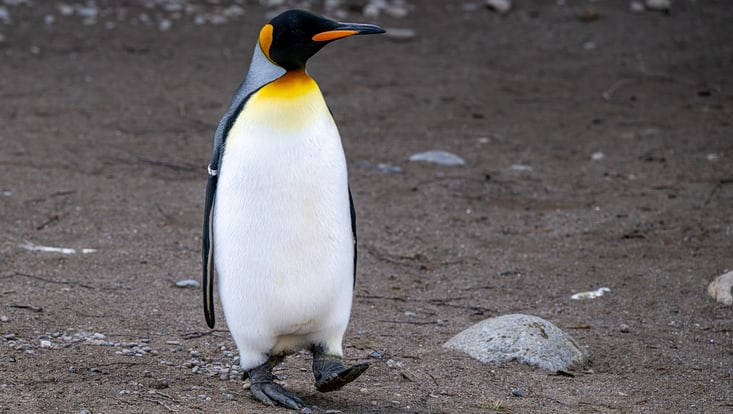
Photo: Zoo Zürich/F. Süss
Researching aging in modern societies is complex, as many factors influence it. For example, social, behavioral, and environmental aspects such as food security, progress in medicine, poverty, or alcohol consumption play a role. These diverse factors make long-term analyses difficult. However, unlike in humans, the socio-economic living conditions of king penguins have not changed significantly over the past centuries. Their life expectancy of twenty to forty years is relatively high for animals, allowing for comparisons with humans—which makes them particularly suitable model organisms.
The aim of the study, now published in “Nature Communications”, was to compare the biological and chronological ages of wild and captive king penguins. To this end, 34 wild animals and 30 zoo animals were examined. The international research team found the wild animals on the Crozet Islands, an archipelago in the Indian Ocean located between South Africa and Antarctica. The zoo animals lead a comfortable life at Zurich Zoo and Loro Parque on Tenerife with comparatively little exercise and a constant food supply—similar to humans in modern Western societies.
“It’s fascinating that modern scientific methods such as so-called epigenetic clocks, which were originally developed for research into human aging, can now also be applied to animals. This analytical method detects chemical markers on DNA that change over the course of a lifetime,” explains Dr. Britta Meyer, an evolutionary biologist at the University of Hamburg and co-author of the study.
The results of the blood analyses are clear: life in the zoo significantly accelerates the aging process in penguins. “A 15-year-old penguin in the zoo has the biological age of a 20-year-old penguin in the wild. The interesting thing is that, overall, zoo penguins still live longer,” explains the study’s lead author, Dr. Robin Cristofari of the university of Helsinki.
Zoo penguins may be in poorer physical condition than their wild counterparts, but without natural predators, Antarctic storms, and with access to veterinary care, they can live significantly longer. This means that both penguins and humans live longer in modern environments with advanced healthcare, but this does not necessarily lead to good health in old age.
The research team’s next step is to investigate what kind of lifestyle promotes not only a longer but also a healthier life for penguins. “We are currently conducting a study in which we encourage penguins to eat less and exercise more. In a world of abundance, it is important to find a moderate lifestyle—for us humans as well,” summarizes Dr. Cristofari.
In addition to the University of Hamburg, the University of Helsinki (Finland), the National Center for Scientific Research (CNRS) in France, the Zurich Zoo (Switzerland), and Loro Parque (Spain) participated in the study.
Link to the original publication: „Lifestyle change accelerates epigenetic ageing in King penguins“
(This content has been translated automatically.)