21 August 2025
Deception in the animal kingdomPraying Mantises—Mating to Death

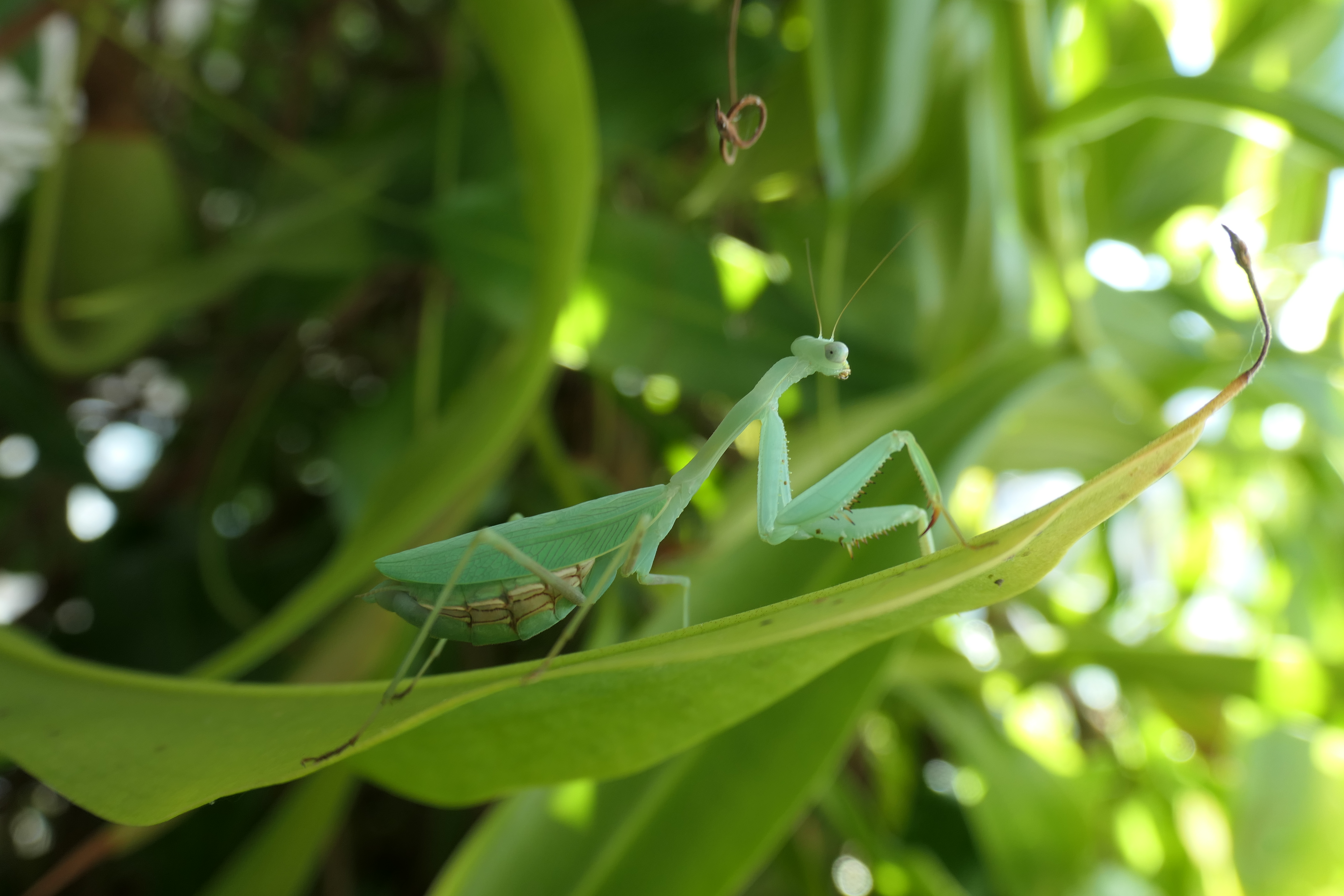
Photo: University of Hamburg / Knapwerth
Like many other female insects, females of the species Miomantis caffra produce pheromones to attract potential sexual partners. These scents usually convey information about the physical condition of the females such as their health status. Particularly fit females that can produce many offspring exude intoxicating fragrances that males find particularly attractive.
Miomantis caffra females can beguile males with their pheromones and even lure them into a trap: A lab experiment within a new study revealed that males chose to mate with a female in poor physical condition in 68 percent of cases, often paying with their lives for this misjudgment. Underweight females attacked the males 3 times more often and ate them 4 times more than better-fed females.
“In the animal world, females and males often have conflicting interests and use different strategies to assert them,” says Laura Knapwerth, first author of the study. This contrast takes on threatening dimensions for the species Miomantis caffra. Although both females and males want to reproduce, the males are also a source of food for the females. By eating a male, hungry females not only increase their own chances of survival, but also the quality of their clutches. These were 52 percent heavier after a cannibalistic act than without.
For her study, Knapwerth and her coauthor Dr. Nathan Burke, an evolutionary biologist, reared praying mantises from 25 different clutches for their study. They divided the females into 2 groups. Animals in the first group received 2 flies per week after the last molt, those in the other group 8. Finally, a better-fed and a less-fed female were placed in the arm of a T-shaped tunnel system and a male was placed in the middle. As the male could not see the females, he had to decide which of the 2 potential sexual partners to approach based on scent alone.
“Our work revealed that females in poor physical condition can really deceive males by sending dishonest signals—messages that deviate from reality,” says Knapwerth.
For the present study, she concentrated entirely on the female strategy—male strategies could be the subject of another study. “I find it absolutely exciting to see how the different interests of the interaction partners are shaped into various strategies to assert them and what dynamics result from this.” Females and males, predators and prey, or even plants and animals— the dynamics between them affect how the behavior and even the physical appearance of animals evolve, both fields of research in evolutionary biology.
The work was carried out in the Behavioral Biology working group under Prof. Dr. Jutta Schneider in the Department of Biology at the University of Hamburg.
Original publication: Knapwerth, L., & Burke, N. W.(2025). Luring cannibal: Dishonest sexual signaling in the springbok mantis. Functional Ecology, 00, 1–11. https://doi.org/10.1111/1365-2435.70115