
Newsroom
Newsroom
2 April 2026, by Steinicke/Red.
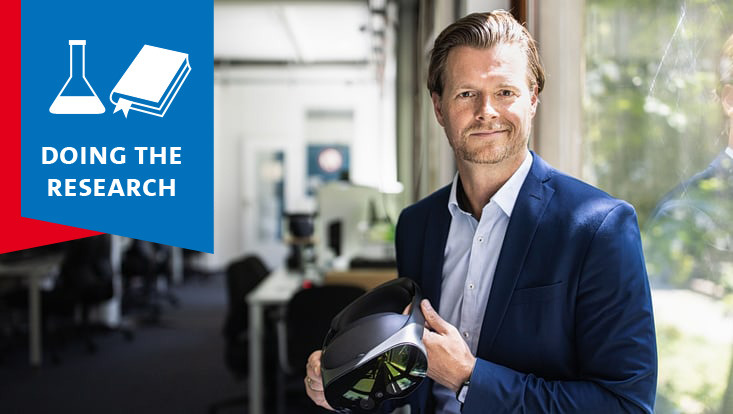
Photo: UHH/Esfandiari
The University of Hamburg is the scientific home to more than 6,200 researchers. Every 2 weeks, we offer a glimpse into their work as part of the “Research and Understanding” series in the Hamburger Abendblatt. In this edition, Prof. Dr. Frank Steinicke explains how AI and virtual reality can be designed to be as user-friendly as possible.
You ask Siri to call Mama—and she explains what a manta ray is. And during a video call, the microphone isn’t working again, with no clear explanation as to why. Although computer technology is an integral part of our lives, we encounter examples of poor usability time and again every day. This term refers to an interaction between humans and technology that is tailored to the users. In other words, at its best, it is intuitive, simple, and quickly leads to the desired result.
Poor usability is very frustrating in everyday life, but in safety-critical systems—such as in a car—it can quickly become life-threatening. That’s why my work focuses on this interface between humans and machines. Together with my team, I’m working to design devices and applications so that people can use them efficiently and with satisfaction.
Our approach is highly interdisciplinary, and in addition to the technical perspective, we also take into account aspects of psychology, design, and engineering. In a current project funded by the Federal Ministry of Research, for example, we are collaborating with the Neurosciences and drawing inspiration from how the brain works. While human hearing is very good at filtering, AI applications controlled by voice input are often still disrupted by multiple voices or background noise. We aim to develop new algorithms that account for and mitigate the so-called “cocktail party phenomenon.” These features could be applied, for example, to smart glasses or intelligent hearing aids.
In another project, we are researching what is known as extended reality, which combines real and virtual environments. We want to find out what an immersive environment must look like so that people can learn or train optimally within it. For example, how can we enable social interactions that are as realistic as possible between people who are physically separated from one another? And how can we best integrate virtual assistance? Our findings show, among other things, that a human visualization of the assistant is helpful for building trust. But the tone of voice and the manner of address are also important for promoting learning.
Even as a child, I was fascinated by science fiction and how people in those worlds could interact with robots, holograms, or on the holodeck. In the Star Trek series, the holodeck allowed people to explore virtual worlds of any size within a small room. Today, my team and I are working on the “redirected walking” technology we developed, in which we have people walk in circles in the real world, for example, while they have the illusion in the virtual world that they are walking straight ahead.
Our collaborations with various clusters of excellence at the University of Hamburg are particularly noteworthy. Here, too, the focus is on immersive technologies—but with an emphasis on bringing science to life. Together with “Understanding Written Artefacts,” for example, we are developing a platform for exploring inscriptions on gravestones at the Jewish cemetery in Altona, and in cooperation with our climate research cluster CLICCS, we are investigating how to make climate change and potential future scenarios emotionally tangible. These experiences could help massively increase willingness to adopt climate protection measures.
The potential applications in teaching and research, business, and society are therefore very diverse. This offers enormous opportunities, but also presents us with major challenges, for example in the areas of privacy, data protection, security, resource consumption, and ethics. All of this makes careful design of Human-Computer Interaction so important, because despite all technological progress: people should always be at the center.
(This content has been translated automatically.)
Prof. Dr. Frank Steinicke has been a professor of Informatics—with a focus on Human-Computer Interaction—at the University of Hamburg since 2014. He was the second German researcher to receive the “IEEE VGTC VR Technical Achievement Award” for his research and was inducted into the XR Hall of Fame in late 2025. In his free time, he enjoys playing soccer on the computer with his son or handball in the real world.

