• Zur Metanavigation
  • Zur Hauptnavigation
  • Zur Suche
  • Zum Inhalt
  • Zur Subnavigation
  • Zum Seitenfuß
  • University of Hamburg
  • For journalists
  • Staff Service Portal0
  • STiNE
https://www.kus.uni-hamburg.de/aktuelles.json?recentnews=true
  • Institutions and target groups
    • Einrichtungen
      • Faculties

        • Faculty of Law
        • Faculty of Business, Economics and Social Sciences
        • Faculty of Medicine
        • Faculty of Education
        • Faculty of Humanities
        • Faculty of Mathematics, Informatics and Natural Sciences
        • Faculty of Psychology and Human Movement Science
        • University of Hamburg Business School
      • Services

        • Study Information Net STiNE
        • Surfmail
        • Exchange
        • Staff Service Portal
        • Learning Platforms
        • Katalogplus – Catalogue of Hamburg Libraries
        • SharePoint
      • Student facilities and services

        • Campus Center
        • Career Center
        • PIASTA
        • AStA (student council)
        • University Sports
        • University Music
        • Family Office
        • University Language Center
        • General Languages
        • Office of Affairs for Students with Disabilities or Chronic Diseases
        • Departmental libraries
        • Healthy Campus
      • Further facilities and services

        • The Cluster of Excellence CLICCS
        • The Cluster of Excellence CUI
        • The Cluster of Excellence Quantum Universe
        • The Cluster of Excellence Understanding Written Artefacts
        • Hamburg Research Academy
        • Pier Plus
        • Hamburg Center for University Teaching and Learning (HUL)
        • Hub for Crossdisciplinary Learning (HCL)
        • CEN
        • Museums and collections
        • University Archives (in German)
        • Regional Computing Center (RRZ)
        • University Administration
        • Knowledge Exchange Agency
        • The Unikontor Shop (in German)
    • Target groups

      • Prospective students
      • Students
      • International prospective students
      • Young researchers
      • Researchers
      • Instructors
      • Staff
      • Prospective continuing education students
      • Alumni
      • Journalists
      • Refugees (in German only)
    Close
  • Language
    • English
    • Deutsch
  • /en/newsroom/sitemap.json
University of Hamburg - to research, to teach, to educate and form, to homepage
Newsroom
Newsroom
  • Newsroom
  • Press releases
  • Social media
  • Videos
  • Events
  1. UHH
  2. Newsroom
  3. Campus
  4. 2023
  5. Welcome aboard!

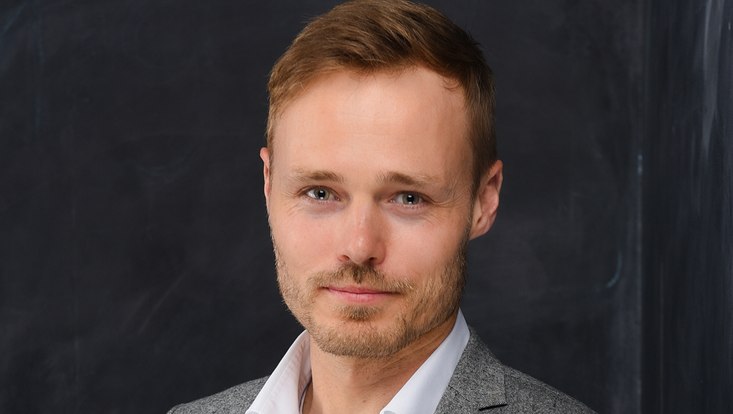
Welcome aboard!How Are Climate Change and Conflict Linked?Prof. Dr. Benno Fladvad joins the MIN Faculty

7 August 2023, by Maria Latos

Prof. Dr. Benno Fladvad

Photo: Studioline

Prof. Dr. Benno Fladvad

Every year, Universität Hamburg welcomes numerous new researchers. This series introduces them and their areas of research. And this time, we talk to geographer and peace researcher Prof. Dr. Benno Fladvad, who is investigating the link between climate change and conflict.

Prof. Dr. Benno Fladvad has accepted the W1 professorship with W2 tenure track Natural Science Peace Research with a Focus on Climate and Security at Universität Hamburg and has been working in the Department of Earth System Sciences at the Faculty of Mathematics, Informatics and Natural Sciences since the summer semester.

Professor Fladvad, can you tell us about your research?

My research brings together peace, security, and conflict studies with debates on environmental and climate justice. I investigate how climate change and its causes and effects are linked to conflict and war. And this can be anywhere from the local to the planetary level. I also look at how action on climate change can itself contribute to conflict and at the new alliances and partnerships that emerge in the process.

Can you give an example of a security risk?

Well, green hydrogen is often seen as a key solution to the energy transition. And its production requires a lot of renewable energy. Certain regions such as the department of La Guajira in Colombia, which the former Colombian energy minister called the “epicenter of the energy transition,” are well suited—at least on the surface—for the production of renewable energy, especially in the form of wind power.  

Has this led to conflicts in the country?

Yes, there are already several reports and preliminary research showing that the expansion of wind energy is creating conflicts very similar to those that have arisen, for example, in connection with coal mining, which has been going on in La Guajira for a long time. This can lead to evictions and land rights violations, but scarce water resources are also a big issue, especially in such arid regions.

So is Colombia a region that you will be working on more closely in the future?

Yes, it is one of them. But Colombia is actually a very promising context for my research because there are conflicts there over renewable energy and at the same time an approach known as environmental peacebuilding is being pursued. Environmental peacebuilding is an attempt to reconcile the protection of the environment with the creation of more peaceful societies. This is also an important area of research for me.

And how will you research this?

I use qualitative social research methods, which means that I mainly conduct interviews and analyze narratives of individuals and groups. Participant observation is also an important part of my research, as is research and document analysis. So it is about establishing contact with the people affected and the parties involved in the conflict. This does not necessarily have to be on the other side of the world. Depending on the topic and research question, I could also work with, for example, fishers in Schleswig-Holstein, who are also facing major challenges with regard to climate change.

So your research methods are purely social science methods?

I studied geography with a focus on human geography and also did my doctorate in this field, which means that I am trained in the social sciences and cannot call myself a natural scientist—at least as far as my working methods are concerned. This might sound a bit paradoxical in view of my job title. But it becomes more understandable when you see that the junior professorship is in integrative geography, which means that it deals quite explicitly with interactions between humans and the environment.

So you are connecting the social and natural sciences.

Yes, that is the goal. For me, nature is not necessarily only an object of research for natural scientists but also for social scientists. You can also understand nature, and especially our relationship to nature, using social science approaches, ways of thinking, and theories.

How will you implement this in your teaching?

The connection between social and natural systems is elementary; in reality, they cannot be separated so categorically. And this is also something that I want to work on with students. For example, a course on environmental justice and environmental security would fit well into the geography degree programs. At the same time, I also plan to offer courses in the Master of Arts in Peace and Security Studies, which students from other faculties will be able to take as well.

Latest articles

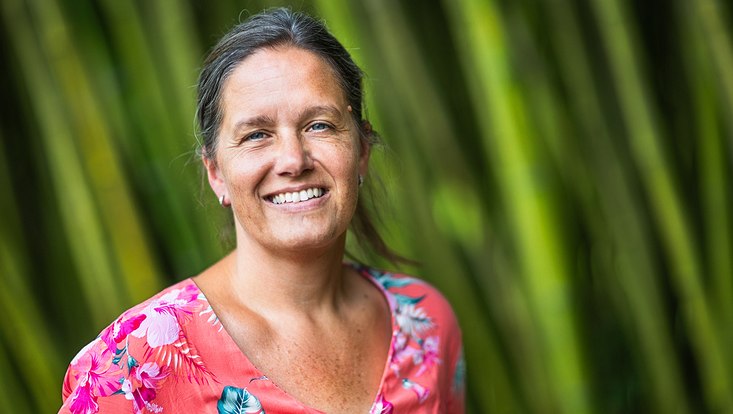
Prof. Dr. Louisa Temme

Photo: privat

11.07.2023|Campus
Willkommen an Bord: Prof. Dr. Louisa Temme verstärkt die MIN-Fakultät
Jedes Jahr kommen zahlreiche neue Wissenschaftlerinnen und Wissenschaftler an die Universität Hamburg. In dieser Reihe stellen wir sie und ihre Forschungsgebiete vor. Dieses Mal: Pharmazeutin und Medizinische Chemikerin Prof. Dr. Louisa Temme. Sie möchte durch systematische Grundlagenforschung die...
Porträt von Nicole Aberle-Malzahn

Photo: UHH/Esfandiari

06.07.2023|Campus
Willkommen an Bord: Prof. Dr. Nicole Aberle-Malzahn verstärkt die MIN-Fakultät
Jedes Jahr kommen zahlreiche neue Wissenschaftlerinnen und Wissenschaftler an die Universität Hamburg. In dieser Reihe stellen wir sie und ihre Forschungsgebiete vor. Dieses Mal: Biologin Prof. Dr. Nicole Aberle-Malzahn.

Last update: 29 September 2023

  • Feedback
  • Legal notice
  • Privacy statement
  • Accessibility
  • Site map

University of Hamburg

Innovating and Cooperating for a Sustainable Future in a Digital Age

  • Instagram
  • Facebook
  • Bluesky
  • YouTube
  • LinkedIn
    • Studies
    • Prospective students
    • Continuing education
    • Research
    • Teaching at UHH
    • Doctoral studies
    • Job opportunities
    • Knowledge exchange
    • University
    • Excellence
    • Faculties
    • Alumni
    • Contact
    • Campus Navigator
    • Emergencies, safety and security
    • Antidiscrimination
audit familiengerechte hochschule
Audit
HRK-Audit
System accreditation

© 2025 University of Hamburg. All rights reserved

OBVZu9