Newsroom
Newsroom
4 January 2022, by Dinter / editors

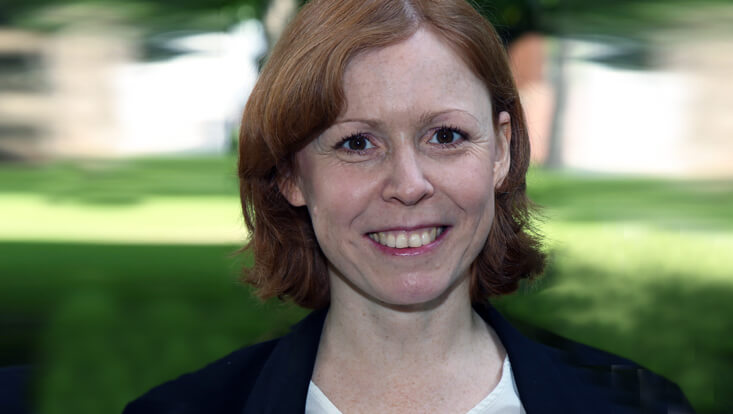
Photo: Private
Every year, Universität Hamburg welcomes numerous new researchers. This series introduces them and their areas of research.
Dr. Sandra Dinter left the Friedrich-Alexander-Universität Erlangen-Nürnberg to join the Faculty of Humanities in Summer Semester 2022. She is a junior professor of British literature and culture.
In my current research, I am focusing on the interplay between space, mobility, and gender and the representation of these in nineteenth-century British literature and culture. In particular, I am focusing on the female pedestrian, who you find in well-known novels such as Jane Austen’s Pride and Prejudice and Charlotte Brontë’s Jane Eyre, and how their daily movements on foot are culturally interpreted, especially against the backdrop of industrialization. My goal is to show that the representation of walking in the literature is not merely coincidental but rather that is crystallizes diverse social issues.
We often think that walking is the purest form of movement and that we move completely intuitively. When we look to the past, however, we see something different: prior to the eighteenth century, taking a walk, which we now see as a normal free-time activity, was not at all such in western Europe; it only became so in relation to various cultural, historical, and technological processes. This shows that traveling on foot, by bike, or by train is shaped by culture and is manifested differently depending on the interplay of factors such as ethnicity, gender, age, and social class. Currently, the corona pandemic provides another good example: taking a walk not only experienced a renaissance in 2020; especially during the lockdown we experienced our everyday lives differently—always concerned to maintain our distance to other pedestrians.
I am looking forward to a lively, diverse, challenging research and teaching environment at Universität Hamburg as well as fruitful cooperation with my colleagues and students in the Faculty of Humanities and at the Institute of English and American Studies. I also hope to wind down on the Elbe now and then and enjoy the many advantages that the City of Hamburg holds.
To more firmly establish mobility studies in the Faculty of Humanities with my research. For my students, I would like to offer a seminar on the famous British writer and feminist Mary Wollstonecraft, who came to Hamburg in 1795 following a suicide attempt, spent a night in Altona, and then traveled to Scandinavia via Itzehoe and Schleswig. She took many legs of this journey on foot and recorded her impressions in a travel log. I would like to discuss this report with my students not only by taking a classic literary approach “from our seats” but by setting out bodily to trace Wollstonecraft’s steps in northern Germany. Movement opens up new ways of thinking and interpreting!
For me, there is nothing better than sharing thoughts with my students and those special “aha!” moments in the classroom. In my courses, students can expect classic close readings in which we study in minute detail how literary texts work and shape our culture as well as discussions about current pop-cultural and social phenomena. One of the great strengths of the humanities is being able to investigate and question dominant structures from new perspectives. This is exactly what I wish to impart in my teaching with reference to British literature and culture.
Thanks to past stays abroad and current projects, I have already cultivated several research contacts in Great Britain and North America, for example, in Reading, Oxford, Edinburgh, and Toronto, which I intend to build upon as a junior professor in Hamburg. Brexit, especially, poses a great challenge to German Anglo studies, culturally and to higher education policy.
Since the corona pandemic, I have seen my Anglo-American colleagues online only. Furthermore, encounters between students have become rarer and the Erasmus program with Great Britain will soon cease. So it is especially important to me to initiate continued cooperation with my British colleagues and to invite them to Hamburg, whether as guest lecturers, for conferences, or collaborative research projects.
The question about how to globally, nationally, and sustainably shape mobility against the backdrop of the climate crisis is now one of humanity’s greatest challenges. My research contributes a meta-perspective to the discourse. I look at discourses on mobility, meaning how society talks or talked about certain modes of travel today and in the past. The car, for example, is much more than simply a means of transportation: in western culture, it is a symbol of freedom, modernity, and individualism. Analyzing and understanding these cultural constructions is a first important step towards ecological change.