Newsroom
Newsroom
30 March 2026, by Claudia Sewig
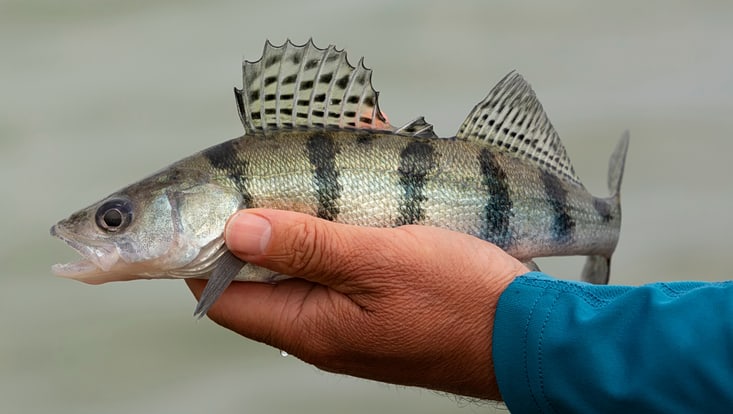
Photo: Adobe Stock / Kondor83
Shovel-headed garden worm, alligator weed, or the Javan mongoose: Hamburg has become home to many invasive, non-native animal and plant species. Most recently, the Volga zander appeared in the Elbe. In an interview, Prof. Dr. Matthias Glaubrecht, professor of Animal Biodiversity at the University of Hamburg, explains the impact new species have on our ecosystems.
There is a so-called Union List at the European level. In this list, the EU identifies non-native animal and plant species whose spread can harm native habitats, species, or ecosystems and thus threaten biodiversity. It thus regulates which species may not be introduced, traded, bred, or released. However, of the approximately 12,000 non-native species now in Europe, only slightly more than 100 species are on the Union List—not even 0.1 percent. The Volga zander is not listed here either, so releasing it was not prohibited.
There are, however, species on the list for which the environmental agency takes action upon sightings. Last summer, for example, this was the case here in Hamburg with the Asian hornet. It causes economic damage because it preys on bees. Here, the focus is not only on our 556 wild bee species, but above all on the honeybee, because it is important for the beekeeping industry and for plant pollination. The pesticides we apply to the landscape pose a much greater threat to honeybees, but since we can’t solve all problems at once, we’re starting with controlling the Asian hornet.
We’re mainly dealing with those that have escaped from breeding facilities. The raccoon dog, originally from East Asia, was bred in countries of the former Soviet Union, escaped from captivity there in the 1920s, and, like the raccoon—which was also bred for its fur—has spread to our region. Both species eat eggs, amphibians, insects, and small mammals, which can threaten local populations. Nutrias also play a major role here. This species from South America, also known as the beaver rat, was similarly bred on fur farms in Germany and entered our natural environment through escape or deliberate release. The animals undermine dikes with their burrows, which is particularly relevant for our region.
Among plants, the Indian balsam is spreading particularly rapidly; it actually originates from the Indian subcontinent and was introduced as an ornamental plant. It grows quickly, thereby depriving other plant species of sunlight and nutrients. It is thus competition for our native flora—but plants can also cause economic damage. Invasive aquatic plants like alligator weed spread via shipping or birds and block irrigation and drainage systems as well as power plant intakes. Non-native mussels, such as zebra mussels, which come from the Black Sea region, do the same.
However, invasive species can harm not only the economy and infrastructure, but also the health of humans, animals, and plants. One example is the introduced American crayfish. It transmits diseases—which do not affect it—to our European crayfish species, which are not accustomed to them. And now the Asian tiger mosquito, a carrier of dengue fever that has reached us via the Mediterranean region, is also finding a breeding habitat here. When ambient temperatures rise, as we are increasingly experiencing in Europe, we always see an increase in diseases not typically found here that are transmitted by insects. This isn’t yet a major problem in Hamburg. But it is on the rise, and we must be clear: as long as we travel to exotic regions, we will continue to carry foreign species around the world.
Compared to the major problems we face in preserving biodiversity, invasive species are our least significant concern. Habitat loss takes top priority—that is, so-called land-use change, fragmentation, and alterations to habitats. So our problem in Hamburg isn’t the Volga pikeperch, but rather the use of our land, where policymakers find themselves in a dilemma. We’ve had the port that sustains Hamburg for 800 years. That’s why we’re trying to keep it globally competitive by dredging the tidal Elbe to a depth of 100 kilometers. But dredging alters the habitat—to the extent that we’re losing, among other species, the smelt, a species typical of the Elbe. Suspended matter covers its eggs and causes the fish to see much less, which impairs their feeding, since they search for zooplankton visually. So the populations of the smelt and many other species are declining not because of a new species of zander, but because of our massive interventions in habitats and nature.
As an evolutionary biologist, I would now say: So here, above all, one introduced species plays an extreme role in species extinction—namely, humans. We originated in Africa about 300,000 years ago; that was our range. And sometime 50,000 years ago, we, as Homo sapiens, left Africa. We migrated to Europe, displacing the Neanderthals and the mammoths in the process. So immigration has always existed, even if we gave the Volga pike a helping hand by introducing it. In principle, however, it is a natural development, but now it is also threatening biodiversity.
(This content has been translated automatically.)
Matthias Glaubrecht is a professor of animal biodiversity at the University of Hamburg. The evolutionary biologist served as director of the Center for Natural History (CeNak) in Hamburg from 2014 to 2021 and, since 2021, has been working as a scientific project manager for the Leibniz Institute for the Analysis of Biodiversity Change—into which CeNak was integrated—to establish the “Evolutioneum” as a new natural history museum in Hamburg.