
Newsroom
Newsroom
21 February 2018, by Ellen Schonter
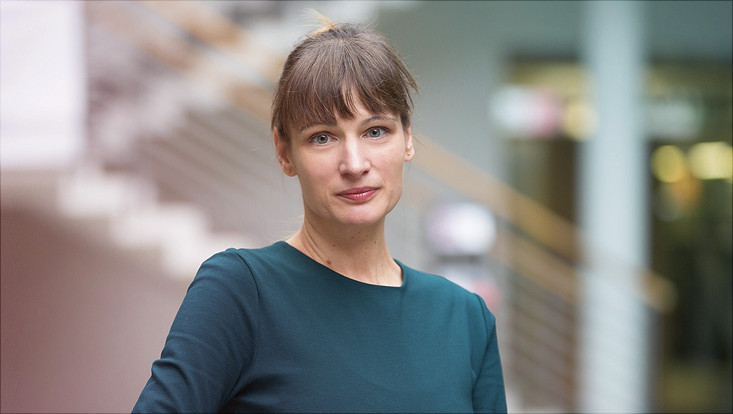
Photo: UHH/Dingler
Where does an artwork come from? Who traded or plundered it, or who might have destroyed it? And to whom does it rightfully belong? Provenance research is an art history discipline concerned with the origins of art objects. At Universität Hamburg, Gesa Jeuthe has been appointed to the Liebelt Professorship for Historical and Contemporary Provenance Research, making her the first professor of provenance research nationwide. The junior professor told us why her area of research garners so much attention, about her plans at the University, and about the challenges of establishing this new discipline.
Ultimately, provenance research is not really new. It was always a part of art history with the aim of ascertaining the authenticity and value of art works. The 1998 Washington Principles on Nazi-Confiscated Art, however, shifted the focus.
The conference’s signatory countries agreed to identify art confiscated by the National Socialists as such and to find both the rightful heirs and just solutions. Since then, questions of changing ownership, trade routes, and their historical contexts have played an ever-larger role and led to the creation of an autonomous discipline.
Of course, for victims with restitution claims, meaning the right to request the return of artworks, this is a long time, but provenance research is not something new. Museums have been doing it for a long time. Twenty years is actually a relatively short period of time for establishing independent professorships for provenance research.
After the conference, people underestimated how extensive provenance research would become. They thought that checking the inventories of artwork confiscated by the National Socialists would take only 2 or 3 years per museum, but it soon became clear that the research couldn’t possibly be done in such a brief period. Now that provenance research has been established at the University, we can lay the as yet incomplete scholarly foundation and implement a curriculum.
Current provenance research has no standard for defining the origins of an artwork. At the moment, we just list the chain of owners without documentation or context and at the author’s stylistic discretion. This is why the Hamburg Association of Provenance Research is developing guidelines: Every chain of provenance should be scientifically comprehensible, meaning that sources must be cited in a footnote.
These guidelines are important and practical but they don’t solve another problem, namely that there is no central, comprehensible and comprehensive registry of current provenance research on a give artwork. At the moment, a provenance researcher needs to research every clue to a specific provenance, e.g., an art dealer, anew, although another institution may have already done this research. This is inefficient. So my goal is to cooperate with various institutions to create a system for managing provenance research.
My professorship is designed to span epochs. As I specialize in the art market, I would like primarily to study Hamburg’s art market, which has not really been considered. Since last winter semester, the Hamburger Kunsthalle and I have also offered a 4-semester series of seminars on the Museum’s former collection. We look at works that for sundry reasons no longer belong to the collection—for example, perhaps the National Socialists confiscated “degenerate art” in 1937.
Last summer, our goal was to develop plausible scenarios and sound hypothesis with our students about who could have handled a given artwork: Which art dealers or governmental institutions come into question? What were their typical trading practices or who were their business partners? In the summer semester, we’ll focus on buying and trading from 1919 through the 1960s and look at the circumstances in which people voluntarily handed over artworks.
For many students, by the way, the approaches we take in provenance research are unusual.
The questions that interest provenance researchers are not necessarily of an art historical nature. Of course, provenance researchers need a basic understanding of artworks and the art world, but we don’t engage in traditional image analysis. We ask instead: How many versions of this work are there? Did the picture always have this frame? What can I ascertain from labels? Who could have possessed this object?
As a provenance researcher, you don’t need only a basic understanding of the object, you also need an understanding of archives, how to analyze sources, the law, and historical and economic issues. Ultimately, our findings are interesting for art historians. So provenance research is highly interdisciplinary. I myself have studied business administration in addition to art history and I ended up in provenance research by way of art market research.
Hamburg is special because the Hamburger Kunsthalle is one of the first museums to have created a permanent position for provenance research. So Hamburg also has Germany’s longest-serving provenance researcher, Ute Haug.
It’s incredibly fortunate that Universität Hamburg has also now established the first professorship for provenance research. Establishing the discipline at a university fosters the interdisciplinary work it requires.
Here in Hamburg there are several departments and institutions that I would like to work with: alongside historians and economics, there is, for example, Hamburg’s Post-Colonial Legacy research center and the Walter A. Berendsohn research center for German exile literature, the Institute for the History of the German Jews, and, of course, countless museums.

