
Newsroom
Newsroom
20 July 2026, by Kim Wegner
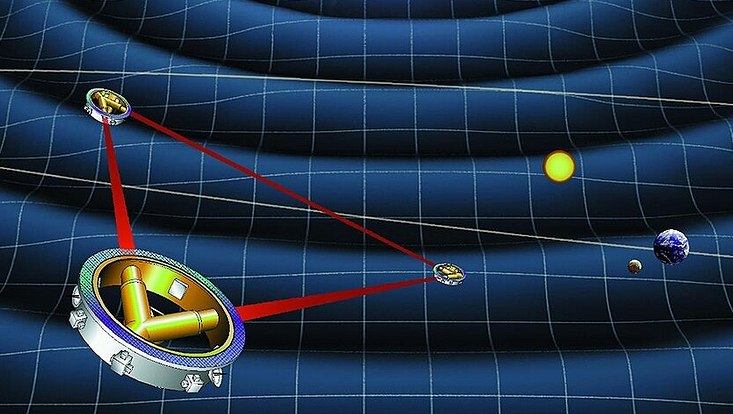
Photo: NASA
A precision measuring device developed at the Cluster of Excellence Quantum Universe at the University of Hamburg has arrived at a partner laboratory in Paris for the testing phase. This marks an important milestone in the preparations for LISA, the ESA mission to detect gravitational waves from space.
The device, known as a phase meter, is set to play a central role in the satellite technology required for the future LISA space telescope. The “Laser Interferometer Space Antenna” (LISA) is a mission of the European Space Agency (ESA) scheduled to launch in 2035. It will be the first observatory designed to measure gravitational waves from space. Three satellites will fly in a triangular formation, several million kilometers apart, exchanging laser signals. Onboard phase meters will detect minute changes in the distance between the satellites: indications of passing gravitational waves.
Development of the Instrument
The phase meter was developed by a team from the Cluster of Excellence Quantum Universe in collaboration between the University of Hamburg and DESY. It is based on hardware originally designed for precise signal readout in particle accelerators—a technology that the team has carefully adapted to meet the high demands of a mission as complex as LISA.
“The handover of the first phase meter prototype to our colleagues at the Laboratory for Astroparticle Physics and Cosmology in Paris represents an important milestone in the instrument’s development cycle,” says Dr. Christian Darsow-Fromm, a postdoctoral researcher at the Institute of Physics at the University of Hamburg, who is playing a key role in the project. “Seeing how years of development work have been transformed into a functioning instrument that is actively being used is incredibly rewarding.”
What’s Next
At the Laboratory for Astroparticle Physics and Cosmology in Paris, a prototype will first be equipped with the phase meter and adapted to new experimental requirements before the device is forwarded to the French space agency CNES. The agency will subject it to a comprehensive end-to-end test campaign and use it in combination with technical models of the LISA satellite instruments to verify that all components function correctly when working together.
Meanwhile, the Hamburg team will deliver additional phase meters to the UK Astronomy Technology Centre in Edinburgh and to the Albert Einstein Institute in Hanover for testing. These tests are part of a coordinated international effort to prepare for the launch of the LISA mission.
The Laser Interferometer Space Antenna (LISA) will detect waves in spacetime generated by some of the highest-energy events in the universe, such as the merger of black holes or neutron stars. LISA will detect sources and frequencies that are beyond the reach of ground-based observatories.

